

6.16 Exercises
221
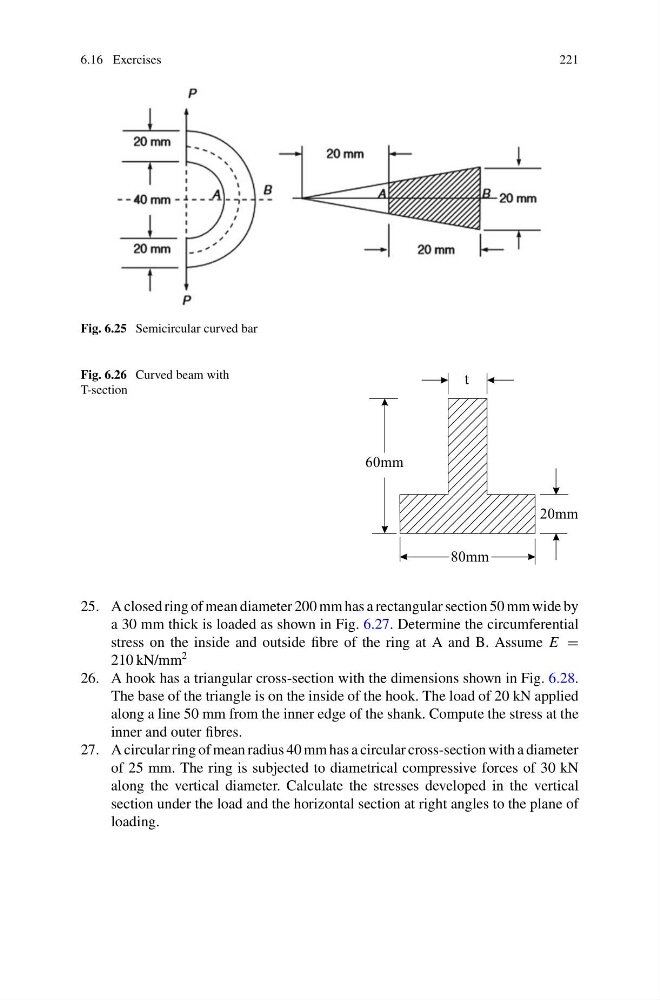
Fig. 6.25 Semicircular curved bar
Fig. 6.26 Curved beam with
T-section
60mm
80mm
20mm
t
25. A closed ring of mean diameter 200 mm has a rectangular section 50 mm wide by
a 30 mm thick is loaded as shown in Fig. 6.27. Determine the circumferential
stress on the inside and outside fibre of the ring at A and B. Assume E =
210 kN/mm
2
26. A hook has a triangular cross-section with the dimensions shown in Fig. 6.28.
The base of the triangle is on the inside of the hook. The load of 20 kN applied
along a line 50 mm from the inner edge of the shank. Compute the stress at the
inner and outer fibres.
27. A circular ring of mean radius 40 mm has a circular cross-section with a diameter
of 25 mm. The ring is subjected to diametrical compressive forces of 30 kN
along the vertical diameter. Calculate the stresses developed in the vertical
section under the load and the horizontal section at right angles to the plane of
loading.
221
Fig. 6.25 Semicircular curved bar
Fig. 6.26 Curved beam with
T-section
60mm
80mm
20mm
t
25. A closed ring of mean diameter 200 mm has a rectangular section 50 mm wide by
a 30 mm thick is loaded as shown in Fig. 6.27. Determine the circumferential
stress on the inside and outside fibre of the ring at A and B. Assume E =
210 kN/mm
2
26. A hook has a triangular cross-section with the dimensions shown in Fig. 6.28.
The base of the triangle is on the inside of the hook. The load of 20 kN applied
along a line 50 mm from the inner edge of the shank. Compute the stress at the
inner and outer fibres.
27. A circular ring of mean radius 40 mm has a circular cross-section with a diameter
of 25 mm. The ring is subjected to diametrical compressive forces of 30 kN
along the vertical diameter. Calculate the stresses developed in the vertical
section under the load and the horizontal section at right angles to the plane of
loading.