

6.14 Stresses in Closed Rings
197
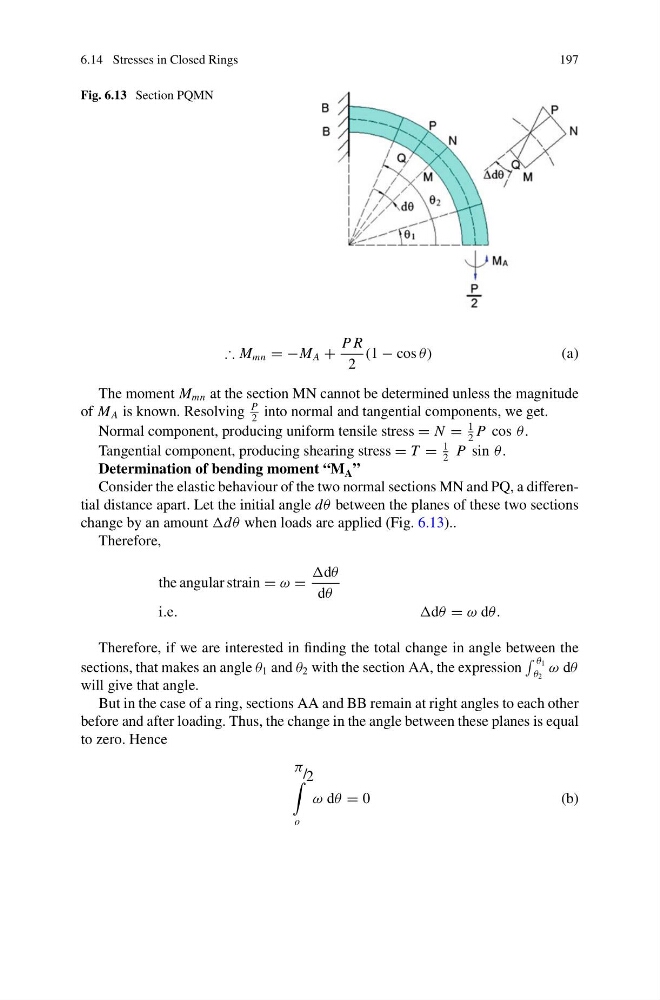
Fig. 6.13 Section PQMN
∴ M mn = −M A +
P R
2
(1 − cos θ )
(a)
The moment M mn at the section MN cannot be determined unless the magnitude
of M A is known. Resolving
P
2
into normal and tangential components, we get.
Normal component, producing uniform tensile stress = N =
1
2
P cos θ .
Tangential component, producing shearing stress = T =
1
2
P sin θ .
Determination of bending moment “M A ”
Consider the elastic behaviour of the two normal sections MN and PQ, a differential distance apart. Let the initial angle dθ between the planes of these two sections
change by an amount dθ when loads are applied (Fig. 6.13)..
Therefore,
the angular strain = ω =
dθ
dθ
i.e.
. dθ = ω dθ.
Therefore, if we are interested in finding the total change in angle between the
sections, that makes an angle θ 1 and θ 2 with the section AA, the expression
θ 1
θ 2
ω dθ
will give that angle.
But in the case of a ring, sections AA and BB remain at right angles to each other
before and after loading. Thus, the change in the angle between these planes is equal
to zero. Hence
π / 2
o
ω dθ = 0
( b )
197
Fig. 6.13 Section PQMN
∴ M mn = −M A +
P R
2
(1 − cos θ )
(a)
The moment M mn at the section MN cannot be determined unless the magnitude
of M A is known. Resolving
P
2
into normal and tangential components, we get.
Normal component, producing uniform tensile stress = N =
1
2
P cos θ .
Tangential component, producing shearing stress = T =
1
2
P sin θ .
Determination of bending moment “M A ”
Consider the elastic behaviour of the two normal sections MN and PQ, a differential distance apart. Let the initial angle dθ between the planes of these two sections
change by an amount dθ when loads are applied (Fig. 6.13)..
Therefore,
the angular strain = ω =
dθ
dθ
i.e.
. dθ = ω dθ.
Therefore, if we are interested in finding the total change in angle between the
sections, that makes an angle θ 1 and θ 2 with the section AA, the expression
θ 1
θ 2
ω dθ
will give that angle.
But in the case of a ring, sections AA and BB remain at right angles to each other
before and after loading. Thus, the change in the angle between these planes is equal
to zero. Hence
π / 2
o
ω dθ = 0
( b )