

180
6 Two-Dimensional Problems in Elasticity …
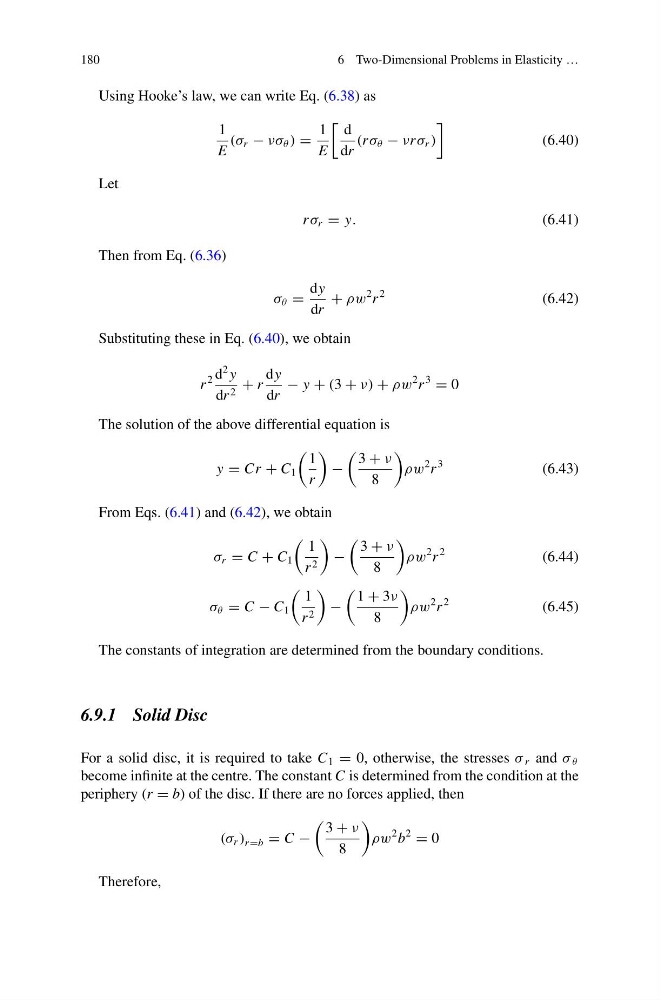
Using Hooke’s law, we can write Eq. (6.38) as
1
E
(σ r − νσ θ ) =
1
E
d
dr
(r σ θ − νr σ r )
(6.40)
Let
r σ r = y.
(6.41)
Then from Eq. (6.36)
σ θ =
dy
dr
+ ρw
2 r
2
(6.42)
Substituting these in Eq. (6.40), we obtain
r
2 d
2 y
dr 2 + r
dy
dr
− y + (3 + ν) + ρw
2 r
3
= 0
The solution of the above differential equation is
y = Cr + C 1
1
r
−
3 + ν
8
ρw
2 r
3
(6.43)
From Eqs. (6.41) and (6.42), we obtain
σ r = C + C 1
1
r 2
−
3 + ν
8
ρw
2 r
2
(6.44)
σ θ = C − C 1
1
r 2
−
1 + 3ν
8
ρw
2 r
2
(6.45)
The constants of integration are determined from the boundary conditions.
6.9.1 Solid Disc
For a solid disc, it is required to take C 1 = 0, otherwise, the stresses σ r and σ θ
become infinite at the centre. The constant C is determined from the condition at the
periphery (r = b) of the disc. If there are no forces applied, then
(σ r ) r =b = C −
3 + ν
8
ρw
2 b
2
= 0
Therefore,
6 Two-Dimensional Problems in Elasticity …
Using Hooke’s law, we can write Eq. (6.38) as
1
E
(σ r − νσ θ ) =
1
E
d
dr
(r σ θ − νr σ r )
(6.40)
Let
r σ r = y.
(6.41)
Then from Eq. (6.36)
σ θ =
dy
dr
+ ρw
2 r
2
(6.42)
Substituting these in Eq. (6.40), we obtain
r
2 d
2 y
dr 2 + r
dy
dr
− y + (3 + ν) + ρw
2 r
3
= 0
The solution of the above differential equation is
y = Cr + C 1
1
r
−
3 + ν
8
ρw
2 r
3
(6.43)
From Eqs. (6.41) and (6.42), we obtain
σ r = C + C 1
1
r 2
−
3 + ν
8
ρw
2 r
2
(6.44)
σ θ = C − C 1
1
r 2
−
1 + 3ν
8
ρw
2 r
2
(6.45)
The constants of integration are determined from the boundary conditions.
6.9.1 Solid Disc
For a solid disc, it is required to take C 1 = 0, otherwise, the stresses σ r and σ θ
become infinite at the centre. The constant C is determined from the condition at the
periphery (r = b) of the disc. If there are no forces applied, then
(σ r ) r =b = C −
3 + ν
8
ρw
2 b
2
= 0
Therefore,