

6.6 Biharmonic Equation
171
−
cos 2φ
r 2
∂φ
∂θ
−
sin θ cos θ
r 2
∂
2
φ
∂θ 2
(iii)
Adding (i) and (ii), we get
∂
2
φ
∂ x 2 +
∂
2
φ
∂ y 2 =
∂
2
φ
∂r 2 +
1
r
∂φ
∂r
+
1
r 2
∂
2
φ
∂θ 2
i.e., ∇
2
φ =
∂
2
φ
∂ x 2 +
∂
2
φ
∂ y 2 =
∂
2
φ
∂r 2 +
1
r
∂φ
∂r
+
1
r 2
∂
2
φ
∂θ 2
or ∇
4
φ = ∇
2
φ∇
2
φ =
∂
2
φ
∂r 2 +
1
r
∂φ
∂r
+
1
r 2
∂
2
φ
∂θ 2
∂
2
φ
∂r 2 +
1
r
∂φ
∂r
+
1
r 2
∂
2
φ
∂θ 2
= 0
The above biharmonic equation is the stress equation of compatibility in terms of
Airy’s stress function referred to a polar co-ordinate system.
6.7 Axisymmetric Problems
Many engineering problems involve solids of revolution subjected to axially
symmetric loading. The examples are a circular cylinder loaded by uniform internal
or external pressure or other axially symmetric loading (Fig. 6.4a), and a semiinfinite half space loaded by a circular area, for example, a circular footing on a soil
mass (Fig. 6.4b). It is convenient to express these problems in terms of the cylindrical co-ordinates. Because of symmetry, the stress components are independent of
the angular (θ ) co-ordinate; hence, all derivatives with respect to θ vanish and the
components v, γ rθ , γ θz , τ rθ and τ θz are zero. The nonzero stress components are σ r ,
σ θ , σ z and τ rz .
The strain–displacement relations for the nonzero strains become
ε r =
∂u
∂r
, ε θ =
u
r
, ε z =
∂w
∂z
γ r z =
∂u
∂z
+
∂w
∂r
(6.19)
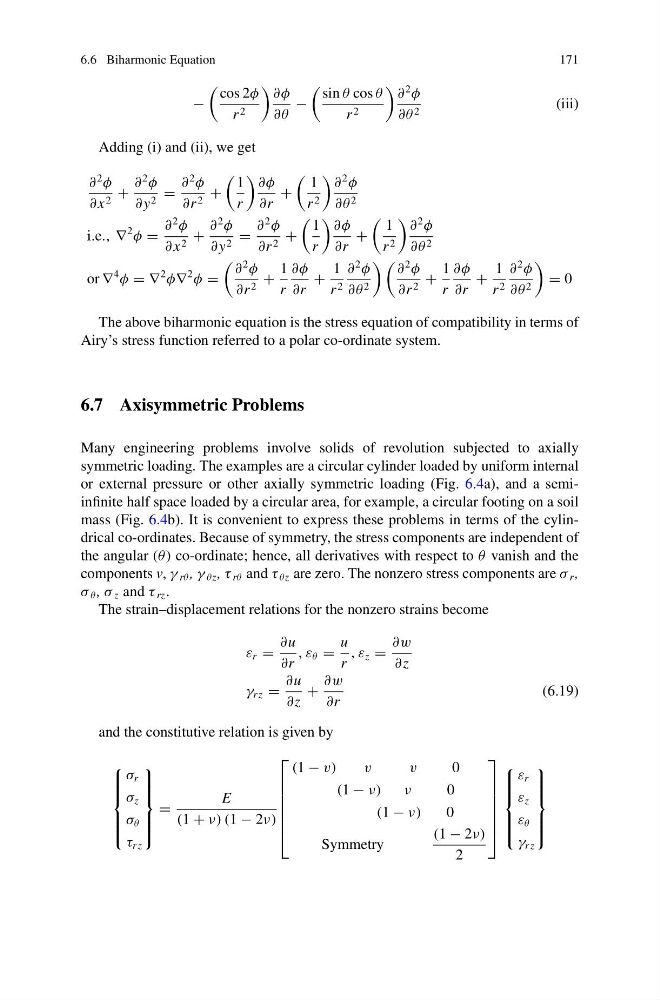
and the constitutive relation is given by
⎧
⎪ ⎪ ⎪ ⎨
⎪ ⎪ ⎪ ⎩
σ r
σ z
σ θ
τ r z
⎫
⎪ ⎪ ⎪ ⎬
⎪ ⎪ ⎪ ⎭
=
E
(1 + ν) (1 − 2ν)
⎡
⎢
⎢
⎢
⎢
⎢
⎣
(1 − v)
v
v
0
(1 − ν)
ν
0
(1 − ν)
0
Symmetry
(1 − 2ν)
2
⎤
⎥
⎥
⎥
⎥
⎥
⎦
⎧
⎪ ⎪ ⎪ ⎨
⎪ ⎪ ⎪ ⎩
ε r
ε z
ε θ
γ r z
⎫
⎪ ⎪ ⎪ ⎬
⎪ ⎪ ⎪ ⎭
171
−
cos 2φ
r 2
∂φ
∂θ
−
sin θ cos θ
r 2
∂
2
φ
∂θ 2
(iii)
Adding (i) and (ii), we get
∂
2
φ
∂ x 2 +
∂
2
φ
∂ y 2 =
∂
2
φ
∂r 2 +
1
r
∂φ
∂r
+
1
r 2
∂
2
φ
∂θ 2
i.e., ∇
2
φ =
∂
2
φ
∂ x 2 +
∂
2
φ
∂ y 2 =
∂
2
φ
∂r 2 +
1
r
∂φ
∂r
+
1
r 2
∂
2
φ
∂θ 2
or ∇
4
φ = ∇
2
φ∇
2
φ =
∂
2
φ
∂r 2 +
1
r
∂φ
∂r
+
1
r 2
∂
2
φ
∂θ 2
∂
2
φ
∂r 2 +
1
r
∂φ
∂r
+
1
r 2
∂
2
φ
∂θ 2
= 0
The above biharmonic equation is the stress equation of compatibility in terms of
Airy’s stress function referred to a polar co-ordinate system.
6.7 Axisymmetric Problems
Many engineering problems involve solids of revolution subjected to axially
symmetric loading. The examples are a circular cylinder loaded by uniform internal
or external pressure or other axially symmetric loading (Fig. 6.4a), and a semiinfinite half space loaded by a circular area, for example, a circular footing on a soil
mass (Fig. 6.4b). It is convenient to express these problems in terms of the cylindrical co-ordinates. Because of symmetry, the stress components are independent of
the angular (θ ) co-ordinate; hence, all derivatives with respect to θ vanish and the
components v, γ rθ , γ θz , τ rθ and τ θz are zero. The nonzero stress components are σ r ,
σ θ , σ z and τ rz .
The strain–displacement relations for the nonzero strains become
ε r =
∂u
∂r
, ε θ =
u
r
, ε z =
∂w
∂z
γ r z =
∂u
∂z
+
∂w
∂r
(6.19)
and the constitutive relation is given by
⎧
⎪ ⎪ ⎪ ⎨
⎪ ⎪ ⎪ ⎩
σ r
σ z
σ θ
τ r z
⎫
⎪ ⎪ ⎪ ⎬
⎪ ⎪ ⎪ ⎭
=
E
(1 + ν) (1 − 2ν)
⎡
⎢
⎢
⎢
⎢
⎢
⎣
(1 − v)
v
v
0
(1 − ν)
ν
0
(1 − ν)
0
Symmetry
(1 − 2ν)
2
⎤
⎥
⎥
⎥
⎥
⎥
⎦
⎧
⎪ ⎪ ⎪ ⎨
⎪ ⎪ ⎪ ⎩
ε r
ε z
ε θ
γ r z
⎫
⎪ ⎪ ⎪ ⎬
⎪ ⎪ ⎪ ⎭