

164
6 Two-Dimensional Problems in Elasticity …
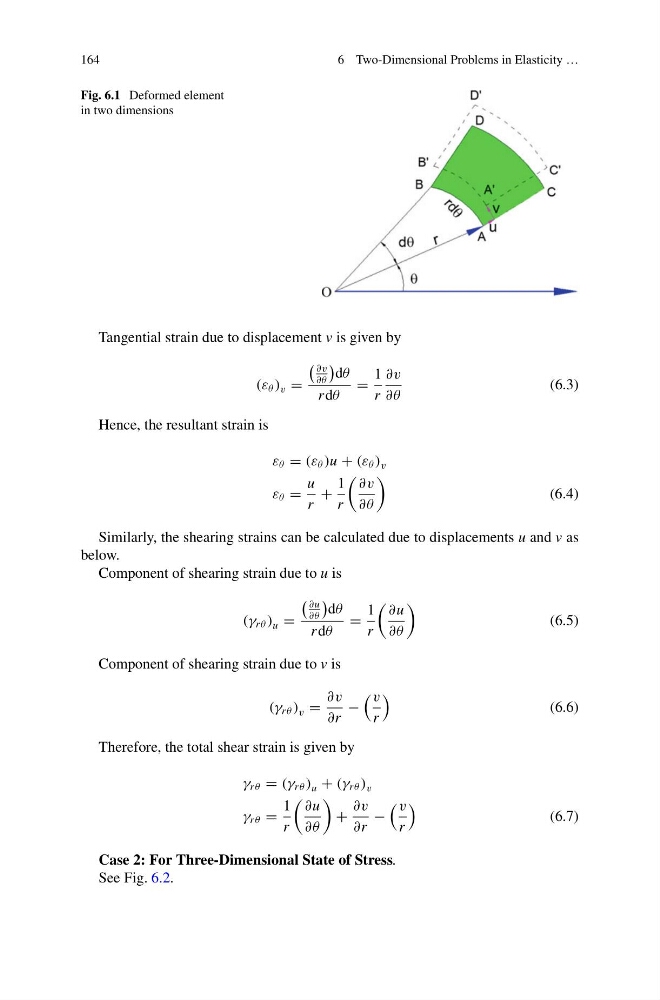
Fig. 6.1 Deformed element
in two dimensions
Tangential strain due to displacement v is given by
(ε θ ) v =
∂v
∂θ
dθ
r dθ
=
1
r
∂v
∂θ
(6.3)
Hence, the resultant strain is
ε θ = (ε θ )u + (ε θ ) v
ε θ =
u
r
+
1
r
∂v
∂θ
(6.4)
Similarly, the shearing strains can be calculated due to displacements u and v as
below.
Component of shearing strain due to u is
(γ r θ ) u =
∂u
∂θ
dθ
r dθ
=
1
r
∂u
∂θ
(6.5)
Component of shearing strain due to v is
(γ r θ ) v =
∂v
∂r
−
v
r
(6.6)
Therefore, the total shear strain is given by
γ r θ = (γ r θ ) u + (γ r θ ) v
γ r θ =
1
r
∂u
∂θ
+
∂v
∂r
−
v
r
(6.7)
Case 2: For Three-Dimensional State of Stress.
See Fig. 6.2.
6 Two-Dimensional Problems in Elasticity …
Fig. 6.1 Deformed element
in two dimensions
Tangential strain due to displacement v is given by
(ε θ ) v =
∂v
∂θ
dθ
r dθ
=
1
r
∂v
∂θ
(6.3)
Hence, the resultant strain is
ε θ = (ε θ )u + (ε θ ) v
ε θ =
u
r
+
1
r
∂v
∂θ
(6.4)
Similarly, the shearing strains can be calculated due to displacements u and v as
below.
Component of shearing strain due to u is
(γ r θ ) u =
∂u
∂θ
dθ
r dθ
=
1
r
∂u
∂θ
(6.5)
Component of shearing strain due to v is
(γ r θ ) v =
∂v
∂r
−
v
r
(6.6)
Therefore, the total shear strain is given by
γ r θ = (γ r θ ) u + (γ r θ ) v
γ r θ =
1
r
∂u
∂θ
+
∂v
∂r
−
v
r
(6.7)
Case 2: For Three-Dimensional State of Stress.
See Fig. 6.2.