

5.10 Exercises
161
6. Using stress function method, obtain the expressions for the stresses in a
cantilever beam fixed x = 0; and carrying a concentrated load P at its free
end. The beam is of rectangular cross section of width b and depth d.
7. Derive the compatibility equation n terms of stress components for plane stress
problems when body forces are not constant.
8. Check whether the following is a stress function.
φ =
3
4
x y −
x y
2
c
−
x y
3
c 2 +
ly
2
c
+
ly
3
c 2
9. Given the following polynomial:
φ = C 1 x
4
+ C 2 x
3 y + C 3 x
2 y
2
+ C 4 x y
3
+ C 5 y
4
adjust the coefficient so that the function is a Biharmonic function.
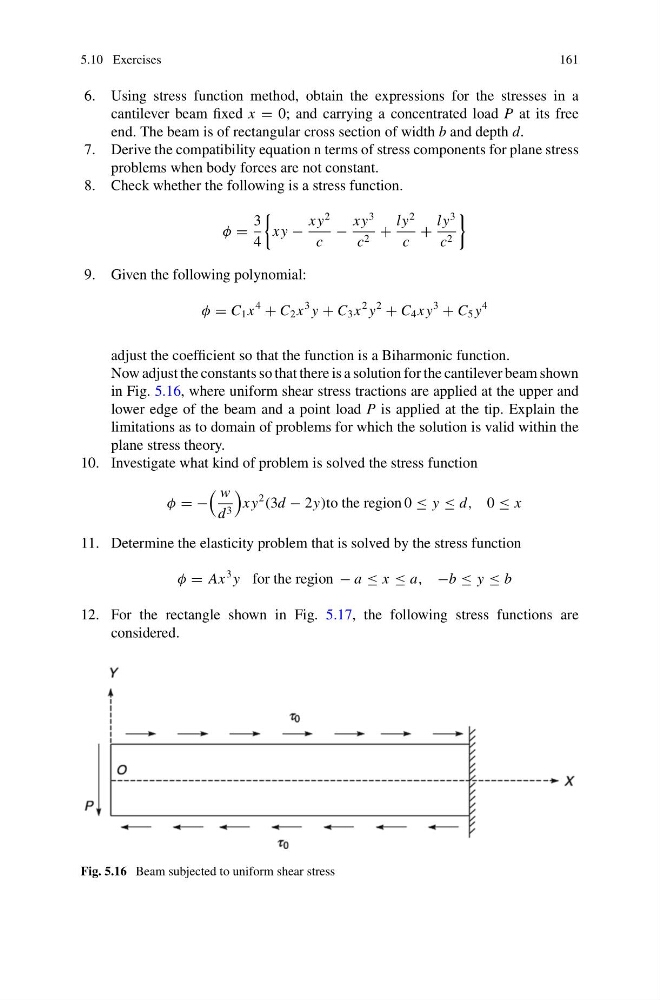
Now adjust the constants so that there is a solution for the cantilever beam shown
in Fig. 5.16, where uniform shear stress tractions are applied at the upper and
lower edge of the beam and a point load P is applied at the tip. Explain the
limitations as to domain of problems for which the solution is valid within the
plane stress theory.
10. Investigate what kind of problem is solved the stress function
φ = −
w
d 3
x y
2
(3d − 2y)to the region 0 ≤ y ≤ d, 0 ≤ x
11. Determine the elasticity problem that is solved by the stress function
φ = Ax
3 y for the region − a ≤ x ≤ a, −b ≤ y ≤ b
12. For the rectangle shown in Fig. 5.17, the following stress functions are
considered.
Fig. 5.16 Beam subjected to uniform shear stress
161
6. Using stress function method, obtain the expressions for the stresses in a
cantilever beam fixed x = 0; and carrying a concentrated load P at its free
end. The beam is of rectangular cross section of width b and depth d.
7. Derive the compatibility equation n terms of stress components for plane stress
problems when body forces are not constant.
8. Check whether the following is a stress function.
φ =
3
4
x y −
x y
2
c
−
x y
3
c 2 +
ly
2
c
+
ly
3
c 2
9. Given the following polynomial:
φ = C 1 x
4
+ C 2 x
3 y + C 3 x
2 y
2
+ C 4 x y
3
+ C 5 y
4
adjust the coefficient so that the function is a Biharmonic function.
Now adjust the constants so that there is a solution for the cantilever beam shown
in Fig. 5.16, where uniform shear stress tractions are applied at the upper and
lower edge of the beam and a point load P is applied at the tip. Explain the
limitations as to domain of problems for which the solution is valid within the
plane stress theory.
10. Investigate what kind of problem is solved the stress function
φ = −
w
d 3
x y
2
(3d − 2y)to the region 0 ≤ y ≤ d, 0 ≤ x
11. Determine the elasticity problem that is solved by the stress function
φ = Ax
3 y for the region − a ≤ x ≤ a, −b ≤ y ≤ b
12. For the rectangle shown in Fig. 5.17, the following stress functions are
considered.
Fig. 5.16 Beam subjected to uniform shear stress