

5.7 Bending of a Narrow Cantilever Beam Subjected to End Load
145
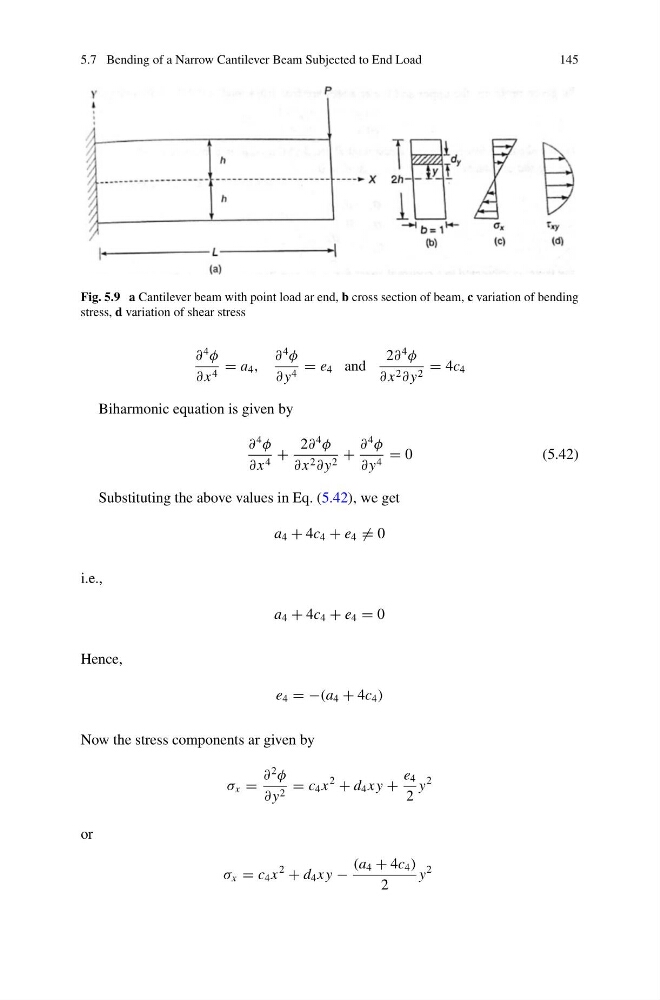
Fig. 5.9 a Cantilever beam with point load ar end, b cross section of beam, c variation of bending
stress, d variation of shear stress
∂
4
φ
∂ x 4 = a 4 ,
∂
4
φ
∂ y 4 = e 4 and
2∂
4
φ
∂ x 2 ∂ y 2 = 4c 4
Biharmonic equation is given by
∂
4
φ
∂ x 4 +
2∂
4
φ
∂ x 2 ∂ y 2 +
∂
4
φ
∂ y 4 = 0
(5.42)
Substituting the above values in Eq. (5.42), we get
a 4 + 4c 4 + e 4 = 0
i.e.,
a 4 + 4c 4 + e 4 = 0
Hence,
e 4 = −(a 4 + 4c 4 )
Now the stress components ar given by
σ x =
∂
2
φ
∂ y 2 = c 4 x
2
+ d 4 x y +
e 4
2
y
2
or
σ x = c 4 x
2
+ d 4 x y −
(a 4 + 4c 4 )
2
y
2
145
Fig. 5.9 a Cantilever beam with point load ar end, b cross section of beam, c variation of bending
stress, d variation of shear stress
∂
4
φ
∂ x 4 = a 4 ,
∂
4
φ
∂ y 4 = e 4 and
2∂
4
φ
∂ x 2 ∂ y 2 = 4c 4
Biharmonic equation is given by
∂
4
φ
∂ x 4 +
2∂
4
φ
∂ x 2 ∂ y 2 +
∂
4
φ
∂ y 4 = 0
(5.42)
Substituting the above values in Eq. (5.42), we get
a 4 + 4c 4 + e 4 = 0
i.e.,
a 4 + 4c 4 + e 4 = 0
Hence,
e 4 = −(a 4 + 4c 4 )
Now the stress components ar given by
σ x =
∂
2
φ
∂ y 2 = c 4 x
2
+ d 4 x y +
e 4
2
y
2
or
σ x = c 4 x
2
+ d 4 x y −
(a 4 + 4c 4 )
2
y
2