

5.5 Solution of Two-Dimensional Problems …
139
In Fig. 5.5, the stress σ y is constant with x (i.e. constant along the span L of the
beam), but varies with y at a particular section. At y = +h, σ y = b 3 h (i.e. tensile),
while at y = -h, σ y = −b 3 h (i.e. compressive). σ x is zero throughout. Shear stress
τ xy is zero at x = 0 and is equal to −b 3 L at x = L. At any other section, the shear
stress is proportional to x.
(d) Polynomial of the Fourth Degree
Let φ 4 =
a 4
24
x
4
+
b 4
6
x
3 y +
c 4
2
x
2 y
2
+
d 4
6
x y
3
+
e 4
24
y
4
The corresponding stresses are given by
σ x = c 4 x
2
+ d 4 x y +
e 4
2
y
2
σ y =
a 4
2
x
2
+ b 4 x y + c 4 y
2
τ xy = −
b 4
2
x
2
− 2c 4 x y −
d 4
2
y
2
Now, taking all coefficients except d 4 equal to zero, we find
σ x = d 4 x y, σ y = 0, τ xy = −
d 4
2
y
2
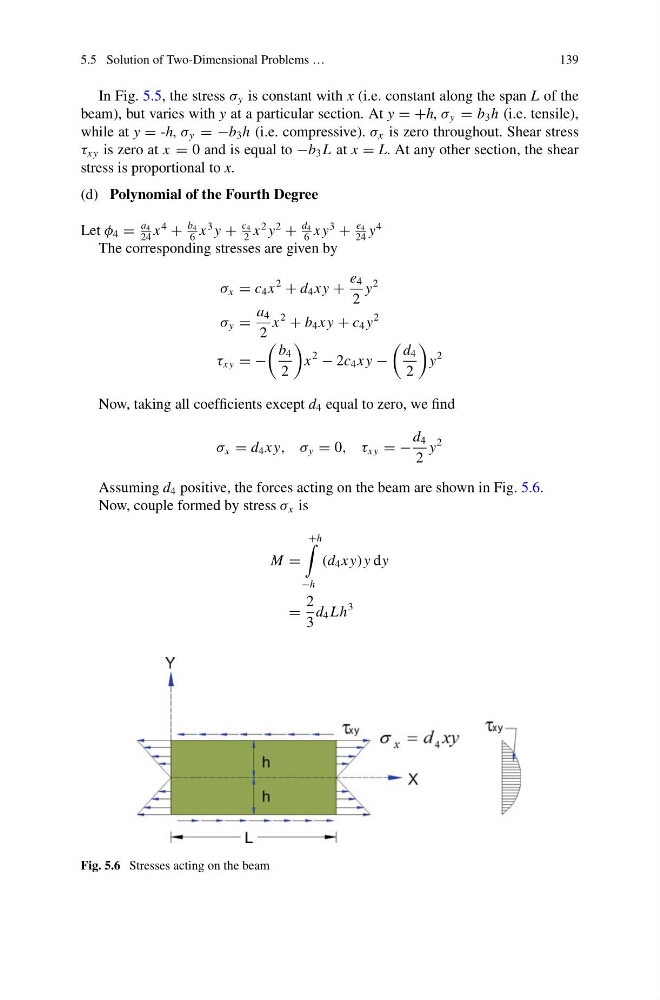
Assuming d 4 positive, the forces acting on the beam are shown in Fig. 5.6.
Now, couple formed by stress σ x is
M =
+h
−h
(d 4 x y)y dy
=
2
3
d 4 Lh
3
Fig. 5.6 Stresses acting on the beam
139
In Fig. 5.5, the stress σ y is constant with x (i.e. constant along the span L of the
beam), but varies with y at a particular section. At y = +h, σ y = b 3 h (i.e. tensile),
while at y = -h, σ y = −b 3 h (i.e. compressive). σ x is zero throughout. Shear stress
τ xy is zero at x = 0 and is equal to −b 3 L at x = L. At any other section, the shear
stress is proportional to x.
(d) Polynomial of the Fourth Degree
Let φ 4 =
a 4
24
x
4
+
b 4
6
x
3 y +
c 4
2
x
2 y
2
+
d 4
6
x y
3
+
e 4
24
y
4
The corresponding stresses are given by
σ x = c 4 x
2
+ d 4 x y +
e 4
2
y
2
σ y =
a 4
2
x
2
+ b 4 x y + c 4 y
2
τ xy = −
b 4
2
x
2
− 2c 4 x y −
d 4
2
y
2
Now, taking all coefficients except d 4 equal to zero, we find
σ x = d 4 x y, σ y = 0, τ xy = −
d 4
2
y
2
Assuming d 4 positive, the forces acting on the beam are shown in Fig. 5.6.
Now, couple formed by stress σ x is
M =
+h
−h
(d 4 x y)y dy
=
2
3
d 4 Lh
3
Fig. 5.6 Stresses acting on the beam