

116
4 Stress–Strain Relations
linear combinations of functions that individually satisfy the equations of elasticity
also satisfy the equations in combined form. This is generally called the principle of
superposition.
Let σ x , σ y , . . . τ xy , τ yz , . . . be the components of stress so determined in a body
due to a set of surface forces ¯
X , ¯
Y , ¯
Z and body forces F x , F y , F z .
Let σ
x , σ
y , . . . τ
xy , τ
yz , . . . be the components of stress in the same body due to a
different set of surface forces ¯
X
, ¯
Y
, ¯
Z
and body forces F
x , F
y , F
z .
Now the stress components σ x + σ
x , σ y + σ
y . . . τ xy + τ
xy . . . will represent the
stresses due to surface forces ¯
X + ¯
X
, . . . and the body forces F x + F
x . . .
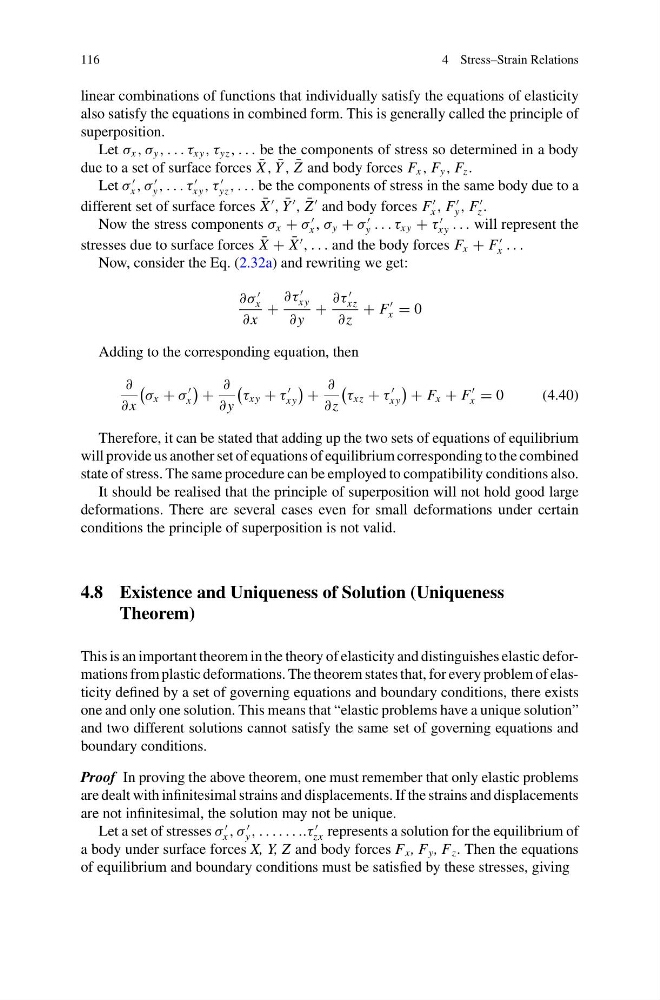
Now, consider the Eq. (2.32a) and rewriting we get:
∂σ
x
∂ x
+
∂τ
xy
∂ y
+
∂τ
xz
∂z
+ F
x = 0
Adding to the corresponding equation, then
∂
∂ x
σ x + σ
x
+
∂
∂ y
τ xy + τ
xy
+
∂
∂z
τ xz + τ
xy
+ F x + F
x = 0
(4.40)
Therefore, it can be stated that adding up the two sets of equations of equilibrium
will provide us another set of equations of equilibrium corresponding to the combined
state of stress. The same procedure can be employed to compatibility conditions also.
It should be realised that the principle of superposition will not hold good large
deformations. There are several cases even for small deformations under certain
conditions the principle of superposition is not valid.
4.8 Existence and Uniqueness of Solution (Uniqueness
Theorem)
This is an important theorem in the theory of elasticity and distinguishes elastic deformations from plastic deformations. The theorem states that, for every problem of elasticity defined by a set of governing equations and boundary conditions, there exists
one and only one solution. This means that “elastic problems have a unique solution”
and two different solutions cannot satisfy the same set of governing equations and
boundary conditions.
Proof In proving the above theorem, one must remember that only elastic problems
are dealt with infinitesimal strains and displacements. If the strains and displacements
are not infinitesimal, the solution may not be unique.
Let a set of stresses σ
x , σ
y , . . . . . . ..τ
zx represents a solution for the equilibrium of
a body under surface forces X, Y, Z and body forces F x , F y , F z . Then the equations
of equilibrium and boundary conditions must be satisfied by these stresses, giving
4 Stress–Strain Relations
linear combinations of functions that individually satisfy the equations of elasticity
also satisfy the equations in combined form. This is generally called the principle of
superposition.
Let σ x , σ y , . . . τ xy , τ yz , . . . be the components of stress so determined in a body
due to a set of surface forces ¯
X , ¯
Y , ¯
Z and body forces F x , F y , F z .
Let σ
x , σ
y , . . . τ
xy , τ
yz , . . . be the components of stress in the same body due to a
different set of surface forces ¯
X
, ¯
Y
, ¯
Z
and body forces F
x , F
y , F
z .
Now the stress components σ x + σ
x , σ y + σ
y . . . τ xy + τ
xy . . . will represent the
stresses due to surface forces ¯
X + ¯
X
, . . . and the body forces F x + F
x . . .
Now, consider the Eq. (2.32a) and rewriting we get:
∂σ
x
∂ x
+
∂τ
xy
∂ y
+
∂τ
xz
∂z
+ F
x = 0
Adding to the corresponding equation, then
∂
∂ x
σ x + σ
x
+
∂
∂ y
τ xy + τ
xy
+
∂
∂z
τ xz + τ
xy
+ F x + F
x = 0
(4.40)
Therefore, it can be stated that adding up the two sets of equations of equilibrium
will provide us another set of equations of equilibrium corresponding to the combined
state of stress. The same procedure can be employed to compatibility conditions also.
It should be realised that the principle of superposition will not hold good large
deformations. There are several cases even for small deformations under certain
conditions the principle of superposition is not valid.
4.8 Existence and Uniqueness of Solution (Uniqueness
Theorem)
This is an important theorem in the theory of elasticity and distinguishes elastic deformations from plastic deformations. The theorem states that, for every problem of elasticity defined by a set of governing equations and boundary conditions, there exists
one and only one solution. This means that “elastic problems have a unique solution”
and two different solutions cannot satisfy the same set of governing equations and
boundary conditions.
Proof In proving the above theorem, one must remember that only elastic problems
are dealt with infinitesimal strains and displacements. If the strains and displacements
are not infinitesimal, the solution may not be unique.
Let a set of stresses σ
x , σ
y , . . . . . . ..τ
zx represents a solution for the equilibrium of
a body under surface forces X, Y, Z and body forces F x , F y , F z . Then the equations
of equilibrium and boundary conditions must be satisfied by these stresses, giving