

110
4 Stress–Strain Relations
to be stored as elastic potential energy. By contrast, the work done in sliding a block
against friction is not recoverable; i.e. friction is a non-conservative mechanism.
Now we can extend the concept of elastic strain energy to arbitrary linearly elastic
bodies subjected to small deformations.
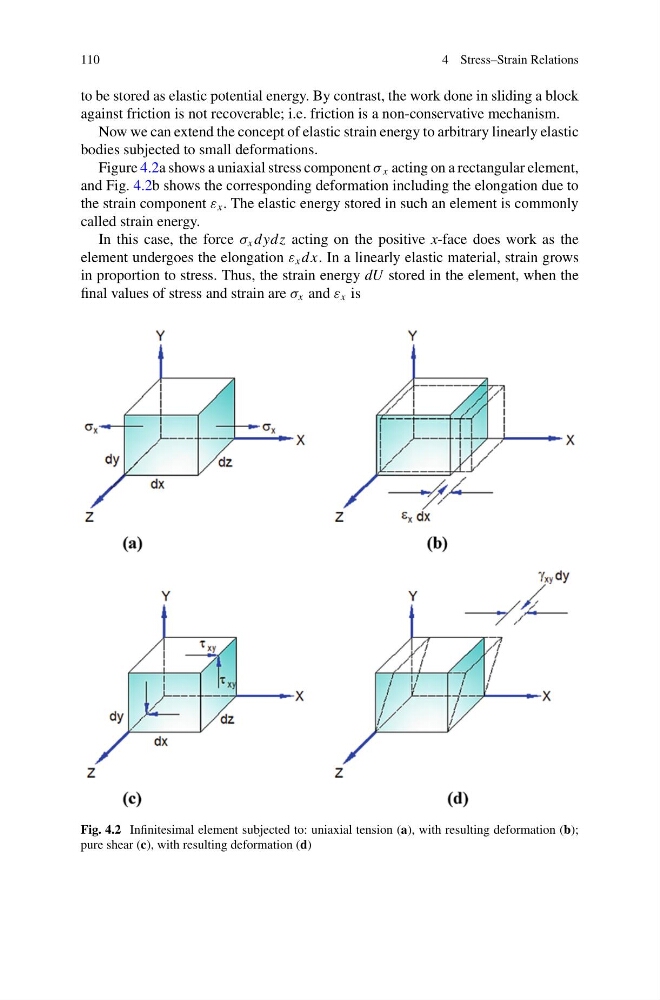
Figure 4.2a shows a uniaxial stress component σ x acting on a rectangular element,
and Fig. 4.2b shows the corresponding deformation including the elongation due to
the strain component ε x . The elastic energy stored in such an element is commonly
called strain energy.
In this case, the force σ x dydz acting on the positive x-face does work as the
element undergoes the elongation ε x dx. In a linearly elastic material, strain grows
in proportion to stress. Thus, the strain energy dU stored in the element, when the
final values of stress and strain are σ x and ε x is
Fig. 4.2 Infinitesimal element subjected to: uniaxial tension (a), with resulting deformation (b);
pure shear (c), with resulting deformation (d)
4 Stress–Strain Relations
to be stored as elastic potential energy. By contrast, the work done in sliding a block
against friction is not recoverable; i.e. friction is a non-conservative mechanism.
Now we can extend the concept of elastic strain energy to arbitrary linearly elastic
bodies subjected to small deformations.
Figure 4.2a shows a uniaxial stress component σ x acting on a rectangular element,
and Fig. 4.2b shows the corresponding deformation including the elongation due to
the strain component ε x . The elastic energy stored in such an element is commonly
called strain energy.
In this case, the force σ x dydz acting on the positive x-face does work as the
element undergoes the elongation ε x dx. In a linearly elastic material, strain grows
in proportion to stress. Thus, the strain energy dU stored in the element, when the
final values of stress and strain are σ x and ε x is
Fig. 4.2 Infinitesimal element subjected to: uniaxial tension (a), with resulting deformation (b);
pure shear (c), with resulting deformation (d)