

106
4 Stress–Strain Relations
Substituting the value of E from Eq. (4.24), we get
ν(λ + G)
G(3λ + 2G)
=
λ
2G(3λ + 2G)
Therefore,
2ν(λ + G) = λ
or v =
λ
2(λ + G)
(4.26)
Solving for λ from Eqs. (4.23) and (4.24), we get
λ =
G(2G − E)
(E − 3G)
=
4G
2
ν
(E − 6Gν)
or G =
E
2(1 + ν)
(4.27)
For a hydrostatic stress, i.e. all round compression p,
σ x = σ y = σ z = −p
Therefore,
ε x + ε y + ε z =
−3(1 − 2ν) p
E
or − p =
E(ε x + ε y + ε z )
3(1 − 2ν)
= (λ +
2G
3
)(ε x + ε y + ε z )
or − p = K (ε x + ε y + ε z )
Hence,
K =
λ +
2G
3
(4.28)
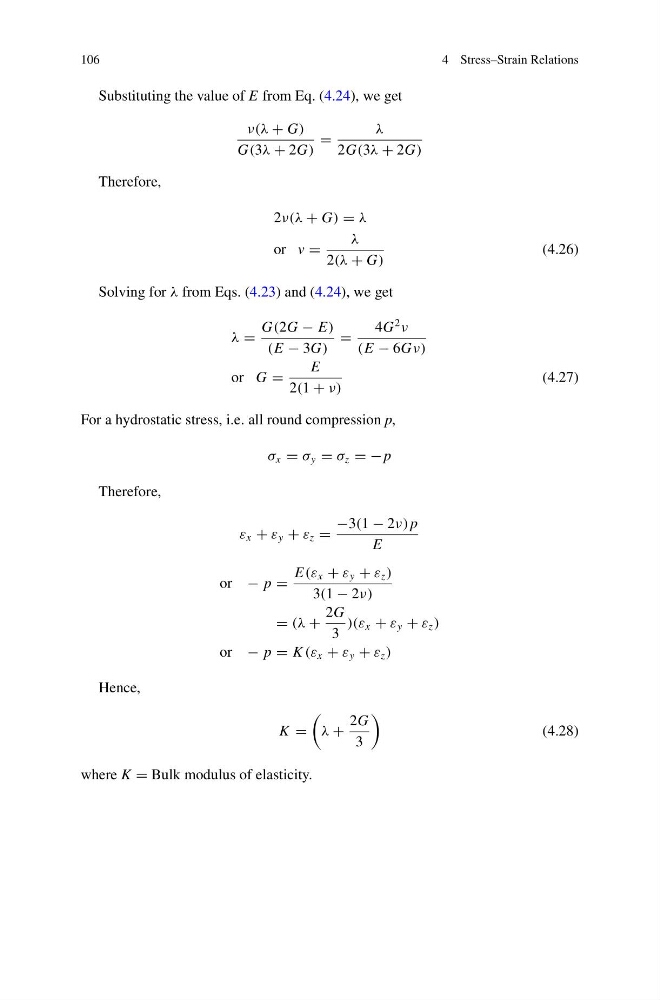
where K = Bulk modulus of elasticity.
4 Stress–Strain Relations
Substituting the value of E from Eq. (4.24), we get
ν(λ + G)
G(3λ + 2G)
=
λ
2G(3λ + 2G)
Therefore,
2ν(λ + G) = λ
or v =
λ
2(λ + G)
(4.26)
Solving for λ from Eqs. (4.23) and (4.24), we get
λ =
G(2G − E)
(E − 3G)
=
4G
2
ν
(E − 6Gν)
or G =
E
2(1 + ν)
(4.27)
For a hydrostatic stress, i.e. all round compression p,
σ x = σ y = σ z = −p
Therefore,
ε x + ε y + ε z =
−3(1 − 2ν) p
E
or − p =
E(ε x + ε y + ε z )
3(1 − 2ν)
= (λ +
2G
3
)(ε x + ε y + ε z )
or − p = K (ε x + ε y + ε z )
Hence,
K =
λ +
2G
3
(4.28)
where K = Bulk modulus of elasticity.