

4.2 Linear Elasticity—Generalized Hooke’s Law
101
⎧
⎪ ⎪ ⎪ ⎪ ⎪ ⎪ ⎪ ⎪ ⎪ ⎪ ⎪ ⎪ ⎪ ⎨
⎪ ⎪ ⎪ ⎪ ⎪ ⎪ ⎪ ⎪ ⎪ ⎪ ⎪ ⎪ ⎪ ⎩
σ x
σ y
σ z
τ xy
τ yz
τ zx
τ xz
τ zy
τ yx
⎫
⎪ ⎪ ⎪ ⎪ ⎪ ⎪ ⎪ ⎪ ⎪ ⎪ ⎪ ⎪ ⎪ ⎬
⎪ ⎪ ⎪ ⎪ ⎪ ⎪ ⎪ ⎪ ⎪ ⎪ ⎪ ⎪ ⎪ ⎭
=
⎡
⎢
⎢
⎢
⎢
⎢
⎢
⎢
⎢
⎢
⎢
⎢
⎢
⎢
⎣
D 11 D 12 D 13 D 14 D 15 D 16 D 17 D 18 D 19
D 21 D 22 D 23 D 24 D 25 D 26 D 27 D 28 D 29
D 31 D 32 D 33 D 34 D 35 D 36 D 37 D 38 D 39
D 41 D 42 D 43 D 44 D 45 D 46 D 47 D 48 D 49
D 51 D 52 D 53 D 54 D 55 D 56 D 57 D 58 D 59
D 61 D 62 D 63 D 64 D 65 D 66 D 67 D 68 D 69
D 71 D 72 D 73 D 74 D 75 D 76 D 77 D 78 D 79
D 81 D 82 D 83 D 84 D 85 D 86 D 87 D 88 D 89
D 91 D 92 D 93 D 94 D 95 D 96 D 97 D 98 D 99
⎤
⎥
⎥
⎥
⎥
⎥
⎥
⎥
⎥
⎥
⎥
⎥
⎥
⎥
⎦
⎧
⎪ ⎪ ⎪ ⎪ ⎪ ⎪ ⎪ ⎪ ⎪ ⎪ ⎪ ⎪ ⎪ ⎨
⎪ ⎪ ⎪ ⎪ ⎪ ⎪ ⎪ ⎪ ⎪ ⎪ ⎪ ⎪ ⎪ ⎩
ε x
ε y
ε z
γ xy
γ yz
γ zx
γ xz
γ zy
γ yx
⎫
⎪ ⎪ ⎪ ⎪ ⎪ ⎪ ⎪ ⎪ ⎪ ⎪ ⎪ ⎪ ⎪ ⎬
⎪ ⎪ ⎪ ⎪ ⎪ ⎪ ⎪ ⎪ ⎪ ⎪ ⎪ ⎪ ⎪ ⎭
(4.5)
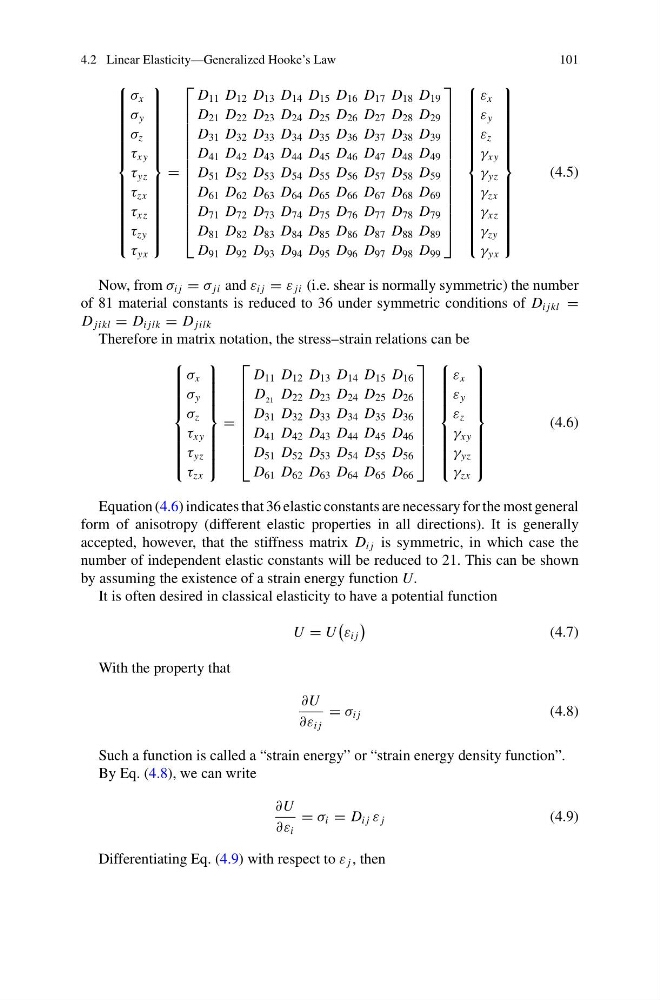
Now, from σ i j = σ ji and ε i j = ε ji (i.e. shear is normally symmetric) the number
of 81 material constants is reduced to 36 under symmetric conditions of D i jkl =
D jikl = D i jlk = D jilk
Therefore in matrix notation, the stress–strain relations can be
⎧
⎪ ⎪ ⎪ ⎪ ⎪ ⎪ ⎪ ⎨
⎪ ⎪ ⎪ ⎪ ⎪ ⎪ ⎪ ⎩
σ x
σ y
σ z
τ xy
τ yz
τ zx
⎫
⎪ ⎪ ⎪ ⎪ ⎪ ⎪ ⎪ ⎬
⎪ ⎪ ⎪ ⎪ ⎪ ⎪ ⎪ ⎭
=
⎡
⎢
⎢
⎢
⎢
⎢
⎢
⎢
⎣
D 11 D 12 D 13 D 14 D 15 D 16
D 21 D 22 D 23 D 24 D 25 D 26
D 31 D 32 D 33 D 34 D 35 D 36
D 41 D 42 D 43 D 44 D 45 D 46
D 51 D 52 D 53 D 54 D 55 D 56
D 61 D 62 D 63 D 64 D 65 D 66
⎤
⎥
⎥
⎥
⎥
⎥
⎥
⎥
⎦
⎧
⎪ ⎪ ⎪ ⎪ ⎪ ⎪ ⎪ ⎨
⎪ ⎪ ⎪ ⎪ ⎪ ⎪ ⎪ ⎩
ε x
ε y
ε z
γ xy
γ yz
γ zx
⎫
⎪ ⎪ ⎪ ⎪ ⎪ ⎪ ⎪ ⎬
⎪ ⎪ ⎪ ⎪ ⎪ ⎪ ⎪ ⎭
(4.6)
Equation (4.6) indicates that 36 elastic constants are necessary for the most general
form of anisotropy (different elastic properties in all directions). It is generally
accepted, however, that the stiffness matrix D i j is symmetric, in which case the
number of independent elastic constants will be reduced to 21. This can be shown
by assuming the existence of a strain energy function U.
It is often desired in classical elasticity to have a potential function
U = U
ε i j
(4.7)
With the property that
∂U
∂ε i j
= σ i j
(4.8)
Such a function is called a “strain energy” or “strain energy density function”.
By Eq. (4.8), we can write
∂U
∂ε i
= σ i = D i j ε j
(4.9)
Differentiating Eq. (4.9) with respect to ε j , then
101
⎧
⎪ ⎪ ⎪ ⎪ ⎪ ⎪ ⎪ ⎪ ⎪ ⎪ ⎪ ⎪ ⎪ ⎨
⎪ ⎪ ⎪ ⎪ ⎪ ⎪ ⎪ ⎪ ⎪ ⎪ ⎪ ⎪ ⎪ ⎩
σ x
σ y
σ z
τ xy
τ yz
τ zx
τ xz
τ zy
τ yx
⎫
⎪ ⎪ ⎪ ⎪ ⎪ ⎪ ⎪ ⎪ ⎪ ⎪ ⎪ ⎪ ⎪ ⎬
⎪ ⎪ ⎪ ⎪ ⎪ ⎪ ⎪ ⎪ ⎪ ⎪ ⎪ ⎪ ⎪ ⎭
=
⎡
⎢
⎢
⎢
⎢
⎢
⎢
⎢
⎢
⎢
⎢
⎢
⎢
⎢
⎣
D 11 D 12 D 13 D 14 D 15 D 16 D 17 D 18 D 19
D 21 D 22 D 23 D 24 D 25 D 26 D 27 D 28 D 29
D 31 D 32 D 33 D 34 D 35 D 36 D 37 D 38 D 39
D 41 D 42 D 43 D 44 D 45 D 46 D 47 D 48 D 49
D 51 D 52 D 53 D 54 D 55 D 56 D 57 D 58 D 59
D 61 D 62 D 63 D 64 D 65 D 66 D 67 D 68 D 69
D 71 D 72 D 73 D 74 D 75 D 76 D 77 D 78 D 79
D 81 D 82 D 83 D 84 D 85 D 86 D 87 D 88 D 89
D 91 D 92 D 93 D 94 D 95 D 96 D 97 D 98 D 99
⎤
⎥
⎥
⎥
⎥
⎥
⎥
⎥
⎥
⎥
⎥
⎥
⎥
⎥
⎦
⎧
⎪ ⎪ ⎪ ⎪ ⎪ ⎪ ⎪ ⎪ ⎪ ⎪ ⎪ ⎪ ⎪ ⎨
⎪ ⎪ ⎪ ⎪ ⎪ ⎪ ⎪ ⎪ ⎪ ⎪ ⎪ ⎪ ⎪ ⎩
ε x
ε y
ε z
γ xy
γ yz
γ zx
γ xz
γ zy
γ yx
⎫
⎪ ⎪ ⎪ ⎪ ⎪ ⎪ ⎪ ⎪ ⎪ ⎪ ⎪ ⎪ ⎪ ⎬
⎪ ⎪ ⎪ ⎪ ⎪ ⎪ ⎪ ⎪ ⎪ ⎪ ⎪ ⎪ ⎪ ⎭
(4.5)
Now, from σ i j = σ ji and ε i j = ε ji (i.e. shear is normally symmetric) the number
of 81 material constants is reduced to 36 under symmetric conditions of D i jkl =
D jikl = D i jlk = D jilk
Therefore in matrix notation, the stress–strain relations can be
⎧
⎪ ⎪ ⎪ ⎪ ⎪ ⎪ ⎪ ⎨
⎪ ⎪ ⎪ ⎪ ⎪ ⎪ ⎪ ⎩
σ x
σ y
σ z
τ xy
τ yz
τ zx
⎫
⎪ ⎪ ⎪ ⎪ ⎪ ⎪ ⎪ ⎬
⎪ ⎪ ⎪ ⎪ ⎪ ⎪ ⎪ ⎭
=
⎡
⎢
⎢
⎢
⎢
⎢
⎢
⎢
⎣
D 11 D 12 D 13 D 14 D 15 D 16
D 21 D 22 D 23 D 24 D 25 D 26
D 31 D 32 D 33 D 34 D 35 D 36
D 41 D 42 D 43 D 44 D 45 D 46
D 51 D 52 D 53 D 54 D 55 D 56
D 61 D 62 D 63 D 64 D 65 D 66
⎤
⎥
⎥
⎥
⎥
⎥
⎥
⎥
⎦
⎧
⎪ ⎪ ⎪ ⎪ ⎪ ⎪ ⎪ ⎨
⎪ ⎪ ⎪ ⎪ ⎪ ⎪ ⎪ ⎩
ε x
ε y
ε z
γ xy
γ yz
γ zx
⎫
⎪ ⎪ ⎪ ⎪ ⎪ ⎪ ⎪ ⎬
⎪ ⎪ ⎪ ⎪ ⎪ ⎪ ⎪ ⎭
(4.6)
Equation (4.6) indicates that 36 elastic constants are necessary for the most general
form of anisotropy (different elastic properties in all directions). It is generally
accepted, however, that the stiffness matrix D i j is symmetric, in which case the
number of independent elastic constants will be reduced to 21. This can be shown
by assuming the existence of a strain energy function U.
It is often desired in classical elasticity to have a potential function
U = U
ε i j
(4.7)
With the property that
∂U
∂ε i j
= σ i j
(4.8)
Such a function is called a “strain energy” or “strain energy density function”.
By Eq. (4.8), we can write
∂U
∂ε i
= σ i = D i j ε j
(4.9)
Differentiating Eq. (4.9) with respect to ε j , then