

92
3 Analysis of Strain
4ax + 2(a + b) = 2αx + β
∴ 4ax = 2αx
or α = 2a.
and β = 2(a + b).
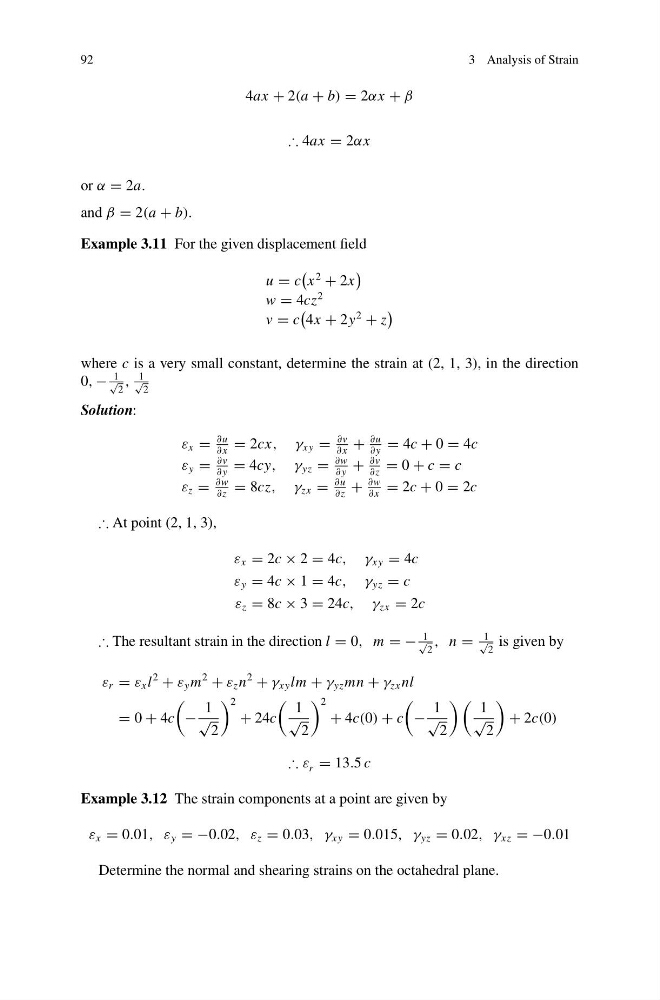
Example 3.11 For the given displacement field
u = c
x
2
+ 2x
w = 4cz
2
v = c
4x + 2y
2
+ z
where c is a very small constant, determine the strain at (2, 1, 3), in the direction
0, −
1
√
2
,
1
√
2
Solution:
ε x =
∂u
∂ x
= 2cx, γ xy =
∂v
∂ x
+
∂u
∂ y
= 4c + 0 = 4c
ε y =
∂v
∂ y
= 4cy, γ yz =
∂w
∂ y
+
∂v
∂z
= 0 + c = c
ε z =
∂w
∂z
= 8cz, γ zx =
∂u
∂z
+
∂w
∂ x
= 2c + 0 = 2c
∴ At point (2, 1, 3),
ε x = 2c × 2 = 4c, γ xy = 4c
ε y = 4c × 1 = 4c, γ yz = c
ε z = 8c × 3 = 24c, γ zx = 2c
∴ The resultant strain in the direction l = 0, m = −
1
√
2
, n =
1
√
2
is given by
ε r = ε x l
2
+ ε y m
2
+ ε z n
2
+ γ xy lm + γ yz mn + γ zx nl
= 0 + 4c
−
1
√
2
2
+ 24c
1
√
2
2
+ 4c(0) + c
−
1
√
2
1
√
2
+ 2c(0)
∴ ε r = 13.5 c
Example 3.12 The strain components at a point are given by
ε x = 0.01, ε y = −0.02, ε z = 0.03, γ xy = 0.015, γ yz = 0.02, γ xz = −0.01
Determine the normal and shearing strains on the octahedral plane.
3 Analysis of Strain
4ax + 2(a + b) = 2αx + β
∴ 4ax = 2αx
or α = 2a.
and β = 2(a + b).
Example 3.11 For the given displacement field
u = c
x
2
+ 2x
w = 4cz
2
v = c
4x + 2y
2
+ z
where c is a very small constant, determine the strain at (2, 1, 3), in the direction
0, −
1
√
2
,
1
√
2
Solution:
ε x =
∂u
∂ x
= 2cx, γ xy =
∂v
∂ x
+
∂u
∂ y
= 4c + 0 = 4c
ε y =
∂v
∂ y
= 4cy, γ yz =
∂w
∂ y
+
∂v
∂z
= 0 + c = c
ε z =
∂w
∂z
= 8cz, γ zx =
∂u
∂z
+
∂w
∂ x
= 2c + 0 = 2c
∴ At point (2, 1, 3),
ε x = 2c × 2 = 4c, γ xy = 4c
ε y = 4c × 1 = 4c, γ yz = c
ε z = 8c × 3 = 24c, γ zx = 2c
∴ The resultant strain in the direction l = 0, m = −
1
√
2
, n =
1
√
2
is given by
ε r = ε x l
2
+ ε y m
2
+ ε z n
2
+ γ xy lm + γ yz mn + γ zx nl
= 0 + 4c
−
1
√
2
2
+ 24c
1
√
2
2
+ 4c(0) + c
−
1
√
2
1
√
2
+ 2c(0)
∴ ε r = 13.5 c
Example 3.12 The strain components at a point are given by
ε x = 0.01, ε y = −0.02, ε z = 0.03, γ xy = 0.015, γ yz = 0.02, γ xz = −0.01
Determine the normal and shearing strains on the octahedral plane.