

76
4 Observer Space-Time Formalism
∂ = (ω)
−1
∂ λ .
(4.7.65)
The operator ∂ L can then be consistently defined on such a field Y , only if it obeys
an equation of the form
(ω)
−1
∂ λ Y = Z ≡ Z 0 − n
i Z i ,
(4.7.66)
for some Lorentz vector Z a , because then we can unambiguously infer the spatial
part of the variation
∂ L Y := n
i Z i .
(4.7.67)
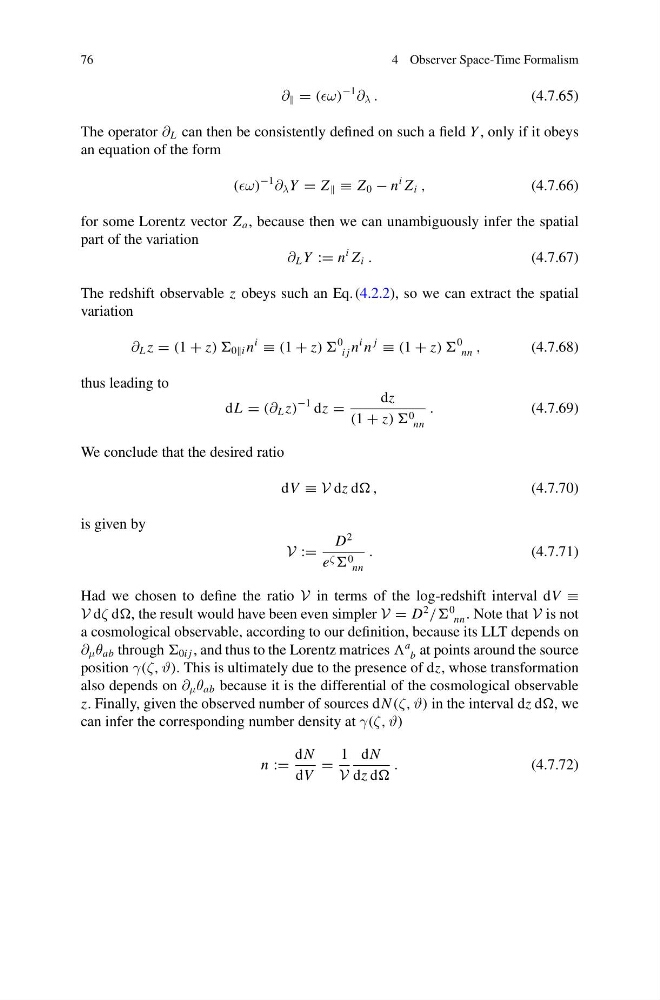
The redshift observable z obeys such an Eq. (4.2.2), so we can extract the spatial
variation
∂ L z = (1 + z) 0i n
i
≡ (1 + z)
0
i j n
i n
j
≡ (1 + z)
0
nn ,
(4.7.68)
thus leading to
dL = (∂ L z)
−1 dz =
dz
(1 + z) 0
nn
.
(4.7.69)
We conclude that the desired ratio
dV ≡ V dz d ,
(4.7.70)
is given by
V :=
D
2
e ζ 0
nn
.
(4.7.71)
Had we chosen to define the ratio V in terms of the log-redshift interval dV ≡
V dζ d, the result would have been even simpler V = D
2
//
0
nn . Note that V is not
a cosmological observable, according to our definition, because its LLT depends on
∂ μ θ ab through 0i j , and thus to the Lorentz matrices
a
b at points around the source
position γ(ζ, ϑ). This is ultimately due to the presence of dz, whose transformation
also depends on ∂ μ θ ab because it is the differential of the cosmological observable
z. Finally, given the observed number of sources dN (ζ, ϑ) in the interval dz d, we
can infer the corresponding number density at γ(ζ, ϑ)
n :=
dN
dV
=
1
V
dN
dz d
.
(4.7.72)
4 Observer Space-Time Formalism
∂ = (ω)
−1
∂ λ .
(4.7.65)
The operator ∂ L can then be consistently defined on such a field Y , only if it obeys
an equation of the form
(ω)
−1
∂ λ Y = Z ≡ Z 0 − n
i Z i ,
(4.7.66)
for some Lorentz vector Z a , because then we can unambiguously infer the spatial
part of the variation
∂ L Y := n
i Z i .
(4.7.67)
The redshift observable z obeys such an Eq. (4.2.2), so we can extract the spatial
variation
∂ L z = (1 + z) 0i n
i
≡ (1 + z)
0
i j n
i n
j
≡ (1 + z)
0
nn ,
(4.7.68)
thus leading to
dL = (∂ L z)
−1 dz =
dz
(1 + z) 0
nn
.
(4.7.69)
We conclude that the desired ratio
dV ≡ V dz d ,
(4.7.70)
is given by
V :=
D
2
e ζ 0
nn
.
(4.7.71)
Had we chosen to define the ratio V in terms of the log-redshift interval dV ≡
V dζ d, the result would have been even simpler V = D
2
//
0
nn . Note that V is not
a cosmological observable, according to our definition, because its LLT depends on
∂ μ θ ab through 0i j , and thus to the Lorentz matrices
a
b at points around the source
position γ(ζ, ϑ). This is ultimately due to the presence of dz, whose transformation
also depends on ∂ μ θ ab because it is the differential of the cosmological observable
z. Finally, given the observed number of sources dN (ζ, ϑ) in the interval dz d, we
can infer the corresponding number density at γ(ζ, ϑ)
n :=
dN
dV
=
1
V
dN
dz d
.
(4.7.72)