

4.5 Full-Sky Sachs Basis
65
k a
A = −n A
k a
ω
+ n a
A ,
n a
A :=
0, n i
A
,
n i n i
A ≡ 0 ,
n i
A n i
B ≡ δ AB .
(4.5.7)
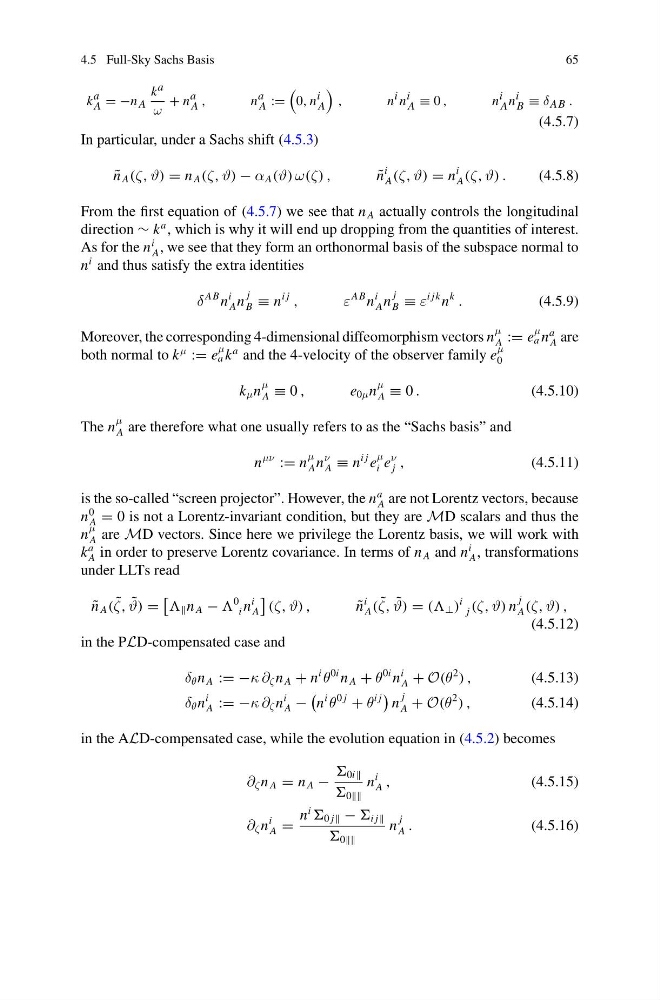
In particular, under a Sachs shift (4.5.3)
˜
n A (ζ, ϑ) = n A (ζ, ϑ) − α A (ϑ) ω(ζ) ,
˜
n
i
A (ζ, ϑ) = n
i
A (ζ, ϑ) .
(4.5.8)
From the first equation of (4.5.7) we see that n A actually controls the longitudinal
direction ∼ k
a , which is why it will end up dropping from the quantities of interest.
As for the n
i
A , we see that they form an orthonormal basis of the subspace normal to
n
i and thus satisfy the extra identities
δ
AB n
i
A n
j
B ≡ n
i j
,
ε
AB n
i
A n
j
B ≡ ε
i jk n
k
.
(4.5.9)
Moreover, the corresponding 4-dimensional diffeomorphism vectors n
μ
A := e
μ
a n
a
A are
both normal to k
μ
:= e
μ
a k
a and the 4-velocity of the observer family e
μ
0
k μ n
μ
A ≡ 0 ,
e 0μ n
μ
A ≡ 0 .
(4.5.10)
The n
μ
A are therefore what one usually refers to as the “Sachs basis” and
n
μν
:= n
μ
A n
ν
A ≡ n
i j e
μ
i e
ν
j ,
(4.5.11)
is the so-called “screen projector”. However, the n
a
A are not Lorentz vectors, because
n
0
A = 0 is not a Lorentz-invariant condition, but they are MD scalars and thus the
n
μ
A are MD vectors. Since here we privilege the Lorentz basis, we will work with
k
a
A in order to preserve Lorentz covariance. In terms of n A and n
i
A , transformations
under LLTs read
˜
n A ( ˜
ζ, ˜
ϑ) =
n A −
0
i n
i
A
(ζ, ϑ) ,
˜
n
i
A ( ˜
ζ, ˜
ϑ) = (( ⊥ )
i
j (ζ, ϑ) n
j
A (ζ, ϑ) ,
(4.5.12)
in the PLD-compensated case and
δ θ n A := −κ ∂ ζ n A + n
i
θ
0i n A + θ
0i n
i
A + O(θ
2
) ,
(4.5.13)
δ θ n
i
A := −κ ∂ ζ n
i
A −
n
i
θ
0 j
+ θ
i j
n
j
A + O(θ
2
) ,
(4.5.14)
in the ALD-compensated case, while the evolution equation in (4.5.2) becomes
∂ ζ n A = n A −
0i
0
n
i
A ,
(4.5.15)
∂ ζ n
i
A =
n
i
0 j − i j
0
n
j
A .
(4.5.16)
65
k a
A = −n A
k a
ω
+ n a
A ,
n a
A :=
0, n i
A
,
n i n i
A ≡ 0 ,
n i
A n i
B ≡ δ AB .
(4.5.7)
In particular, under a Sachs shift (4.5.3)
˜
n A (ζ, ϑ) = n A (ζ, ϑ) − α A (ϑ) ω(ζ) ,
˜
n
i
A (ζ, ϑ) = n
i
A (ζ, ϑ) .
(4.5.8)
From the first equation of (4.5.7) we see that n A actually controls the longitudinal
direction ∼ k
a , which is why it will end up dropping from the quantities of interest.
As for the n
i
A , we see that they form an orthonormal basis of the subspace normal to
n
i and thus satisfy the extra identities
δ
AB n
i
A n
j
B ≡ n
i j
,
ε
AB n
i
A n
j
B ≡ ε
i jk n
k
.
(4.5.9)
Moreover, the corresponding 4-dimensional diffeomorphism vectors n
μ
A := e
μ
a n
a
A are
both normal to k
μ
:= e
μ
a k
a and the 4-velocity of the observer family e
μ
0
k μ n
μ
A ≡ 0 ,
e 0μ n
μ
A ≡ 0 .
(4.5.10)
The n
μ
A are therefore what one usually refers to as the “Sachs basis” and
n
μν
:= n
μ
A n
ν
A ≡ n
i j e
μ
i e
ν
j ,
(4.5.11)
is the so-called “screen projector”. However, the n
a
A are not Lorentz vectors, because
n
0
A = 0 is not a Lorentz-invariant condition, but they are MD scalars and thus the
n
μ
A are MD vectors. Since here we privilege the Lorentz basis, we will work with
k
a
A in order to preserve Lorentz covariance. In terms of n A and n
i
A , transformations
under LLTs read
˜
n A ( ˜
ζ, ˜
ϑ) =
n A −
0
i n
i
A
(ζ, ϑ) ,
˜
n
i
A ( ˜
ζ, ˜
ϑ) = (( ⊥ )
i
j (ζ, ϑ) n
j
A (ζ, ϑ) ,
(4.5.12)
in the PLD-compensated case and
δ θ n A := −κ ∂ ζ n A + n
i
θ
0i n A + θ
0i n
i
A + O(θ
2
) ,
(4.5.13)
δ θ n
i
A := −κ ∂ ζ n
i
A −
n
i
θ
0 j
+ θ
i j
n
j
A + O(θ
2
) ,
(4.5.14)
in the ALD-compensated case, while the evolution equation in (4.5.2) becomes
∂ ζ n A = n A −
0i
0
n
i
A ,
(4.5.15)
∂ ζ n
i
A =
n
i
0 j − i j
0
n
j
A .
(4.5.16)