

3.2 Space-Time Fields
35
of the passive transformation for the former)
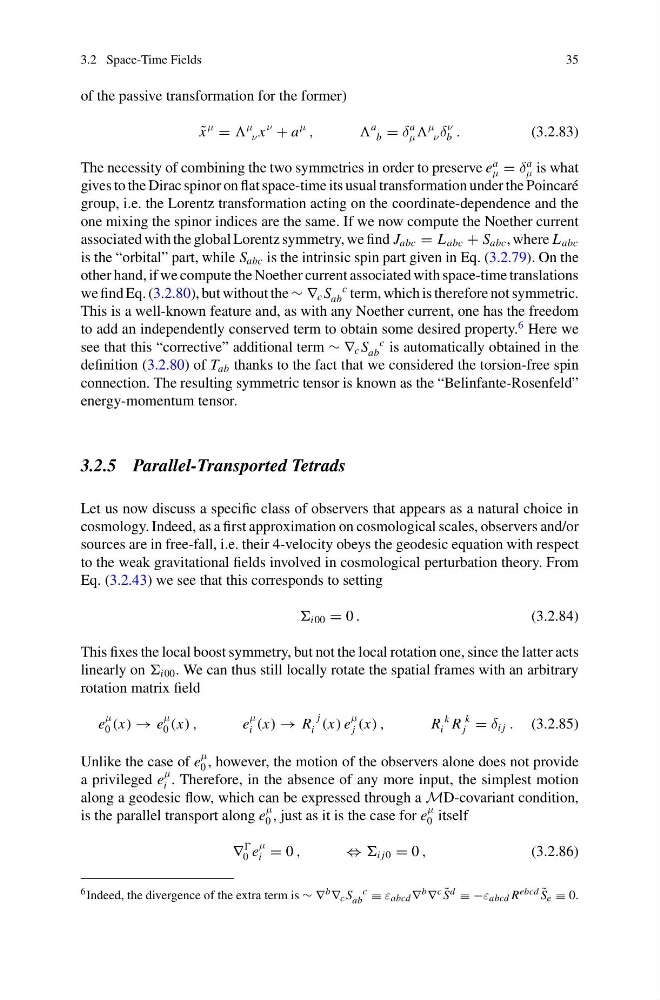
˜
x
μ
=
μ
ν x
ν
+ a
μ
,
,
a
b = δ
a
μ
μ
ν δ
ν
b .
(3.2.83)
The necessity of combining the two symmetries in order to preserve e
a
μ = δ
a
μ is what
gives to the Dirac spinor on flat space-time its usual transformation under the Poincaré
group, i.e. the Lorentz transformation acting on the coordinate-dependence and the
one mixing the spinor indices are the same. If we now compute the Noether current
associated with the global Lorentz symmetry, we find J abc = L abc + S abc , where L abc
is the “orbital” part, while S abc is the intrinsic spin part given in Eq. (3.2.79). On the
other hand, if we compute the Noether current associated with space-time translations
we find Eq. (3.2.80), but without the ∼ ∇ c S
c
ab term, which is therefore not symmetric.
This is a well-known feature and, as with any Noether current, one has the freedom
to add an independently conserved term to obtain some desired property.
6 Here we
see that this “corrective” additional term ∼ ∇ c S
c
ab is automatically obtained in the
definition (3.2.80) of T ab thanks to the fact that we considered the torsion-free spin
connection. The resulting symmetric tensor is known as the “Belinfante-Rosenfeld”
energy-momentum tensor.
3.2.5 Parallel-Transported Tetrads
Let us now discuss a specific class of observers that appears as a natural choice in
cosmology. Indeed, as a first approximation on cosmological scales, observers and/or
sources are in free-fall, i.e. their 4-velocity obeys the geodesic equation with respect
to the weak gravitational fields involved in cosmological perturbation theory. From
Eq. (3.2.43) we see that this corresponds to setting
i00 = 0 .
(3.2.84)
This fixes the local boost symmetry, but not the local rotation one, since the latter acts
linearly on i00 . We can thus still locally rotate the spatial frames with an arbitrary
rotation matrix field
e
μ
0 (x) → e
μ
0 (x) ,
e
μ
i (x) → R
j
i (x) e
μ
j (x) ,
R
k
i R
k
j = δ i j . (3.2.85)
Unlike the case of e
μ
0 , however, the motion of the observers alone does not provide
a privileged e
μ
i . Therefore, in the absence of any more input, the simplest motion
along a geodesic flow, which can be expressed through a MD-covariant condition,
is the parallel transport along e
μ
0 , just as it is the case for e
μ
0 itself
∇
0 e
μ
i = 0 ,
⇔ i j0 = 0 ,
(3.2.86)
6 Indeed, the divergence of the extra term is ∼ ∇ b ∇ c S c
ab ≡ ε abcd ∇ b ∇ c ˜
S d ≡ −ε abcd R ebcd ˜
S e ≡ 0.
35
of the passive transformation for the former)
˜
x
μ
=
μ
ν x
ν
+ a
μ
,
,
a
b = δ
a
μ
μ
ν δ
ν
b .
(3.2.83)
The necessity of combining the two symmetries in order to preserve e
a
μ = δ
a
μ is what
gives to the Dirac spinor on flat space-time its usual transformation under the Poincaré
group, i.e. the Lorentz transformation acting on the coordinate-dependence and the
one mixing the spinor indices are the same. If we now compute the Noether current
associated with the global Lorentz symmetry, we find J abc = L abc + S abc , where L abc
is the “orbital” part, while S abc is the intrinsic spin part given in Eq. (3.2.79). On the
other hand, if we compute the Noether current associated with space-time translations
we find Eq. (3.2.80), but without the ∼ ∇ c S
c
ab term, which is therefore not symmetric.
This is a well-known feature and, as with any Noether current, one has the freedom
to add an independently conserved term to obtain some desired property.
6 Here we
see that this “corrective” additional term ∼ ∇ c S
c
ab is automatically obtained in the
definition (3.2.80) of T ab thanks to the fact that we considered the torsion-free spin
connection. The resulting symmetric tensor is known as the “Belinfante-Rosenfeld”
energy-momentum tensor.
3.2.5 Parallel-Transported Tetrads
Let us now discuss a specific class of observers that appears as a natural choice in
cosmology. Indeed, as a first approximation on cosmological scales, observers and/or
sources are in free-fall, i.e. their 4-velocity obeys the geodesic equation with respect
to the weak gravitational fields involved in cosmological perturbation theory. From
Eq. (3.2.43) we see that this corresponds to setting
i00 = 0 .
(3.2.84)
This fixes the local boost symmetry, but not the local rotation one, since the latter acts
linearly on i00 . We can thus still locally rotate the spatial frames with an arbitrary
rotation matrix field
e
μ
0 (x) → e
μ
0 (x) ,
e
μ
i (x) → R
j
i (x) e
μ
j (x) ,
R
k
i R
k
j = δ i j . (3.2.85)
Unlike the case of e
μ
0 , however, the motion of the observers alone does not provide
a privileged e
μ
i . Therefore, in the absence of any more input, the simplest motion
along a geodesic flow, which can be expressed through a MD-covariant condition,
is the parallel transport along e
μ
0 , just as it is the case for e
μ
0 itself
∇
0 e
μ
i = 0 ,
⇔ i j0 = 0 ,
(3.2.86)
6 Indeed, the divergence of the extra term is ∼ ∇ b ∇ c S c
ab ≡ ε abcd ∇ b ∇ c ˜
S d ≡ −ε abcd R ebcd ˜
S e ≡ 0.