

26
3 Mathematical Framework
δ ξ
ρ
μν is the difference of two infinitesimally close connections. Finally, the torsion
and curvature fields defined in Eq. (3.2.16) transform as tensors.
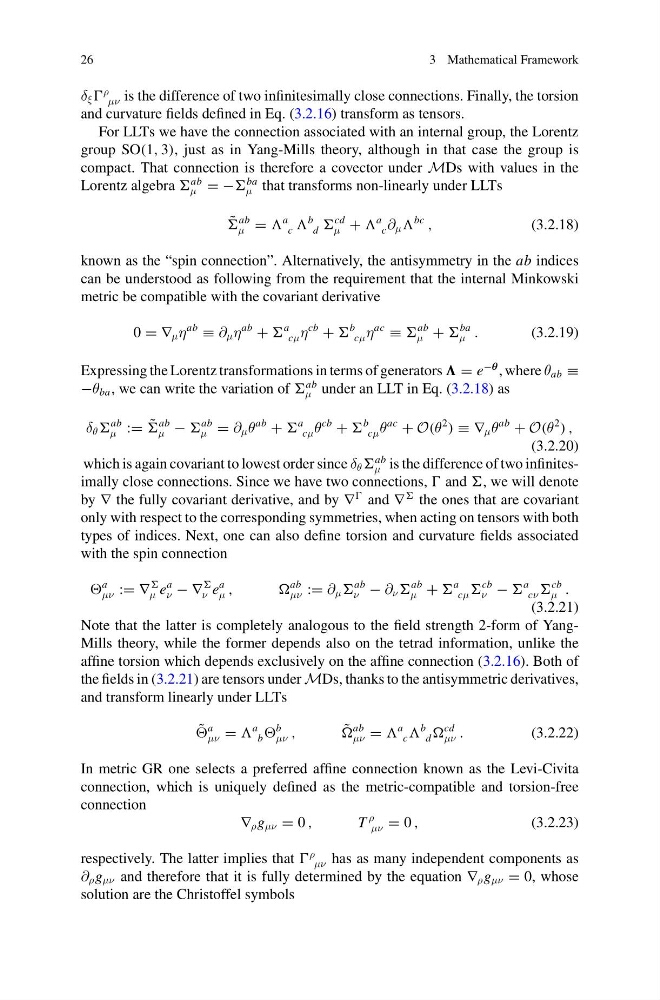
For LLTs we have the connection associated with an internal group, the Lorentz
group SO(1, 3), just as in Yang-Mills theory, although in that case the group is
compact. That connection is therefore a covector under MDs with values in the
Lorentz algebra
ab
μ = −
ba
μ that transforms non-linearly under LLTs
˜
ab
μ =
a
c
b
d
cd
μ +
a
c ∂ μ
bc
,
(3.2.18)
known as the “spin connection”. Alternatively, the antisymmetry in the ab indices
can be understood as following from the requirement that the internal Minkowski
metric be compatible with the covariant derivative
0 = ∇ μ η
ab
≡ ∂ μ η
ab
+
a
cμ η
cb
+
b
cμ η
ac
≡
ab
μ +
ba
μ .
(3.2.19)
Expressing the Lorentz transformations in terms of generators = e
−θ , where θ ab ≡
−θ ba , we can write the variation of
ab
μ under an LLT in Eq. (3.2.18) as
δ θ
ab
μ := ˜
ab
μ −
ab
μ = ∂ μ θ
ab
+
a
cμ θ
cb
+
b
cμ θ
ac
+ O(θ
2
) ≡ ∇ μ θ
ab
+ O(θ
2
) ,
(3.2.20)
which is again covariant to lowest order since δ θ
ab
μ is the difference of two infinitesimally close connections. Since we have two connections, and , we will denote
by ∇ the fully covariant derivative, and by ∇
and ∇
the ones that are covariant
only with respect to the corresponding symmetries, when acting on tensors with both
types of indices. Next, one can also define torsion and curvature fields associated
with the spin connection
a
μν := ∇
μ e
a
ν − ∇
ν e
a
μ ,
,
ab
μν := ∂ μ
ab
ν − ∂ ν
ab
μ +
a
cμ
cb
ν −
a
cν
cb
μ .
(3.2.21)
Note that the latter is completely analogous to the field strength 2-form of YangMills theory, while the former depends also on the tetrad information, unlike the
affine torsion which depends exclusively on the affine connection (3.2.16). Both of
the fields in (3.2.21) are tensors under MDs, thanks to the antisymmetric derivatives,
and transform linearly under LLTs
˜
a
μν =
a
b
b
μν ,
˜
ab
μν =
a
c
b
d
cd
μν .
(3.2.22)
In metric GR one selects a preferred affine connection known as the Levi-Civita
connection, which is uniquely defined as the metric-compatible and torsion-free
connection
∇ ρ g μν = 0 ,
T
ρ
μν = 0 ,
(3.2.23)
respectively. The latter implies that
ρ
μν has as many independent components as
∂ ρ g μν and therefore that it is fully determined by the equation ∇ ρ g μν = 0, whose
solution are the Christoffel symbols
3 Mathematical Framework
δ ξ
ρ
μν is the difference of two infinitesimally close connections. Finally, the torsion
and curvature fields defined in Eq. (3.2.16) transform as tensors.
For LLTs we have the connection associated with an internal group, the Lorentz
group SO(1, 3), just as in Yang-Mills theory, although in that case the group is
compact. That connection is therefore a covector under MDs with values in the
Lorentz algebra
ab
μ = −
ba
μ that transforms non-linearly under LLTs
˜
ab
μ =
a
c
b
d
cd
μ +
a
c ∂ μ
bc
,
(3.2.18)
known as the “spin connection”. Alternatively, the antisymmetry in the ab indices
can be understood as following from the requirement that the internal Minkowski
metric be compatible with the covariant derivative
0 = ∇ μ η
ab
≡ ∂ μ η
ab
+
a
cμ η
cb
+
b
cμ η
ac
≡
ab
μ +
ba
μ .
(3.2.19)
Expressing the Lorentz transformations in terms of generators = e
−θ , where θ ab ≡
−θ ba , we can write the variation of
ab
μ under an LLT in Eq. (3.2.18) as
δ θ
ab
μ := ˜
ab
μ −
ab
μ = ∂ μ θ
ab
+
a
cμ θ
cb
+
b
cμ θ
ac
+ O(θ
2
) ≡ ∇ μ θ
ab
+ O(θ
2
) ,
(3.2.20)
which is again covariant to lowest order since δ θ
ab
μ is the difference of two infinitesimally close connections. Since we have two connections, and , we will denote
by ∇ the fully covariant derivative, and by ∇
and ∇
the ones that are covariant
only with respect to the corresponding symmetries, when acting on tensors with both
types of indices. Next, one can also define torsion and curvature fields associated
with the spin connection
a
μν := ∇
μ e
a
ν − ∇
ν e
a
μ ,
,
ab
μν := ∂ μ
ab
ν − ∂ ν
ab
μ +
a
cμ
cb
ν −
a
cν
cb
μ .
(3.2.21)
Note that the latter is completely analogous to the field strength 2-form of YangMills theory, while the former depends also on the tetrad information, unlike the
affine torsion which depends exclusively on the affine connection (3.2.16). Both of
the fields in (3.2.21) are tensors under MDs, thanks to the antisymmetric derivatives,
and transform linearly under LLTs
˜
a
μν =
a
b
b
μν ,
˜
ab
μν =
a
c
b
d
cd
μν .
(3.2.22)
In metric GR one selects a preferred affine connection known as the Levi-Civita
connection, which is uniquely defined as the metric-compatible and torsion-free
connection
∇ ρ g μν = 0 ,
T
ρ
μν = 0 ,
(3.2.23)
respectively. The latter implies that
ρ
μν has as many independent components as
∂ ρ g μν and therefore that it is fully determined by the equation ∇ ρ g μν = 0, whose
solution are the Christoffel symbols