

128
5 General-Relativistic Matrix Kinetic Theory
In the case of local boosts, however, the non-trivial transformation of the derivative
(5.11.19) and the simple result (5.11.26), imply that the electric and magnetic fields
must mix and their transformation is non-local on S spec (inverse derivative operators).
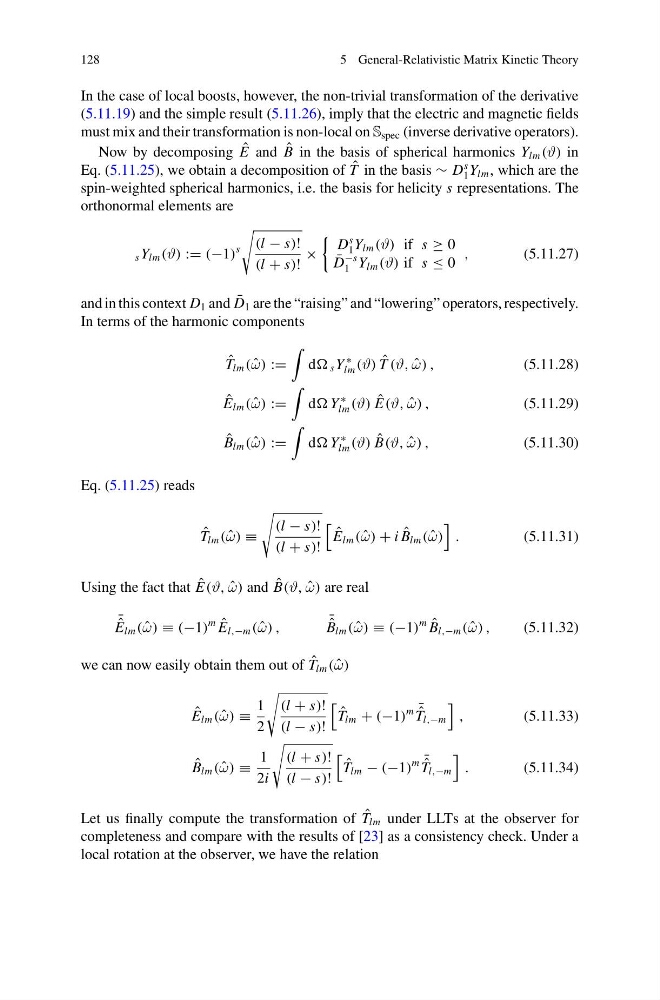
Now by decomposing ˆ
E and ˆ
B in the basis of spherical harmonics Y lm (ϑ) in
Eq. (5.11.25), we obtain a decomposition of ˆ
T in the basis ∼ D
s
1 Y lm , which are the
spin-weighted spherical harmonics, i.e. the basis for helicity s representations. The
orthonormal elements are
s Y lm (ϑ) := (−1)
s
(l − s)!
(l + s)!
×
D
s
1 Y lm (ϑ) if s ≥ 0
¯
D
−s
1 Y lm (ϑ) if s ≤ 0
,
(5.11.27)
and in this context D 1 and ¯
D 1 are the “raising” and “lowering” operators, respectively.
In terms of the harmonic components
ˆ
T lm ( ˆ
ω) :=
d s Y
∗
lm (ϑ) ˆ
T (ϑ, ˆ
ω) ,
(5.11.28)
ˆ
E lm ( ˆ
ω) :=
d Y
∗
lm (ϑ) ˆ
E(ϑ, ˆ
ω) ,
(5.11.29)
ˆ
B lm ( ˆ
ω) :=
d Y
∗
lm (ϑ) ˆ
B(ϑ, ˆ
ω) ,
(5.11.30)
Eq. (5.11.25) reads
ˆ
T lm ( ˆ
ω) ≡
(l − s)!
(l + s)!
ˆ
E lm ( ˆ
ω) + i ˆ
B lm ( ˆ
ω)
.
(5.11.31)
Using the fact that ˆ
E(ϑ, ˆ
ω) and ˆ
B(ϑ, ˆ
ω) are real
¯ ˆ
E lm ( ˆ
ω) ≡ (−1)
m ˆ
E l,−m ( ˆ
ω) ,
¯ ˆ
B lm ( ˆ
ω) ≡ (−1)
m ˆ
B l,−m ( ˆ
ω) ,
(5.11.32)
we can now easily obtain them out of ˆ
T lm ( ˆ
ω)
ˆ
E lm ( ˆ
ω) ≡
1
2
(l + s)!
(l − s)!
ˆ
T lm + (−1)
m ¯ ˆ
T l,−m
,
(5.11.33)
ˆ
B lm ( ˆ
ω) ≡
1
2i
(l + s)!
(l − s)!
ˆ
T lm − (−1)
m ¯ ˆ
T l,−m
.
(5.11.34)
Let us finally compute the transformation of ˆ
T lm under LLTs at the observer for
completeness and compare with the results of [23] as a consistency check. Under a
local rotation at the observer, we have the relation
5 General-Relativistic Matrix Kinetic Theory
In the case of local boosts, however, the non-trivial transformation of the derivative
(5.11.19) and the simple result (5.11.26), imply that the electric and magnetic fields
must mix and their transformation is non-local on S spec (inverse derivative operators).
Now by decomposing ˆ
E and ˆ
B in the basis of spherical harmonics Y lm (ϑ) in
Eq. (5.11.25), we obtain a decomposition of ˆ
T in the basis ∼ D
s
1 Y lm , which are the
spin-weighted spherical harmonics, i.e. the basis for helicity s representations. The
orthonormal elements are
s Y lm (ϑ) := (−1)
s
(l − s)!
(l + s)!
×
D
s
1 Y lm (ϑ) if s ≥ 0
¯
D
−s
1 Y lm (ϑ) if s ≤ 0
,
(5.11.27)
and in this context D 1 and ¯
D 1 are the “raising” and “lowering” operators, respectively.
In terms of the harmonic components
ˆ
T lm ( ˆ
ω) :=
d s Y
∗
lm (ϑ) ˆ
T (ϑ, ˆ
ω) ,
(5.11.28)
ˆ
E lm ( ˆ
ω) :=
d Y
∗
lm (ϑ) ˆ
E(ϑ, ˆ
ω) ,
(5.11.29)
ˆ
B lm ( ˆ
ω) :=
d Y
∗
lm (ϑ) ˆ
B(ϑ, ˆ
ω) ,
(5.11.30)
Eq. (5.11.25) reads
ˆ
T lm ( ˆ
ω) ≡
(l − s)!
(l + s)!
ˆ
E lm ( ˆ
ω) + i ˆ
B lm ( ˆ
ω)
.
(5.11.31)
Using the fact that ˆ
E(ϑ, ˆ
ω) and ˆ
B(ϑ, ˆ
ω) are real
¯ ˆ
E lm ( ˆ
ω) ≡ (−1)
m ˆ
E l,−m ( ˆ
ω) ,
¯ ˆ
B lm ( ˆ
ω) ≡ (−1)
m ˆ
B l,−m ( ˆ
ω) ,
(5.11.32)
we can now easily obtain them out of ˆ
T lm ( ˆ
ω)
ˆ
E lm ( ˆ
ω) ≡
1
2
(l + s)!
(l − s)!
ˆ
T lm + (−1)
m ¯ ˆ
T l,−m
,
(5.11.33)
ˆ
B lm ( ˆ
ω) ≡
1
2i
(l + s)!
(l − s)!
ˆ
T lm − (−1)
m ¯ ˆ
T l,−m
.
(5.11.34)
Let us finally compute the transformation of ˆ
T lm under LLTs at the observer for
completeness and compare with the results of [23] as a consistency check. Under a
local rotation at the observer, we have the relation