

124
5 General-Relativistic Matrix Kinetic Theory
for some “form factors” f 1,2,3 , which depend on the precise K
ab function. Contracting
this quantity with ˜
P ab,1 then gives trivially zero. Such simplifications occur with the
spin polarizations S
a
e, p as well and in real contributions to the collision terms too.
To conclude this example, observe that, as anticipated in Sect. 2.2, the matrix
elements entering the above collision terms, e.g. X, X
a
1,2 , X
ab , etc., are explicitly
independent of x
μ , i.e. they solely depend on the momenta k
a , p
a and q
a . Importantly,
this is true for all observer families e
μ
a (x), because the S-matrix is Lorentz invariant,
so the x
μ -dependence of LLTs is irrelevant. Note that the amplitudes (5.10.15),
(5.10.16) and (5.10.17) do depend on x
μ , but only because of the wave-functions
a
r , u s and u t . The latter must depend on x
μ , because they must transform as vector
distributions under LLTs for our equations to be covariant. Therefore, by expressing
the Boltzmann matrix distribution f through Lorentz tensor distributions using the
wave-functions, we precisely cancel out all occurrences of the latter in the BUU
equation and the resulting tensor amplitudes are then explicitly x
μ -independent.
Remember also that for this last step to be possible we need the wave-functions to
commute with L, so they must be Liouville-transported.
5.11 Cosmic Microwave Background Observables
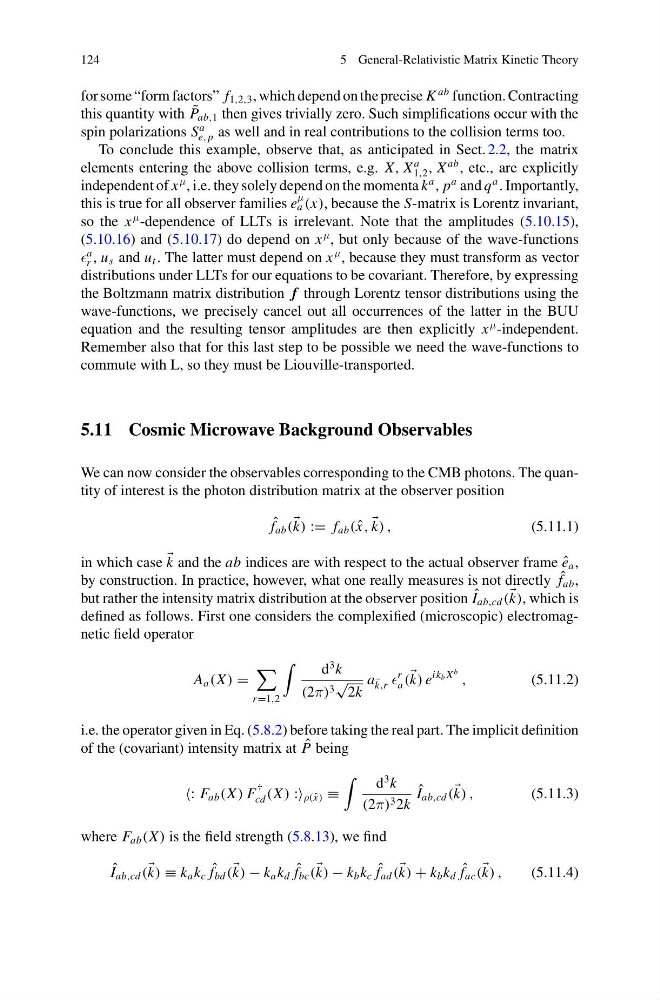
We can now consider the observables corresponding to the CMB photons. The quantity of interest is the photon distribution matrix at the observer position
ˆ
f ab (
k) := f ab ( ˆ
x,
k) ,
(5.11.1)
in which case
k and the ab indices are with respect to the actual observer frame ˆ
e a ,
by construction. In practice, however, what one really measures is not directly ˆ
f ab ,
but rather the intensity matrix distribution at the observer position ˆ
I ab,cd (
k), which is
defined as follows. First one considers the complexified (microscopic) electromagnetic field operator
A a (X ) =
r =1,2
d
3 k
(2π) 3
√
2k
a
k,r
r
a (
k) e
ik b X
b ,
(5.11.2)
i.e. the operator given in Eq. (5.8.2) before taking the real part. The implicit definition
of the (covariant) intensity matrix at ˆ
P being
: F ab (X ) F
†
cd (X ) :: ρ( ˆ
x) ≡
d
3 k
(2π) 3 2k
ˆ
I ab,cd (
k) ,
(5.11.3)
where F ab (X ) is the field strength (5.8.13), we find
ˆ
I ab,cd (
k) ≡ k a k c ˆ
f bd (
k) − k a k d ˆ
f bc (
k) − k b k c ˆ
f ad (
k) + k b k d ˆ
f ac (
k) ,
(5.11.4)
5 General-Relativistic Matrix Kinetic Theory
for some “form factors” f 1,2,3 , which depend on the precise K
ab function. Contracting
this quantity with ˜
P ab,1 then gives trivially zero. Such simplifications occur with the
spin polarizations S
a
e, p as well and in real contributions to the collision terms too.
To conclude this example, observe that, as anticipated in Sect. 2.2, the matrix
elements entering the above collision terms, e.g. X, X
a
1,2 , X
ab , etc., are explicitly
independent of x
μ , i.e. they solely depend on the momenta k
a , p
a and q
a . Importantly,
this is true for all observer families e
μ
a (x), because the S-matrix is Lorentz invariant,
so the x
μ -dependence of LLTs is irrelevant. Note that the amplitudes (5.10.15),
(5.10.16) and (5.10.17) do depend on x
μ , but only because of the wave-functions
a
r , u s and u t . The latter must depend on x
μ , because they must transform as vector
distributions under LLTs for our equations to be covariant. Therefore, by expressing
the Boltzmann matrix distribution f through Lorentz tensor distributions using the
wave-functions, we precisely cancel out all occurrences of the latter in the BUU
equation and the resulting tensor amplitudes are then explicitly x
μ -independent.
Remember also that for this last step to be possible we need the wave-functions to
commute with L, so they must be Liouville-transported.
5.11 Cosmic Microwave Background Observables
We can now consider the observables corresponding to the CMB photons. The quantity of interest is the photon distribution matrix at the observer position
ˆ
f ab (
k) := f ab ( ˆ
x,
k) ,
(5.11.1)
in which case
k and the ab indices are with respect to the actual observer frame ˆ
e a ,
by construction. In practice, however, what one really measures is not directly ˆ
f ab ,
but rather the intensity matrix distribution at the observer position ˆ
I ab,cd (
k), which is
defined as follows. First one considers the complexified (microscopic) electromagnetic field operator
A a (X ) =
r =1,2
d
3 k
(2π) 3
√
2k
a
k,r
r
a (
k) e
ik b X
b ,
(5.11.2)
i.e. the operator given in Eq. (5.8.2) before taking the real part. The implicit definition
of the (covariant) intensity matrix at ˆ
P being
: F ab (X ) F
†
cd (X ) :: ρ( ˆ
x) ≡
d
3 k
(2π) 3 2k
ˆ
I ab,cd (
k) ,
(5.11.3)
where F ab (X ) is the field strength (5.8.13), we find
ˆ
I ab,cd (
k) ≡ k a k c ˆ
f bd (
k) − k a k d ˆ
f bc (
k) − k b k c ˆ
f ad (
k) + k b k d ˆ
f ac (
k) ,
(5.11.4)