

5.10 Example: The Photon-Electron-Proton Fluid
117
fundamental Dirac particle. We also focus on typical energies way below the electron mass m e ≈ 0.51 MeV and way above the Rydberg energy Ry ≈ 14 eV, so we
can neglect positrons, anti-protons and the hydrogen bound states without spoiling
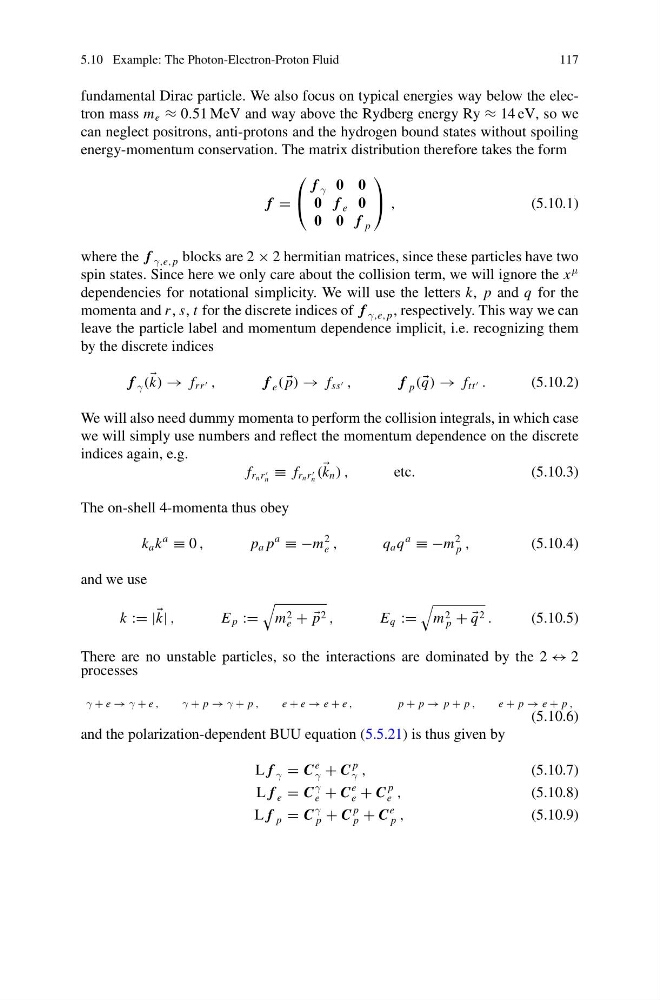
energy-momentum conservation. The matrix distribution therefore takes the form
f =
⎛
⎝
f γ 0 0
0 f e 0
0 0 f p
⎞
⎠ ,
(5.10.1)
where the f γ,e, p blocks are 2 × 2 hermitian matrices, since these particles have two
spin states. Since here we only care about the collision term, we will ignore the x
μ
dependencies for notational simplicity. We will use the letters k, p and q for the
momenta and r , s, t for the discrete indices of f γ,e, p , respectively. This way we can
leave the particle label and momentum dependence implicit, i.e. recognizing them
by the discrete indices
f γ (
k) → f rr ,
f e (
p) → f ss ,
f p ( q) → f tt .
(5.10.2)
We will also need dummy momenta to perform the collision integrals, in which case
we will simply use numbers and reflect the momentum dependence on the discrete
indices again, e.g.
f r n r
n
≡ f r n r
n
(
k n ) ,
etc.
(5.10.3)
The on-shell 4-momenta thus obey
k a k
a
≡ 0 ,
p a p
a
≡ −m
2
e ,
q a q
a
≡ −m
2
p ,
(5.10.4)
and we use
k := |
k| ,
E p :=
m 2
e + +
p 2 ,
E q :=
m 2
p + +
q 2 .
(5.10.5)
There are no unstable particles, so the interactions are dominated by the 2 ↔ 2
processes
γ + e → γ + e ,
γ + p → γ + p ,
e + e → e + e ,
p + p → p + p ,
e + p → e + p ,
(5.10.6)
and the polarization-dependent BUU equation (5.5.21) is thus given by
L f γ = C
e
γ + C
p
γ ,
(5.10.7)
L f e = C
γ
e + C
e
e + C
p
e ,
(5.10.8)
L f p = C
γ
p + C
p
p + C
e
p ,
(5.10.9)
117
fundamental Dirac particle. We also focus on typical energies way below the electron mass m e ≈ 0.51 MeV and way above the Rydberg energy Ry ≈ 14 eV, so we
can neglect positrons, anti-protons and the hydrogen bound states without spoiling
energy-momentum conservation. The matrix distribution therefore takes the form
f =
⎛
⎝
f γ 0 0
0 f e 0
0 0 f p
⎞
⎠ ,
(5.10.1)
where the f γ,e, p blocks are 2 × 2 hermitian matrices, since these particles have two
spin states. Since here we only care about the collision term, we will ignore the x
μ
dependencies for notational simplicity. We will use the letters k, p and q for the
momenta and r , s, t for the discrete indices of f γ,e, p , respectively. This way we can
leave the particle label and momentum dependence implicit, i.e. recognizing them
by the discrete indices
f γ (
k) → f rr ,
f e (
p) → f ss ,
f p ( q) → f tt .
(5.10.2)
We will also need dummy momenta to perform the collision integrals, in which case
we will simply use numbers and reflect the momentum dependence on the discrete
indices again, e.g.
f r n r
n
≡ f r n r
n
(
k n ) ,
etc.
(5.10.3)
The on-shell 4-momenta thus obey
k a k
a
≡ 0 ,
p a p
a
≡ −m
2
e ,
q a q
a
≡ −m
2
p ,
(5.10.4)
and we use
k := |
k| ,
E p :=
m 2
e + +
p 2 ,
E q :=
m 2
p + +
q 2 .
(5.10.5)
There are no unstable particles, so the interactions are dominated by the 2 ↔ 2
processes
γ + e → γ + e ,
γ + p → γ + p ,
e + e → e + e ,
p + p → p + p ,
e + p → e + p ,
(5.10.6)
and the polarization-dependent BUU equation (5.5.21) is thus given by
L f γ = C
e
γ + C
p
γ ,
(5.10.7)
L f e = C
γ
e + C
e
e + C
p
e ,
(5.10.8)
L f p = C
γ
p + C
p
p + C
e
p ,
(5.10.9)