

108
5 General-Relativistic Matrix Kinetic Theory
or more generally the corresponding space-time coordinates X
a , are the Fourier
conjugates of the momentum variables p
a , which are clearly independent of the
macroscopic coordinates x
μ or the geodesic parameter λ, which is usually taken
to be the proper time for massive particles. In light of this mathematical structure,
considering the identification ∂ λ
!
= ∂ T , or its covariant generalization (5.6.3), seems
rather unnatural.
5.7 Exact Conservation Equations of the Collisional
Equation
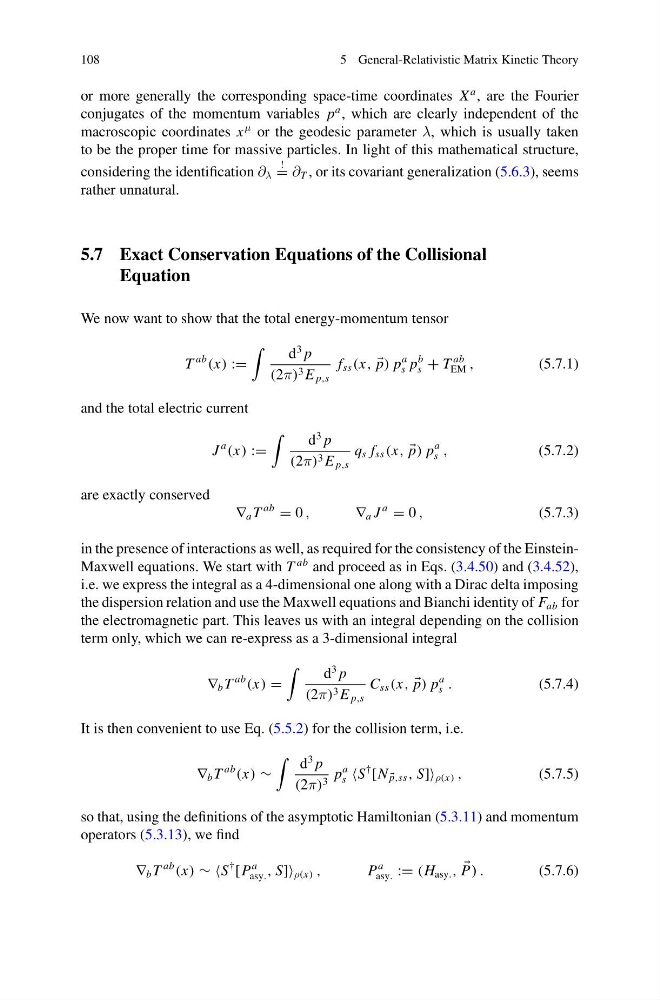
We now want to show that the total energy-momentum tensor
T
ab
(x) :=
d
3 p
(2π) 3 E p,s
f ss (x,
p) p
a
s p
b
s + T
ab
EM ,
(5.7.1)
and the total electric current
J
a
(x) :=
d
3 p
(2π) 3 E p,s
q s f ss (x,
p) p
a
s ,
(5.7.2)
are exactly conserved
∇ a T
ab
= 0 ,
∇ a J
a
= 0 ,
(5.7.3)
in the presence of interactions as well, as required for the consistency of the EinsteinMaxwell equations. We start with T
ab and proceed as in Eqs. (3.4.50) and (3.4.52),
i.e. we express the integral as a 4-dimensional one along with a Dirac delta imposing
the dispersion relation and use the Maxwell equations and Bianchi identity of F ab for
the electromagnetic part. This leaves us with an integral depending on the collision
term only, which we can re-express as a 3-dimensional integral
∇ b T
ab
(x) =
d
3 p
(2π) 3 E p,s
C ss (x,
p) p
a
s .
(5.7.4)
It is then convenient to use Eq. (5.5.2) for the collision term, i.e.
∇ b T
ab
(x) ∼
d
3 p
(2π) 3 p
a
s S
†
[N
p,ss , S]] ρ(x) ,
(5.7.5)
so that, using the definitions of the asymptotic Hamiltonian (5.3.11) and momentum
operators (5.3.13), we find
∇ b T
ab
(x) ∼ ∼S
†
[P
a
asy. , S]] ρ(x) ,
P
a
asy. := (H asy. ,
P) .
(5.7.6)
5 General-Relativistic Matrix Kinetic Theory
or more generally the corresponding space-time coordinates X
a , are the Fourier
conjugates of the momentum variables p
a , which are clearly independent of the
macroscopic coordinates x
μ or the geodesic parameter λ, which is usually taken
to be the proper time for massive particles. In light of this mathematical structure,
considering the identification ∂ λ
!
= ∂ T , or its covariant generalization (5.6.3), seems
rather unnatural.
5.7 Exact Conservation Equations of the Collisional
Equation
We now want to show that the total energy-momentum tensor
T
ab
(x) :=
d
3 p
(2π) 3 E p,s
f ss (x,
p) p
a
s p
b
s + T
ab
EM ,
(5.7.1)
and the total electric current
J
a
(x) :=
d
3 p
(2π) 3 E p,s
q s f ss (x,
p) p
a
s ,
(5.7.2)
are exactly conserved
∇ a T
ab
= 0 ,
∇ a J
a
= 0 ,
(5.7.3)
in the presence of interactions as well, as required for the consistency of the EinsteinMaxwell equations. We start with T
ab and proceed as in Eqs. (3.4.50) and (3.4.52),
i.e. we express the integral as a 4-dimensional one along with a Dirac delta imposing
the dispersion relation and use the Maxwell equations and Bianchi identity of F ab for
the electromagnetic part. This leaves us with an integral depending on the collision
term only, which we can re-express as a 3-dimensional integral
∇ b T
ab
(x) =
d
3 p
(2π) 3 E p,s
C ss (x,
p) p
a
s .
(5.7.4)
It is then convenient to use Eq. (5.5.2) for the collision term, i.e.
∇ b T
ab
(x) ∼
d
3 p
(2π) 3 p
a
s S
†
[N
p,ss , S]] ρ(x) ,
(5.7.5)
so that, using the definitions of the asymptotic Hamiltonian (5.3.11) and momentum
operators (5.3.13), we find
∇ b T
ab
(x) ∼ ∼S
†
[P
a
asy. , S]] ρ(x) ,
P
a
asy. := (H asy. ,
P) .
(5.7.6)