

2
1 Introduction and Summary
note that what one really measures in cosmology is the functional relation between
observables, e.g. the relation between the temperature of the photon fluid and the
angular direction in which it is observed on the sky T (ϑ), or the average relation
between the luminosity distance and the redshift of some set of sources D L (z).
One then immediately recognizes that there exists a subset of observables which
appear as more “fundamental”, because they are able to parametrize the rest of
the observables, and also because they are model-independent quantities, thus leading to the aforementioned observable functions. This fundamental set is composed
of the redshift z associated with some source, the observed angular parametrization of the sky {ϑ, ϕ} and the observed frequency parametrization of light spectra
ˆ
ω. The { ˆ
ω, z} observables depend on the information of the observer and source
4-velocities. The { ˆ
ω, z} quantities are therefore uniquely defined for a given observer,
but change if one alters her 4-velocity, i.e. they are defined up to a boost of the
observer. As for the angular parametrization {ϑ, ϕ}, it is defined only up to a global
rotation of the sky, since one needs to pick a definite spatial reference frame in order
to associate {ϑ, ϕ} numbers to sources. From the viewpoint of the 4-dimensional
space-time manifold, this spatial frame corresponds to three space-like orthonormal vectors in the tangent space of the observer position, which are normal to the
4-velocity of the observer, i.e. they generate her “rest-frame”. Together, these four
vectors therefore form an orthonormal basis of the observer’s tangent space, i.e. a
“tetrad” or “vierbein”. Such a basis represents the “observer frame” with respect to
which she measures tensorial components. The prototypical example in this case is
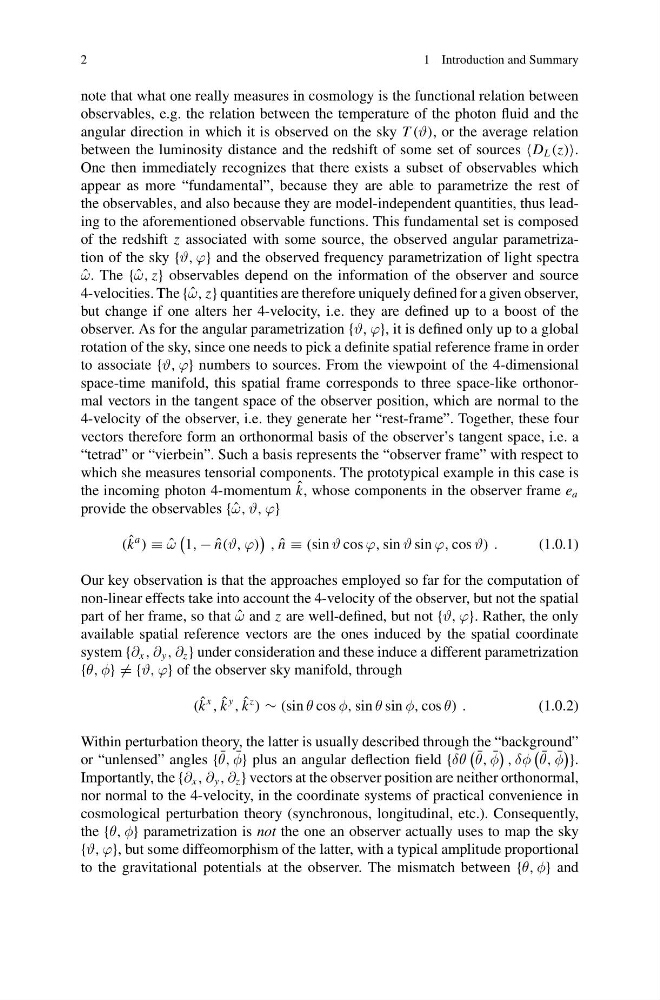
the incoming photon 4-momentum ˆ
k, whose components in the observer frame e a
provide the observables { ˆ
ω, ϑ, ϕ}
( ˆ
k
a
) ≡ ˆ
ω
1, − ˆ
n(ϑ, ϕ)
, ˆ
n ≡ (sin ϑ cos ϕ, sin ϑ sin ϕ, cos ϑ) .
(1.0.1)
Our key observation is that the approaches employed so far for the computation of
non-linear effects take into account the 4-velocity of the observer, but not the spatial
part of her frame, so that ˆ
ω and z are well-defined, but not {ϑ, ϕ}. Rather, the only
available spatial reference vectors are the ones induced by the spatial coordinate
system {∂ x , ∂ y , ∂ z } under consideration and these induce a different parametrization
{θ, φ} = {ϑ, ϕ} of the observer sky manifold, through
( ˆ
k
x
, ˆ
k
y
, ˆ
k
z
) ∼ (sin θ cos φ, sin θ sin φ, cos θ) .
(1.0.2)
Within perturbation theory, the latter is usually described through the “background”
or “unlensed” angles { ¯
θ, ¯
φ} plus an angular deflection field {δθ
¯
θ, ¯
φ
, δφ
¯
θ, ¯
φ
}.
Importantly, the {∂ x , ∂ y , ∂ z } vectors at the observer position are neither orthonormal,
nor normal to the 4-velocity, in the coordinate systems of practical convenience in
cosmological perturbation theory (synchronous, longitudinal, etc.). Consequently,
the {θ, φ} parametrization is not the one an observer actually uses to map the sky
{ϑ, ϕ}, but some diffeomorphism of the latter, with a typical amplitude proportional
to the gravitational potentials at the observer. The mismatch between {θ, φ} and
1 Introduction and Summary
note that what one really measures in cosmology is the functional relation between
observables, e.g. the relation between the temperature of the photon fluid and the
angular direction in which it is observed on the sky T (ϑ), or the average relation
between the luminosity distance and the redshift of some set of sources D L (z).
One then immediately recognizes that there exists a subset of observables which
appear as more “fundamental”, because they are able to parametrize the rest of
the observables, and also because they are model-independent quantities, thus leading to the aforementioned observable functions. This fundamental set is composed
of the redshift z associated with some source, the observed angular parametrization of the sky {ϑ, ϕ} and the observed frequency parametrization of light spectra
ˆ
ω. The { ˆ
ω, z} observables depend on the information of the observer and source
4-velocities. The { ˆ
ω, z} quantities are therefore uniquely defined for a given observer,
but change if one alters her 4-velocity, i.e. they are defined up to a boost of the
observer. As for the angular parametrization {ϑ, ϕ}, it is defined only up to a global
rotation of the sky, since one needs to pick a definite spatial reference frame in order
to associate {ϑ, ϕ} numbers to sources. From the viewpoint of the 4-dimensional
space-time manifold, this spatial frame corresponds to three space-like orthonormal vectors in the tangent space of the observer position, which are normal to the
4-velocity of the observer, i.e. they generate her “rest-frame”. Together, these four
vectors therefore form an orthonormal basis of the observer’s tangent space, i.e. a
“tetrad” or “vierbein”. Such a basis represents the “observer frame” with respect to
which she measures tensorial components. The prototypical example in this case is
the incoming photon 4-momentum ˆ
k, whose components in the observer frame e a
provide the observables { ˆ
ω, ϑ, ϕ}
( ˆ
k
a
) ≡ ˆ
ω
1, − ˆ
n(ϑ, ϕ)
, ˆ
n ≡ (sin ϑ cos ϕ, sin ϑ sin ϕ, cos ϑ) .
(1.0.1)
Our key observation is that the approaches employed so far for the computation of
non-linear effects take into account the 4-velocity of the observer, but not the spatial
part of her frame, so that ˆ
ω and z are well-defined, but not {ϑ, ϕ}. Rather, the only
available spatial reference vectors are the ones induced by the spatial coordinate
system {∂ x , ∂ y , ∂ z } under consideration and these induce a different parametrization
{θ, φ} = {ϑ, ϕ} of the observer sky manifold, through
( ˆ
k
x
, ˆ
k
y
, ˆ
k
z
) ∼ (sin θ cos φ, sin θ sin φ, cos θ) .
(1.0.2)
Within perturbation theory, the latter is usually described through the “background”
or “unlensed” angles { ¯
θ, ¯
φ} plus an angular deflection field {δθ
¯
θ, ¯
φ
, δφ
¯
θ, ¯
φ
}.
Importantly, the {∂ x , ∂ y , ∂ z } vectors at the observer position are neither orthonormal,
nor normal to the 4-velocity, in the coordinate systems of practical convenience in
cosmological perturbation theory (synchronous, longitudinal, etc.). Consequently,
the {θ, φ} parametrization is not the one an observer actually uses to map the sky
{ϑ, ϕ}, but some diffeomorphism of the latter, with a typical amplitude proportional
to the gravitational potentials at the observer. The mismatch between {θ, φ} and