

4.2 Methane Metabolism in Methane-Oxidizing Bacteria
89
4.2.3.3 Electron Donor
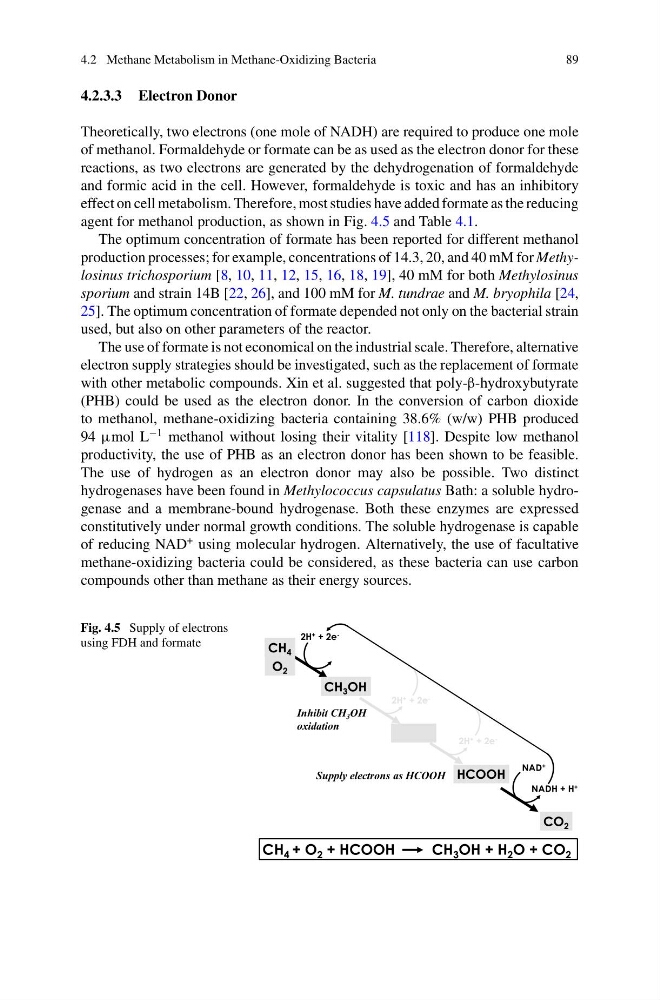
Theoretically, two electrons (one mole of NADH) are required to produce one mole
of methanol. Formaldehyde or formate can be as used as the electron donor for these
reactions, as two electrons are generated by the dehydrogenation of formaldehyde
and formic acid in the cell. However, formaldehyde is toxic and has an inhibitory
effect on cell metabolism. Therefore, most studies have added formate as the reducing
agent for methanol production, as shown in Fig. 4.5 and Table 4.1.
The optimum concentration of formate has been reported for different methanol
production processes; for example, concentrations of 14.3, 20, and 40 mM for Methylosinus trichosporium [8, 10, 11, 12, 15, 16, 18, 19], 40 mM for both Methylosinus
sporium and strain 14B [22, 26], and 100 mM for M. tundrae and M. bryophila [24,
25]. The optimum concentration of formate depended not only on the bacterial strain
used, but also on other parameters of the reactor.
The use of formate is not economical on the industrial scale. Therefore, alternative
electron supply strategies should be investigated, such as the replacement of formate
with other metabolic compounds. Xin et al. suggested that poly-β-hydroxybutyrate
(PHB) could be used as the electron donor. In the conversion of carbon dioxide
to methanol, methane-oxidizing bacteria containing 38.6% (w/w) PHB produced
94 μmol L
−1 methanol without losing their vitality [118]. Despite low methanol
productivity, the use of PHB as an electron donor has been shown to be feasible.
The use of hydrogen as an electron donor may also be possible. Two distinct
hydrogenases have been found in Methylococcus capsulatus Bath: a soluble hydrogenase and a membrane-bound hydrogenase. Both these enzymes are expressed
constitutively under normal growth conditions. The soluble hydrogenase is capable
of reducing NAD
+ using molecular hydrogen. Alternatively, the use of facultative
methane-oxidizing bacteria could be considered, as these bacteria can use carbon
compounds other than methane as their energy sources.
Fig. 4.5 Supply of electrons
using FDH and formate
CH 3 OH
CH 4
HCHO
HCOOH
CO 2
2H + + 2e -
2H + + 2e -
NADH + H +
2H + + 2e -
NAD +
Inhibit CH 3 OH
oxidation
Supply electrons as HCOOH
CH 4 + O 2 + HCOOH
CH 3 OH + H 2 O + CO 2
O 2
HCHO
89
4.2.3.3 Electron Donor
Theoretically, two electrons (one mole of NADH) are required to produce one mole
of methanol. Formaldehyde or formate can be as used as the electron donor for these
reactions, as two electrons are generated by the dehydrogenation of formaldehyde
and formic acid in the cell. However, formaldehyde is toxic and has an inhibitory
effect on cell metabolism. Therefore, most studies have added formate as the reducing
agent for methanol production, as shown in Fig. 4.5 and Table 4.1.
The optimum concentration of formate has been reported for different methanol
production processes; for example, concentrations of 14.3, 20, and 40 mM for Methylosinus trichosporium [8, 10, 11, 12, 15, 16, 18, 19], 40 mM for both Methylosinus
sporium and strain 14B [22, 26], and 100 mM for M. tundrae and M. bryophila [24,
25]. The optimum concentration of formate depended not only on the bacterial strain
used, but also on other parameters of the reactor.
The use of formate is not economical on the industrial scale. Therefore, alternative
electron supply strategies should be investigated, such as the replacement of formate
with other metabolic compounds. Xin et al. suggested that poly-β-hydroxybutyrate
(PHB) could be used as the electron donor. In the conversion of carbon dioxide
to methanol, methane-oxidizing bacteria containing 38.6% (w/w) PHB produced
94 μmol L
−1 methanol without losing their vitality [118]. Despite low methanol
productivity, the use of PHB as an electron donor has been shown to be feasible.
The use of hydrogen as an electron donor may also be possible. Two distinct
hydrogenases have been found in Methylococcus capsulatus Bath: a soluble hydrogenase and a membrane-bound hydrogenase. Both these enzymes are expressed
constitutively under normal growth conditions. The soluble hydrogenase is capable
of reducing NAD
+ using molecular hydrogen. Alternatively, the use of facultative
methane-oxidizing bacteria could be considered, as these bacteria can use carbon
compounds other than methane as their energy sources.
Fig. 4.5 Supply of electrons
using FDH and formate
CH 3 OH
CH 4
HCHO
HCOOH
CO 2
2H + + 2e -
2H + + 2e -
NADH + H +
2H + + 2e -
NAD +
Inhibit CH 3 OH
oxidation
Supply electrons as HCOOH
CH 4 + O 2 + HCOOH
CH 3 OH + H 2 O + CO 2
O 2
HCHO