

84
4 Application of Biocatalysts for the Production of Methanol …
the pyruvate is used in an incomplete TCA cycle and converted to carbon dioxide.
The main intermediates of the RuMP cycle are sugar phosphates [30, 75, 87–89].
In the serine cycle, formate is converted to methylene-tetrahydrofolate (H 4 F)
by methylene H 4 F dehydrogenase (MtdA) [90]. Methylene-H 4 F activates the serine
cycle by mediating the reaction between formate and glycine [75, 88]. In addition, this
cycle produces acetyl-CoA, which is a crucial compound in the complete TCA cycle
required for energy generation and biomass synthesis [91]. The major intermediates
of the serine cycle are amino acids and CoA derivatives [75].
4.2.2 Preparation of Biocatalysts for the Production
of Methanol from Methane
To use methane-oxidizing bacteria as a biocatalyst, the bacteria must be cultured
before the methane conversion reaction is started. Most methane-oxidizing bacteria
utilize methane as their sole carbon and energy source. Therefore, methane is not
only a raw material for the production of methanol, but also for the biocatalyst itself
when methane-oxidizing bacteria are used in the methane conversion process.
Most commonly, nitrate mineral salts (NMS) and ammonium mineral salts (AMS)
are used to grow methane-oxidizing bacteria [38]. These salts contain elements essential to the biological system, such as nitrate or/and ammonium as a nitrogen source,
phosphate as the phosphorous source, and several metal ions. To optimize the yield of
methane-oxidizing bacteria, the concentrations of the nitrogen source and metal ions
and the salinity, pH, temperature, as well as the dissolved methane and oxygen concentrations must be adjusted. In addition, methane-oxidizing bacteria can be isolated
from a variety of locations, including acidic wetlands, hot springs, mud volcanoes,
and high salt lakes. Each strain requires specific growth conditions and a specific
medium [92–96]. The factors affecting the growth of methane-oxidizing bacteria are
not yet completely clear, and should be investigated in their natural habitats or in
bioreactors.
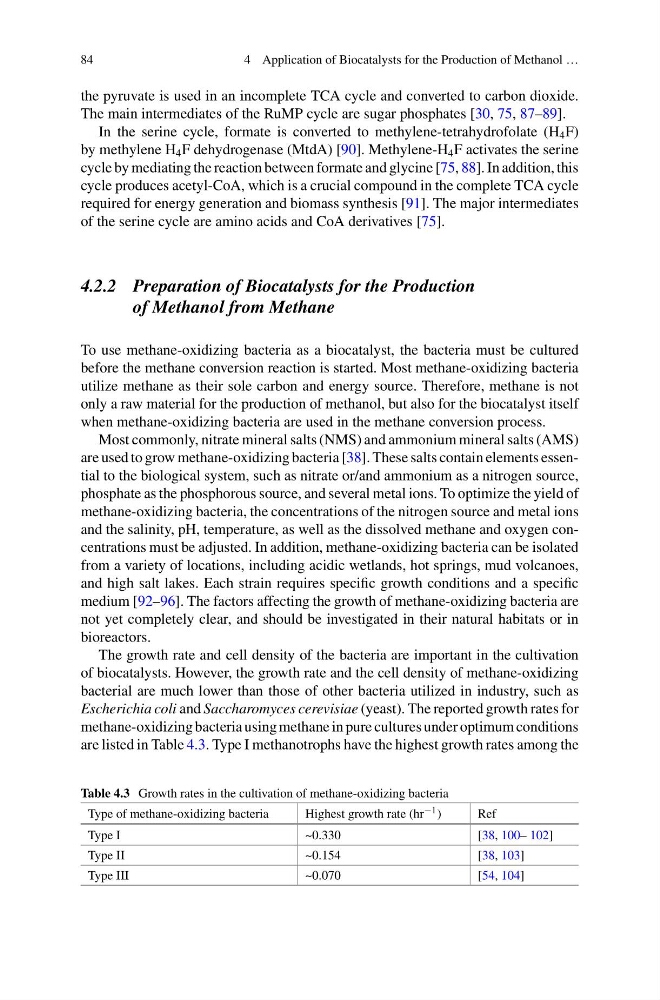
The growth rate and cell density of the bacteria are important in the cultivation
of biocatalysts. However, the growth rate and the cell density of methane-oxidizing
bacterial are much lower than those of other bacteria utilized in industry, such as
Escherichia coli and Saccharomyces cerevisiae (yeast). The reported growth rates for
methane-oxidizing bacteria using methane in pure cultures under optimum conditions
are listed in Table 4.3. Type I methanotrophs have the highest growth rates among the
Table 4.3 Growth rates in the cultivation of methane-oxidizing bacteria
Type of methane-oxidizing bacteria
Highest growth rate (hr −1 )
Ref
Type I
~0.330
[38, 100– 102]
Type II
~0.154
[38, 103]
Type III
~0.070
[54, 104]
4 Application of Biocatalysts for the Production of Methanol …
the pyruvate is used in an incomplete TCA cycle and converted to carbon dioxide.
The main intermediates of the RuMP cycle are sugar phosphates [30, 75, 87–89].
In the serine cycle, formate is converted to methylene-tetrahydrofolate (H 4 F)
by methylene H 4 F dehydrogenase (MtdA) [90]. Methylene-H 4 F activates the serine
cycle by mediating the reaction between formate and glycine [75, 88]. In addition, this
cycle produces acetyl-CoA, which is a crucial compound in the complete TCA cycle
required for energy generation and biomass synthesis [91]. The major intermediates
of the serine cycle are amino acids and CoA derivatives [75].
4.2.2 Preparation of Biocatalysts for the Production
of Methanol from Methane
To use methane-oxidizing bacteria as a biocatalyst, the bacteria must be cultured
before the methane conversion reaction is started. Most methane-oxidizing bacteria
utilize methane as their sole carbon and energy source. Therefore, methane is not
only a raw material for the production of methanol, but also for the biocatalyst itself
when methane-oxidizing bacteria are used in the methane conversion process.
Most commonly, nitrate mineral salts (NMS) and ammonium mineral salts (AMS)
are used to grow methane-oxidizing bacteria [38]. These salts contain elements essential to the biological system, such as nitrate or/and ammonium as a nitrogen source,
phosphate as the phosphorous source, and several metal ions. To optimize the yield of
methane-oxidizing bacteria, the concentrations of the nitrogen source and metal ions
and the salinity, pH, temperature, as well as the dissolved methane and oxygen concentrations must be adjusted. In addition, methane-oxidizing bacteria can be isolated
from a variety of locations, including acidic wetlands, hot springs, mud volcanoes,
and high salt lakes. Each strain requires specific growth conditions and a specific
medium [92–96]. The factors affecting the growth of methane-oxidizing bacteria are
not yet completely clear, and should be investigated in their natural habitats or in
bioreactors.
The growth rate and cell density of the bacteria are important in the cultivation
of biocatalysts. However, the growth rate and the cell density of methane-oxidizing
bacterial are much lower than those of other bacteria utilized in industry, such as
Escherichia coli and Saccharomyces cerevisiae (yeast). The reported growth rates for
methane-oxidizing bacteria using methane in pure cultures under optimum conditions
are listed in Table 4.3. Type I methanotrophs have the highest growth rates among the
Table 4.3 Growth rates in the cultivation of methane-oxidizing bacteria
Type of methane-oxidizing bacteria
Highest growth rate (hr −1 )
Ref
Type I
~0.330
[38, 100– 102]
Type II
~0.154
[38, 103]
Type III
~0.070
[54, 104]