

76
4 Application of Biocatalysts for the Production of Methanol …
but also electron donors to supply the energy needs of the bacterial cells must be
utilized in biocatalytic methanol production.
Thus, an understanding of bacterial methane metabolism is crucial to develop
practical methanol production processes using whole-cell biocatalysts. Therefore,
this section describes how methane is metabolized in methane-oxidizing bacteria,
though the current understanding of their metabolism remains incomplete. Subsequently, the development of methanol production processes using biocatalysts is
described.
4.2 Methane Metabolism in Methane-Oxidizing Bacteria
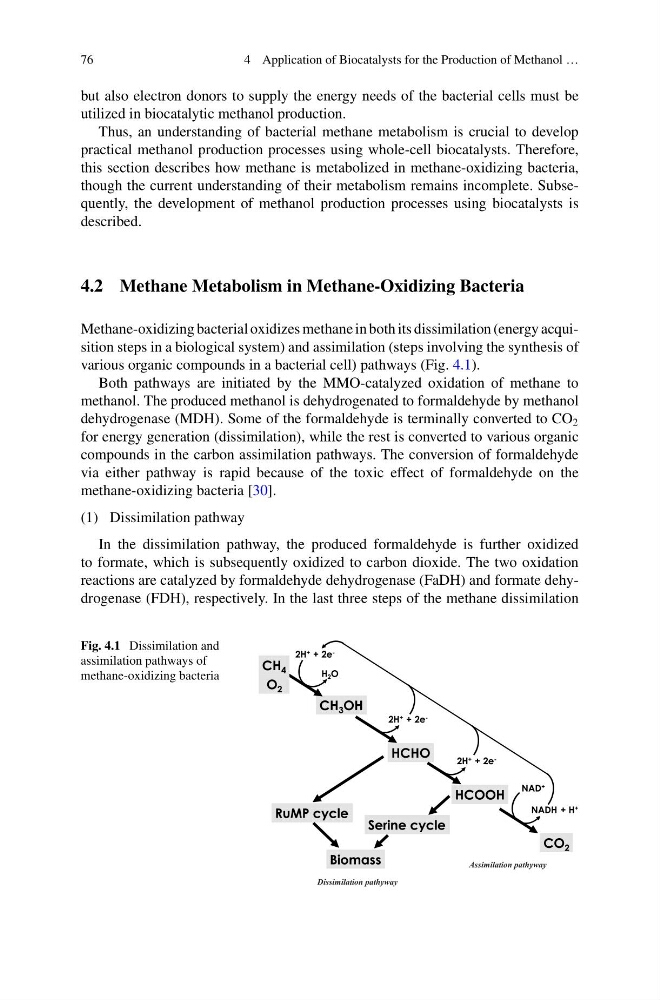
Methane-oxidizing bacterial oxidizes methane in both its dissimilation (energy acquisition steps in a biological system) and assimilation (steps involving the synthesis of
various organic compounds in a bacterial cell) pathways (Fig. 4.1).
Both pathways are initiated by the MMO-catalyzed oxidation of methane to
methanol. The produced methanol is dehydrogenated to formaldehyde by methanol
dehydrogenase (MDH). Some of the formaldehyde is terminally converted to CO 2
for energy generation (dissimilation), while the rest is converted to various organic
compounds in the carbon assimilation pathways. The conversion of formaldehyde
via either pathway is rapid because of the toxic effect of formaldehyde on the
methane-oxidizing bacteria [30].
(1) Dissimilation pathway
In the dissimilation pathway, the produced formaldehyde is further oxidized
to formate, which is subsequently oxidized to carbon dioxide. The two oxidation
reactions are catalyzed by formaldehyde dehydrogenase (FaDH) and formate dehydrogenase (FDH), respectively. In the last three steps of the methane dissimilation
Fig. 4.1 Dissimilation and
assimilation pathways of
methane-oxidizing bacteria
4 Application of Biocatalysts for the Production of Methanol …
but also electron donors to supply the energy needs of the bacterial cells must be
utilized in biocatalytic methanol production.
Thus, an understanding of bacterial methane metabolism is crucial to develop
practical methanol production processes using whole-cell biocatalysts. Therefore,
this section describes how methane is metabolized in methane-oxidizing bacteria,
though the current understanding of their metabolism remains incomplete. Subsequently, the development of methanol production processes using biocatalysts is
described.
4.2 Methane Metabolism in Methane-Oxidizing Bacteria
Methane-oxidizing bacterial oxidizes methane in both its dissimilation (energy acquisition steps in a biological system) and assimilation (steps involving the synthesis of
various organic compounds in a bacterial cell) pathways (Fig. 4.1).
Both pathways are initiated by the MMO-catalyzed oxidation of methane to
methanol. The produced methanol is dehydrogenated to formaldehyde by methanol
dehydrogenase (MDH). Some of the formaldehyde is terminally converted to CO 2
for energy generation (dissimilation), while the rest is converted to various organic
compounds in the carbon assimilation pathways. The conversion of formaldehyde
via either pathway is rapid because of the toxic effect of formaldehyde on the
methane-oxidizing bacteria [30].
(1) Dissimilation pathway
In the dissimilation pathway, the produced formaldehyde is further oxidized
to formate, which is subsequently oxidized to carbon dioxide. The two oxidation
reactions are catalyzed by formaldehyde dehydrogenase (FaDH) and formate dehydrogenase (FDH), respectively. In the last three steps of the methane dissimilation
Fig. 4.1 Dissimilation and
assimilation pathways of
methane-oxidizing bacteria