

2.2 sMMO
37
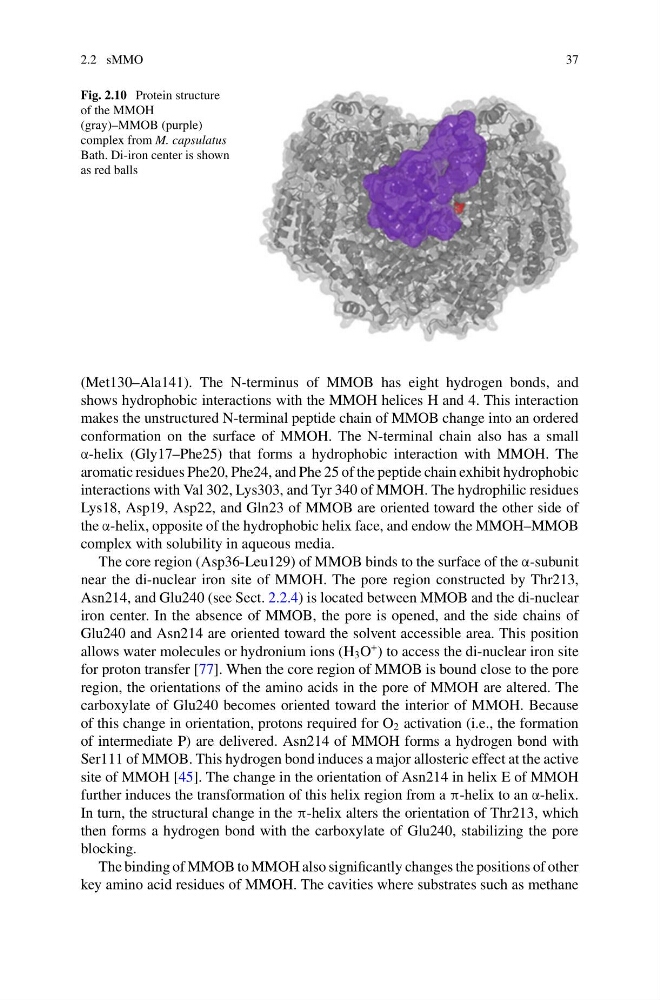
Fig. 2.10 Protein structure
of the MMOH
(gray)–MMOB (purple)
complex from M. capsulatus
Bath. Di-iron center is shown
as red balls
(Met130–Ala141). The N-terminus of MMOB has eight hydrogen bonds, and
shows hydrophobic interactions with the MMOH helices H and 4. This interaction
makes the unstructured N-terminal peptide chain of MMOB change into an ordered
conformation on the surface of MMOH. The N-terminal chain also has a small
α-helix (Gly17–Phe25) that forms a hydrophobic interaction with MMOH. The
aromatic residues Phe20, Phe24, and Phe 25 of the peptide chain exhibit hydrophobic
interactions with Val 302, Lys303, and Tyr 340 of MMOH. The hydrophilic residues
Lys18, Asp19, Asp22, and Gln23 of MMOB are oriented toward the other side of
the α-helix, opposite of the hydrophobic helix face, and endow the MMOH–MMOB
complex with solubility in aqueous media.
The core region (Asp36-Leu129) of MMOB binds to the surface of the α-subunit
near the di-nuclear iron site of MMOH. The pore region constructed by Thr213,
Asn214, and Glu240 (see Sect. 2.2.4) is located between MMOB and the di-nuclear
iron center. In the absence of MMOB, the pore is opened, and the side chains of
Glu240 and Asn214 are oriented toward the solvent accessible area. This position
allows water molecules or hydronium ions (H 3 O
+ ) to access the di-nuclear iron site
for proton transfer [77]. When the core region of MMOB is bound close to the pore
region, the orientations of the amino acids in the pore of MMOH are altered. The
carboxylate of Glu240 becomes oriented toward the interior of MMOH. Because
of this change in orientation, protons required for O 2 activation (i.e., the formation
of intermediate P) are delivered. Asn214 of MMOH forms a hydrogen bond with
Ser111 of MMOB. This hydrogen bond induces a major allosteric effect at the active
site of MMOH [45]. The change in the orientation of Asn214 in helix E of MMOH
further induces the transformation of this helix region from a π-helix to an α-helix.
In turn, the structural change in the π-helix alters the orientation of Thr213, which
then forms a hydrogen bond with the carboxylate of Glu240, stabilizing the pore
blocking.
The binding of MMOB to MMOH also significantly changes the positions of other
key amino acid residues of MMOH. The cavities where substrates such as methane
37
Fig. 2.10 Protein structure
of the MMOH
(gray)–MMOB (purple)
complex from M. capsulatus
Bath. Di-iron center is shown
as red balls
(Met130–Ala141). The N-terminus of MMOB has eight hydrogen bonds, and
shows hydrophobic interactions with the MMOH helices H and 4. This interaction
makes the unstructured N-terminal peptide chain of MMOB change into an ordered
conformation on the surface of MMOH. The N-terminal chain also has a small
α-helix (Gly17–Phe25) that forms a hydrophobic interaction with MMOH. The
aromatic residues Phe20, Phe24, and Phe 25 of the peptide chain exhibit hydrophobic
interactions with Val 302, Lys303, and Tyr 340 of MMOH. The hydrophilic residues
Lys18, Asp19, Asp22, and Gln23 of MMOB are oriented toward the other side of
the α-helix, opposite of the hydrophobic helix face, and endow the MMOH–MMOB
complex with solubility in aqueous media.
The core region (Asp36-Leu129) of MMOB binds to the surface of the α-subunit
near the di-nuclear iron site of MMOH. The pore region constructed by Thr213,
Asn214, and Glu240 (see Sect. 2.2.4) is located between MMOB and the di-nuclear
iron center. In the absence of MMOB, the pore is opened, and the side chains of
Glu240 and Asn214 are oriented toward the solvent accessible area. This position
allows water molecules or hydronium ions (H 3 O
+ ) to access the di-nuclear iron site
for proton transfer [77]. When the core region of MMOB is bound close to the pore
region, the orientations of the amino acids in the pore of MMOH are altered. The
carboxylate of Glu240 becomes oriented toward the interior of MMOH. Because
of this change in orientation, protons required for O 2 activation (i.e., the formation
of intermediate P) are delivered. Asn214 of MMOH forms a hydrogen bond with
Ser111 of MMOB. This hydrogen bond induces a major allosteric effect at the active
site of MMOH [45]. The change in the orientation of Asn214 in helix E of MMOH
further induces the transformation of this helix region from a π-helix to an α-helix.
In turn, the structural change in the π-helix alters the orientation of Thr213, which
then forms a hydrogen bond with the carboxylate of Glu240, stabilizing the pore
blocking.
The binding of MMOB to MMOH also significantly changes the positions of other
key amino acid residues of MMOH. The cavities where substrates such as methane