

2.2 sMMO
35
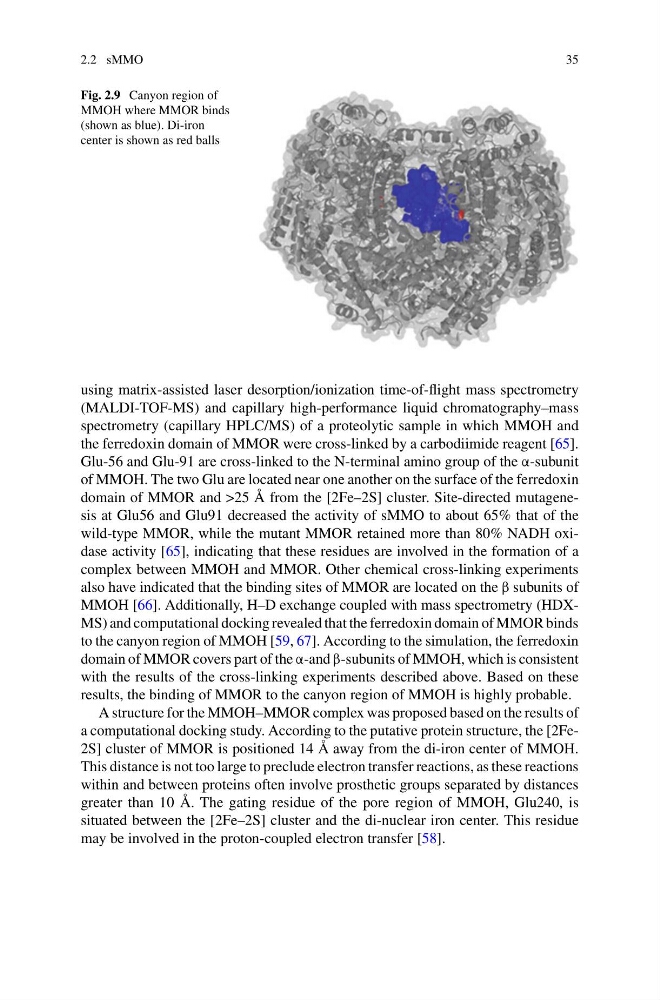
Fig. 2.9 Canyon region of
MMOH where MMOR binds
(shown as blue). Di-iron
center is shown as red balls
using matrix-assisted laser desorption/ionization time-of-flight mass spectrometry
(MALDI-TOF-MS) and capillary high-performance liquid chromatography–mass
spectrometry (capillary HPLC/MS) of a proteolytic sample in which MMOH and
the ferredoxin domain of MMOR were cross-linked by a carbodiimide reagent [65].
Glu-56 and Glu-91 are cross-linked to the N-terminal amino group of the α-subunit
of MMOH. The two Glu are located near one another on the surface of the ferredoxin
domain of MMOR and >25 Å from the [2Fe–2S] cluster. Site-directed mutagenesis at Glu56 and Glu91 decreased the activity of sMMO to about 65% that of the
wild-type MMOR, while the mutant MMOR retained more than 80% NADH oxidase activity [65], indicating that these residues are involved in the formation of a
complex between MMOH and MMOR. Other chemical cross-linking experiments
also have indicated that the binding sites of MMOR are located on the β subunits of
MMOH [66]. Additionally, H–D exchange coupled with mass spectrometry (HDXMS) and computational docking revealed that the ferredoxin domain of MMOR binds
to the canyon region of MMOH [59, 67]. According to the simulation, the ferredoxin
domain of MMOR covers part of the α-and β-subunits of MMOH, which is consistent
with the results of the cross-linking experiments described above. Based on these
results, the binding of MMOR to the canyon region of MMOH is highly probable.
A structure for the MMOH–MMOR complex was proposed based on the results of
a computational docking study. According to the putative protein structure, the [2Fe2S] cluster of MMOR is positioned 14 Å away from the di-iron center of MMOH.
This distance is not too large to preclude electron transfer reactions, as these reactions
within and between proteins often involve prosthetic groups separated by distances
greater than 10 Å. The gating residue of the pore region of MMOH, Glu240, is
situated between the [2Fe–2S] cluster and the di-nuclear iron center. This residue
may be involved in the proton-coupled electron transfer [58].
35
Fig. 2.9 Canyon region of
MMOH where MMOR binds
(shown as blue). Di-iron
center is shown as red balls
using matrix-assisted laser desorption/ionization time-of-flight mass spectrometry
(MALDI-TOF-MS) and capillary high-performance liquid chromatography–mass
spectrometry (capillary HPLC/MS) of a proteolytic sample in which MMOH and
the ferredoxin domain of MMOR were cross-linked by a carbodiimide reagent [65].
Glu-56 and Glu-91 are cross-linked to the N-terminal amino group of the α-subunit
of MMOH. The two Glu are located near one another on the surface of the ferredoxin
domain of MMOR and >25 Å from the [2Fe–2S] cluster. Site-directed mutagenesis at Glu56 and Glu91 decreased the activity of sMMO to about 65% that of the
wild-type MMOR, while the mutant MMOR retained more than 80% NADH oxidase activity [65], indicating that these residues are involved in the formation of a
complex between MMOH and MMOR. Other chemical cross-linking experiments
also have indicated that the binding sites of MMOR are located on the β subunits of
MMOH [66]. Additionally, H–D exchange coupled with mass spectrometry (HDXMS) and computational docking revealed that the ferredoxin domain of MMOR binds
to the canyon region of MMOH [59, 67]. According to the simulation, the ferredoxin
domain of MMOR covers part of the α-and β-subunits of MMOH, which is consistent
with the results of the cross-linking experiments described above. Based on these
results, the binding of MMOR to the canyon region of MMOH is highly probable.
A structure for the MMOH–MMOR complex was proposed based on the results of
a computational docking study. According to the putative protein structure, the [2Fe2S] cluster of MMOR is positioned 14 Å away from the di-iron center of MMOH.
This distance is not too large to preclude electron transfer reactions, as these reactions
within and between proteins often involve prosthetic groups separated by distances
greater than 10 Å. The gating residue of the pore region of MMOH, Glu240, is
situated between the [2Fe–2S] cluster and the di-nuclear iron center. This residue
may be involved in the proton-coupled electron transfer [58].