

10
1 Overview of Direct Methane Conversion to Chemicals …
Although Ag
+ -exchanged zeolites (Ag-zeolites) can catalyze the reaction of
methane with alkenes (e.g., C 2 H 4 ) and aromatic hydrocarbons (e.g., benzene),
as shown in reactions (1.11) and (1.12), respectively, they cannot catalyze the
self-coupling of methane shown in reaction (1.10) [58, 59].
CH 4 + C 2 H 4
C 3 H 6 + H 2
(1.11)
CH 4 +
+ H 2
CH 3
(1.12)
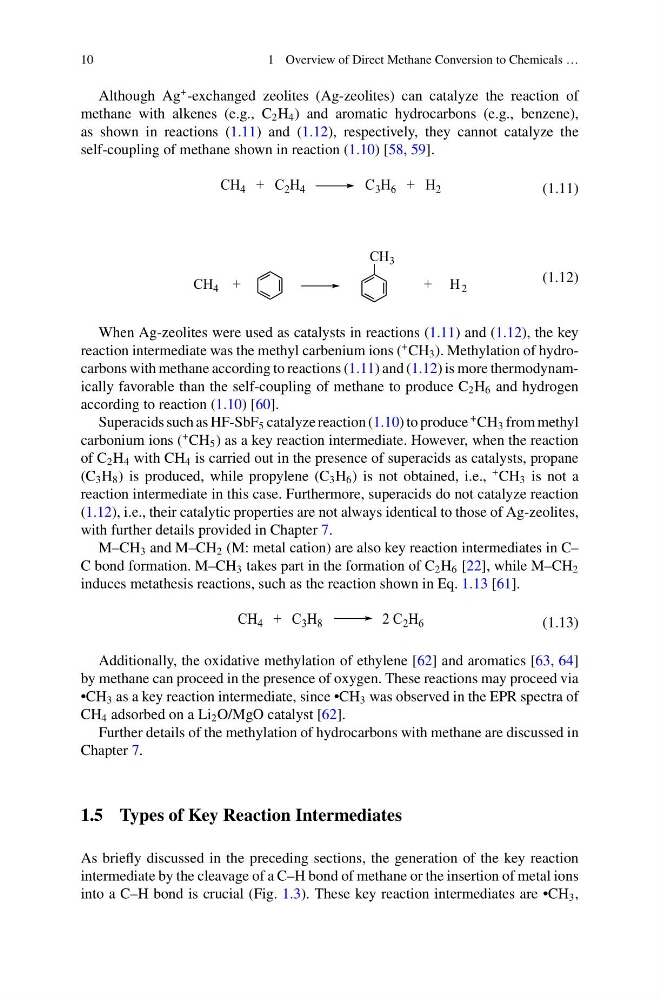
When Ag-zeolites were used as catalysts in reactions (1.11) and (1.12), the key
reaction intermediate was the methyl carbenium ions (
+ CH 3 ). Methylation of hydrocarbons with methane according to reactions (1.11) and (1.12) is more thermodynamically favorable than the self-coupling of methane to produce C 2 H 6 and hydrogen
according to reaction (1.10) [60].
Superacids such as HF-SbF 5 catalyze reaction (1.10) to produce
+ CH 3 from methyl
carbonium ions (
+ CH 5 ) as a key reaction intermediate. However, when the reaction
of C 2 H 4 with CH 4 is carried out in the presence of superacids as catalysts, propane
(C 3 H 8 ) is produced, while propylene (C 3 H 6 ) is not obtained, i.e.,
+ CH 3 is not a
reaction intermediate in this case. Furthermore, superacids do not catalyze reaction
(1.12), i.e., their catalytic properties are not always identical to those of Ag-zeolites,
with further details provided in Chapter 7.
M–CH 3 and M–CH 2 (M: metal cation) are also key reaction intermediates in C–
C bond formation. M–CH 3 takes part in the formation of C 2 H 6 [22], while M–CH 2
induces metathesis reactions, such as the reaction shown in Eq. 1.13 [61].
CH 4 + C 3 H 8
2 C 2 H 6
(1.13)
Additionally, the oxidative methylation of ethylene [62] and aromatics [63, 64]
by methane can proceed in the presence of oxygen. These reactions may proceed via
•CH 3 as a key reaction intermediate, since •CH 3 was observed in the EPR spectra of
CH 4 adsorbed on a Li 2 O/MgO catalyst [62].
Further details of the methylation of hydrocarbons with methane are discussed in
Chapter 7.
1.5 Types of Key Reaction Intermediates
As briefly discussed in the preceding sections, the generation of the key reaction
intermediate by the cleavage of a C–H bond of methane or the insertion of metal ions
into a C–H bond is crucial (Fig. 1.3). These key reaction intermediates are •CH 3 ,
1 Overview of Direct Methane Conversion to Chemicals …
Although Ag
+ -exchanged zeolites (Ag-zeolites) can catalyze the reaction of
methane with alkenes (e.g., C 2 H 4 ) and aromatic hydrocarbons (e.g., benzene),
as shown in reactions (1.11) and (1.12), respectively, they cannot catalyze the
self-coupling of methane shown in reaction (1.10) [58, 59].
CH 4 + C 2 H 4
C 3 H 6 + H 2
(1.11)
CH 4 +
+ H 2
CH 3
(1.12)
When Ag-zeolites were used as catalysts in reactions (1.11) and (1.12), the key
reaction intermediate was the methyl carbenium ions (
+ CH 3 ). Methylation of hydrocarbons with methane according to reactions (1.11) and (1.12) is more thermodynamically favorable than the self-coupling of methane to produce C 2 H 6 and hydrogen
according to reaction (1.10) [60].
Superacids such as HF-SbF 5 catalyze reaction (1.10) to produce
+ CH 3 from methyl
carbonium ions (
+ CH 5 ) as a key reaction intermediate. However, when the reaction
of C 2 H 4 with CH 4 is carried out in the presence of superacids as catalysts, propane
(C 3 H 8 ) is produced, while propylene (C 3 H 6 ) is not obtained, i.e.,
+ CH 3 is not a
reaction intermediate in this case. Furthermore, superacids do not catalyze reaction
(1.12), i.e., their catalytic properties are not always identical to those of Ag-zeolites,
with further details provided in Chapter 7.
M–CH 3 and M–CH 2 (M: metal cation) are also key reaction intermediates in C–
C bond formation. M–CH 3 takes part in the formation of C 2 H 6 [22], while M–CH 2
induces metathesis reactions, such as the reaction shown in Eq. 1.13 [61].
CH 4 + C 3 H 8
2 C 2 H 6
(1.13)
Additionally, the oxidative methylation of ethylene [62] and aromatics [63, 64]
by methane can proceed in the presence of oxygen. These reactions may proceed via
•CH 3 as a key reaction intermediate, since •CH 3 was observed in the EPR spectra of
CH 4 adsorbed on a Li 2 O/MgO catalyst [62].
Further details of the methylation of hydrocarbons with methane are discussed in
Chapter 7.
1.5 Types of Key Reaction Intermediates
As briefly discussed in the preceding sections, the generation of the key reaction
intermediate by the cleavage of a C–H bond of methane or the insertion of metal ions
into a C–H bond is crucial (Fig. 1.3). These key reaction intermediates are •CH 3 ,