

204
7 C–C Bond Formation via Carbocations in the Methane …
Based on the above activation mechanism, which is valid for lower alkanes other
than methane, Ono et al. examined the primary reactions in the cracking of n-butane
over H-ZSM-5 at 773 K [92, 93]. They carried out the reaction at a low n-butane
pressure of 8.0 kPa, which resulted in an n-butane conversion of less than 5%, to
avoid the hydride-transfer reaction. Some of their experimental results (n-butane conversion and the selectivities of the produced hydrocarbons at different contact times
W /F) are shown in Table 7.8 [92]. CH 4 , C 2 H 6 , C 2 H 4 , C 3 H 8 , C 3 H 6 , C 4 H 8 (butanes),
and H 2 were produced as the reaction products, while C 5
+ (aliphatic hydrocarbons
with more than five carbon atoms) and aromatic hydrocarbons were not produced at
n-butane conversions lower than ~ 5.4%.
The authors proposed that the primary reaction products in n-butane conversion
could be determined by plotting the selectivities of the hydrocarbon products and H 2
against the n-butane conversion. In this manner, the relative rates of reaction products
in the primary reactions can be estimated by extrapolating the product selectivities
at zero conversion of n-butane. The estimated values are also shown in Table 7.8.
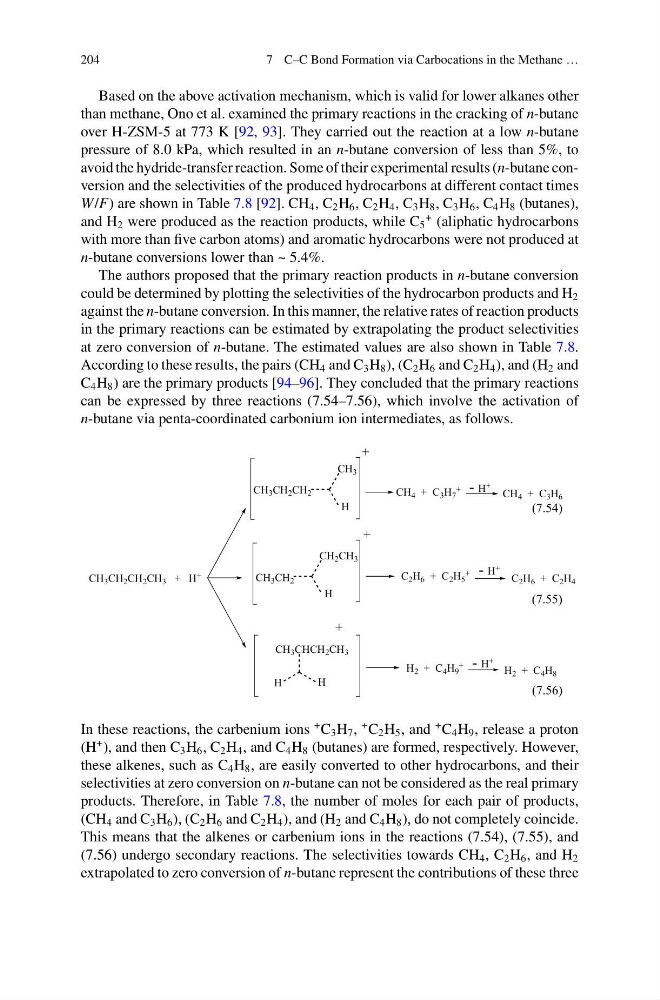
According to these results, the pairs (CH 4 and C 3 H 8 ), (C 2 H 6 and C 2 H 4 ), and (H 2 and
C 4 H 8 ) are the primary products [94–96]. They concluded that the primary reactions
can be expressed by three reactions (7.54–7.56), which involve the activation of
n-butane via penta-coordinated carbonium ion intermediates, as follows.
(7.54)
(7.55)
(7.56)
CH 3 CH 2 CH 2 CH 3 + H +
CH 3 CHCH 2 CH 3
CH 3 CH 2
CH 3 CH 2 CH 2
CH 3
CH 2 CH 3
H
H
H
H
+
+
+
CH 4 + C 3 H 7
+ - H +
- H +
C 2 H 6 + C 2 H 4
H 2 + C 4 H 8
CH 4 + C 3 H 6
C 2 H 6 + C 2 H 5
+
H 2 + C 4 H 9
+
- H +
In these reactions, the carbenium ions
+ C 3 H 7 ,
+ C 2 H 5 , and
+ C 4 H 9 , release a proton
(H
+ ), and then C 3 H 6 , C 2 H 4 , and C 4 H 8 (butanes) are formed, respectively. However,
these alkenes, such as C 4 H 8 , are easily converted to other hydrocarbons, and their
selectivities at zero conversion on n-butane can not be considered as the real primary
products. Therefore, in Table 7.8, the number of moles for each pair of products,
(CH 4 and C 3 H 6 ), (C 2 H 6 and C 2 H 4 ), and (H 2 and C 4 H 8 ), do not completely coincide.
This means that the alkenes or carbenium ions in the reactions (7.54), (7.55), and
(7.56) undergo secondary reactions. The selectivities towards CH 4 , C 2 H 6 , and H 2
extrapolated to zero conversion of n-butane represent the contributions of these three
7 C–C Bond Formation via Carbocations in the Methane …
Based on the above activation mechanism, which is valid for lower alkanes other
than methane, Ono et al. examined the primary reactions in the cracking of n-butane
over H-ZSM-5 at 773 K [92, 93]. They carried out the reaction at a low n-butane
pressure of 8.0 kPa, which resulted in an n-butane conversion of less than 5%, to
avoid the hydride-transfer reaction. Some of their experimental results (n-butane conversion and the selectivities of the produced hydrocarbons at different contact times
W /F) are shown in Table 7.8 [92]. CH 4 , C 2 H 6 , C 2 H 4 , C 3 H 8 , C 3 H 6 , C 4 H 8 (butanes),
and H 2 were produced as the reaction products, while C 5
+ (aliphatic hydrocarbons
with more than five carbon atoms) and aromatic hydrocarbons were not produced at
n-butane conversions lower than ~ 5.4%.
The authors proposed that the primary reaction products in n-butane conversion
could be determined by plotting the selectivities of the hydrocarbon products and H 2
against the n-butane conversion. In this manner, the relative rates of reaction products
in the primary reactions can be estimated by extrapolating the product selectivities
at zero conversion of n-butane. The estimated values are also shown in Table 7.8.
According to these results, the pairs (CH 4 and C 3 H 8 ), (C 2 H 6 and C 2 H 4 ), and (H 2 and
C 4 H 8 ) are the primary products [94–96]. They concluded that the primary reactions
can be expressed by three reactions (7.54–7.56), which involve the activation of
n-butane via penta-coordinated carbonium ion intermediates, as follows.
(7.54)
(7.55)
(7.56)
CH 3 CH 2 CH 2 CH 3 + H +
CH 3 CHCH 2 CH 3
CH 3 CH 2
CH 3 CH 2 CH 2
CH 3
CH 2 CH 3
H
H
H
H
+
+
+
CH 4 + C 3 H 7
+ - H +
- H +
C 2 H 6 + C 2 H 4
H 2 + C 4 H 8
CH 4 + C 3 H 6
C 2 H 6 + C 2 H 5
+
H 2 + C 4 H 9
+
- H +
In these reactions, the carbenium ions
+ C 3 H 7 ,
+ C 2 H 5 , and
+ C 4 H 9 , release a proton
(H
+ ), and then C 3 H 6 , C 2 H 4 , and C 4 H 8 (butanes) are formed, respectively. However,
these alkenes, such as C 4 H 8 , are easily converted to other hydrocarbons, and their
selectivities at zero conversion on n-butane can not be considered as the real primary
products. Therefore, in Table 7.8, the number of moles for each pair of products,
(CH 4 and C 3 H 6 ), (C 2 H 6 and C 2 H 4 ), and (H 2 and C 4 H 8 ), do not completely coincide.
This means that the alkenes or carbenium ions in the reactions (7.54), (7.55), and
(7.56) undergo secondary reactions. The selectivities towards CH 4 , C 2 H 6 , and H 2
extrapolated to zero conversion of n-butane represent the contributions of these three