

200
7 C–C Bond Formation via Carbocations in the Methane …
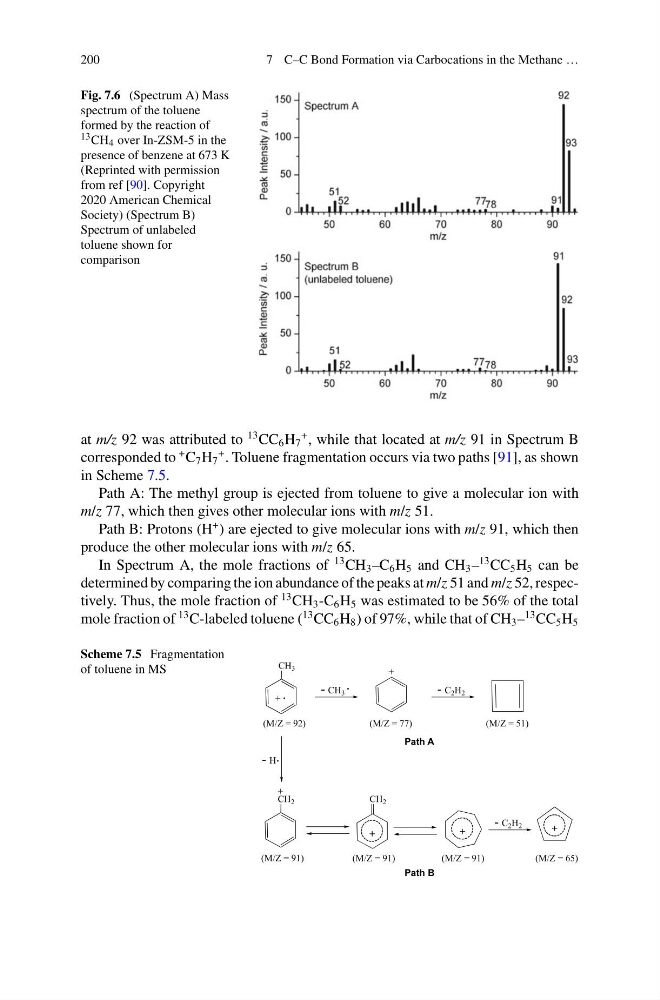
Fig. 7.6 (Spectrum A) Mass
spectrum of the toluene
formed by the reaction of
13 CH 4 over In-ZSM-5 in the
presence of benzene at 673 K
(Reprinted with permission
from ref [90]. Copyright
2020 American Chemical
Society) (Spectrum B)
Spectrum of unlabeled
toluene shown for
comparison
at m/z 92 was attributed to
13 CC 6 H 7
+ , while that located at m/z 91 in Spectrum B
corresponded to
+ C 7 H 7
+ . Toluene fragmentation occurs via two paths [91], as shown
in Scheme 7.5.
Path A: The methyl group is ejected from toluene to give a molecular ion with
m/z 77, which then gives other molecular ions with m/z 51.
Path B: Protons (H
+ ) are ejected to give molecular ions with m/z 91, which then
produce the other molecular ions with m/z 65.
In Spectrum A, the mole fractions of
13 CH 3 –C 6 H 5 and CH 3 –
13 CC 5 H 5 can be
determined by comparing the ion abundance of the peaks at m/z 51 and m/z 52, respectively. Thus, the mole fraction of
13 CH 3 -C 6 H 5 was estimated to be 56% of the total
mole fraction of
13 C-labeled toluene (
13 CC 6 H 8 ) of 97%, while that of CH 3 –
13 CC 5 H 5
Scheme 7.5 Fragmentation
of toluene in MS
CH 3
+
(M/Z = 92)
- H
CH 2
+
- CH 3
+
(M/Z = 91)
(M/Z = 77)
- C 2 H 2
(M/Z = 51)
CH 2
- C 2 H 2
(M/Z = 91)
(M/Z = 91)
(M/Z = 65)
Path A
Path B
+
+
+
7 C–C Bond Formation via Carbocations in the Methane …
Fig. 7.6 (Spectrum A) Mass
spectrum of the toluene
formed by the reaction of
13 CH 4 over In-ZSM-5 in the
presence of benzene at 673 K
(Reprinted with permission
from ref [90]. Copyright
2020 American Chemical
Society) (Spectrum B)
Spectrum of unlabeled
toluene shown for
comparison
at m/z 92 was attributed to
13 CC 6 H 7
+ , while that located at m/z 91 in Spectrum B
corresponded to
+ C 7 H 7
+ . Toluene fragmentation occurs via two paths [91], as shown
in Scheme 7.5.
Path A: The methyl group is ejected from toluene to give a molecular ion with
m/z 77, which then gives other molecular ions with m/z 51.
Path B: Protons (H
+ ) are ejected to give molecular ions with m/z 91, which then
produce the other molecular ions with m/z 65.
In Spectrum A, the mole fractions of
13 CH 3 –C 6 H 5 and CH 3 –
13 CC 5 H 5 can be
determined by comparing the ion abundance of the peaks at m/z 51 and m/z 52, respectively. Thus, the mole fraction of
13 CH 3 -C 6 H 5 was estimated to be 56% of the total
mole fraction of
13 C-labeled toluene (
13 CC 6 H 8 ) of 97%, while that of CH 3 –
13 CC 5 H 5
Scheme 7.5 Fragmentation
of toluene in MS
CH 3
+
(M/Z = 92)
- H
CH 2
+
- CH 3
+
(M/Z = 91)
(M/Z = 77)
- C 2 H 2
(M/Z = 51)
CH 2
- C 2 H 2
(M/Z = 91)
(M/Z = 91)
(M/Z = 65)
Path A
Path B
+
+
+