

166
7 C–C Bond Formation via Carbocations in the Methane …
of CH 4 with other hydrocarbons (alkenes, alkanes, and aromatics) are thermodynamically more favorable than polycondensations of methane, such as MDA, under
non-oxidative reaction conditions [5].
This chapter focuses on the activation of methane for the formation of C–C bonds
via the reaction of methane with itself or various hydrocarbons such as ethylene and
benzene. The mechanisms for the activation of methane and the subsequent C–C
bond formation, along with the role of the catalysts in these reactions, will be the
main topics of discussion.
7.2 Superacid Catalysts for the Activation of CH 4
and Other Lower Alkanes for C–C Bond Formation
Olah et al. reported the conversion of methane to higher molecular weight hydrocarbons (higher hydrocarbons) via the treatment of CH 4 either at 423 K in an autoclave
with a ten-fold excess of 1:1 FSO 3 H-SbF 5 solution or at 413 K under atmospheric
pressure [1]. In the following sections, the catalytic properties of superacids and their
role in the catalytic activation of C–H bonds in CH 4 and other alkanes are discussed.
7.2.1 Definition of Brønsted Superacids
As mentioned above, superacids have been shown to catalyze the conversion of
methane into higher hydrocarbons. In this section, the chemical properties of
superacids will first be discussed. A Brønsted superacid is defined as an acid whose
acid strength is at least 100 times stronger than that of 100% sulfuric acid (H 2 SO 4 )
[6, 7]. However, the acid strength referred to in this definition is arbitrary, as the
concept of acid strength is only defined in relation to a reference base. Among the
various methods to measure the acid strength, the Hammett acidity function (H 0 )
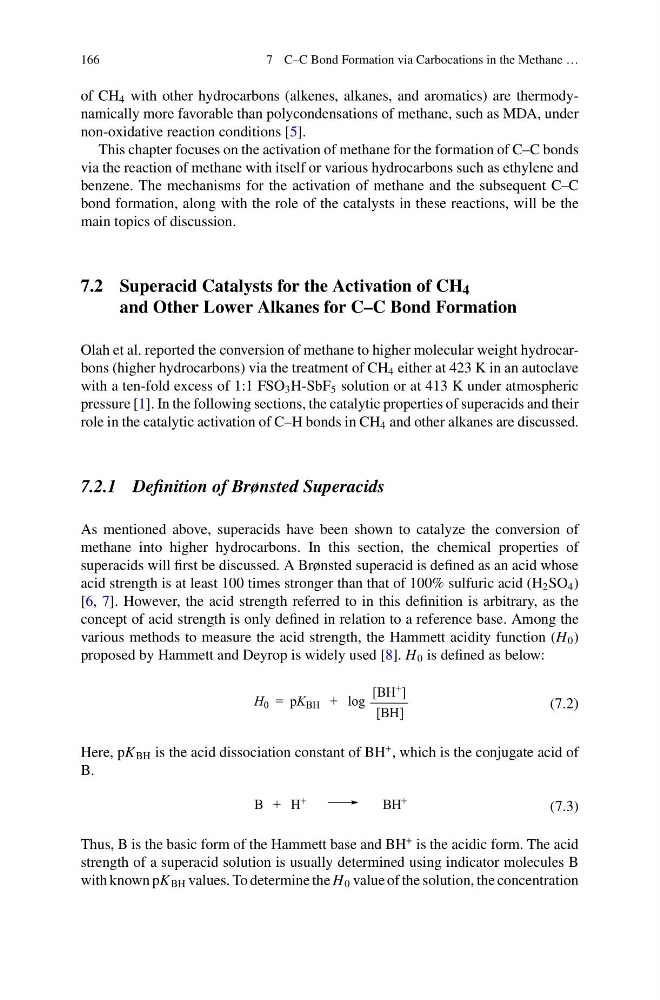
proposed by Hammett and Deyrop is widely used [8]. H 0 is defined as below:
H 0 = pK BH + log
[BH + ]
[BH]
(7.2)
Here, pK BH is the acid dissociation constant of BH
+ , which is the conjugate acid of
B.
B + H +
BH +
(7.3)
Thus, B is the basic form of the Hammett base and BH
+ is the acidic form. The acid
strength of a superacid solution is usually determined using indicator molecules B
with known pK BH values. To determine the H 0 value of the solution, the concentration
7 C–C Bond Formation via Carbocations in the Methane …
of CH 4 with other hydrocarbons (alkenes, alkanes, and aromatics) are thermodynamically more favorable than polycondensations of methane, such as MDA, under
non-oxidative reaction conditions [5].
This chapter focuses on the activation of methane for the formation of C–C bonds
via the reaction of methane with itself or various hydrocarbons such as ethylene and
benzene. The mechanisms for the activation of methane and the subsequent C–C
bond formation, along with the role of the catalysts in these reactions, will be the
main topics of discussion.
7.2 Superacid Catalysts for the Activation of CH 4
and Other Lower Alkanes for C–C Bond Formation
Olah et al. reported the conversion of methane to higher molecular weight hydrocarbons (higher hydrocarbons) via the treatment of CH 4 either at 423 K in an autoclave
with a ten-fold excess of 1:1 FSO 3 H-SbF 5 solution or at 413 K under atmospheric
pressure [1]. In the following sections, the catalytic properties of superacids and their
role in the catalytic activation of C–H bonds in CH 4 and other alkanes are discussed.
7.2.1 Definition of Brønsted Superacids
As mentioned above, superacids have been shown to catalyze the conversion of
methane into higher hydrocarbons. In this section, the chemical properties of
superacids will first be discussed. A Brønsted superacid is defined as an acid whose
acid strength is at least 100 times stronger than that of 100% sulfuric acid (H 2 SO 4 )
[6, 7]. However, the acid strength referred to in this definition is arbitrary, as the
concept of acid strength is only defined in relation to a reference base. Among the
various methods to measure the acid strength, the Hammett acidity function (H 0 )
proposed by Hammett and Deyrop is widely used [8]. H 0 is defined as below:
H 0 = pK BH + log
[BH + ]
[BH]
(7.2)
Here, pK BH is the acid dissociation constant of BH
+ , which is the conjugate acid of
B.
B + H +
BH +
(7.3)
Thus, B is the basic form of the Hammett base and BH
+ is the acidic form. The acid
strength of a superacid solution is usually determined using indicator molecules B
with known pK BH values. To determine the H 0 value of the solution, the concentration