

6.5 Interaction of Mo Species with Brønsted …
147
Fig. 6.1 Structure of Mo
species (II) (Reprinted from
ref. [72], Copyright 2020,
with permission from
Elsevier)
Si
O
O
O
O
O
Al
O
O
Si
O
O
O
O
O
Al
O
O
O
Mo O
O
Mo
O
O
3.70 Å
d O-O
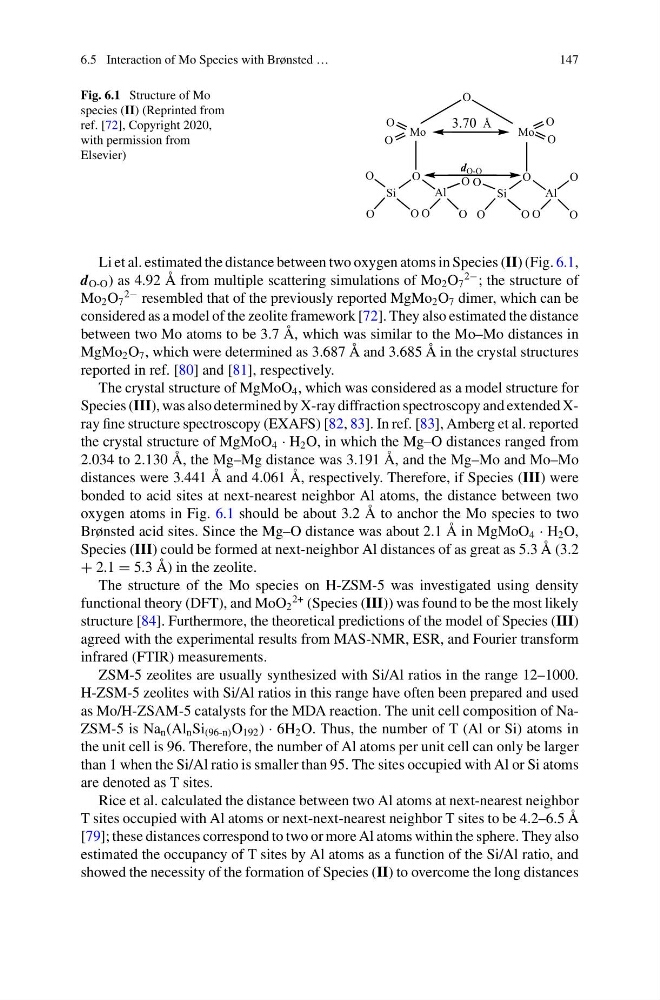
Li et al. estimated the distance between two oxygen atoms in Species (II) (Fig. 6.1,
d O-O ) as 4.92 Å from multiple scattering simulations of Mo 2 O 7
2− ; the structure of
Mo 2 O 7
2− resembled that of the previously reported MgMo 2 O 7 dimer, which can be
considered as a model of the zeolite framework [72]. They also estimated the distance
between two Mo atoms to be 3.7 Å, which was similar to the Mo–Mo distances in
MgMo 2 O 7 , which were determined as 3.687 Å and 3.685 Å in the crystal structures
reported in ref. [80] and [81], respectively.
The crystal structure of MgMoO 4 , which was considered as a model structure for
Species (III), was also determined by X-ray diffraction spectroscopy and extended Xray fine structure spectroscopy (EXAFS) [82, 83]. In ref. [83], Amberg et al. reported
the crystal structure of MgMoO 4 · H 2 O, in which the Mg–O distances ranged from
2.034 to 2.130 Å, the Mg–Mg distance was 3.191 Å, and the Mg–Mo and Mo–Mo
distances were 3.441 Å and 4.061 Å, respectively. Therefore, if Species (III) were
bonded to acid sites at next-nearest neighbor Al atoms, the distance between two
oxygen atoms in Fig. 6.1 should be about 3.2 Å to anchor the Mo species to two
Brønsted acid sites. Since the Mg–O distance was about 2.1 Å in MgMoO 4 · H 2 O,
Species (III) could be formed at next-neighbor Al distances of as great as 5.3 Å (3.2
+ 2.1 = 5.3 Å) in the zeolite.
The structure of the Mo species on H-ZSM-5 was investigated using density
functional theory (DFT), and MoO 2
2+ (Species (III)) was found to be the most likely
structure [84]. Furthermore, the theoretical predictions of the model of Species (III)
agreed with the experimental results from MAS-NMR, ESR, and Fourier transform
infrared (FTIR) measurements.
ZSM-5 zeolites are usually synthesized with Si/Al ratios in the range 12–1000.
H-ZSM-5 zeolites with Si/Al ratios in this range have often been prepared and used
as Mo/H-ZSAM-5 catalysts for the MDA reaction. The unit cell composition of NaZSM-5 is Na n (Al n Si (96-n) O 192 ) · 6H 2 O. Thus, the number of T (Al or Si) atoms in
the unit cell is 96. Therefore, the number of Al atoms per unit cell can only be larger
than 1 when the Si/Al ratio is smaller than 95. The sites occupied with Al or Si atoms
are denoted as T sites.
Rice et al. calculated the distance between two Al atoms at next-nearest neighbor
T sites occupied with Al atoms or next-next-nearest neighbor T sites to be 4.2–6.5 Å
[79]; these distances correspond to two or more Al atoms within the sphere. They also
estimated the occupancy of T sites by Al atoms as a function of the Si/Al ratio, and
showed the necessity of the formation of Species (II) to overcome the long distances
147
Fig. 6.1 Structure of Mo
species (II) (Reprinted from
ref. [72], Copyright 2020,
with permission from
Elsevier)
Si
O
O
O
O
O
Al
O
O
Si
O
O
O
O
O
Al
O
O
O
Mo O
O
Mo
O
O
3.70 Å
d O-O
Li et al. estimated the distance between two oxygen atoms in Species (II) (Fig. 6.1,
d O-O ) as 4.92 Å from multiple scattering simulations of Mo 2 O 7
2− ; the structure of
Mo 2 O 7
2− resembled that of the previously reported MgMo 2 O 7 dimer, which can be
considered as a model of the zeolite framework [72]. They also estimated the distance
between two Mo atoms to be 3.7 Å, which was similar to the Mo–Mo distances in
MgMo 2 O 7 , which were determined as 3.687 Å and 3.685 Å in the crystal structures
reported in ref. [80] and [81], respectively.
The crystal structure of MgMoO 4 , which was considered as a model structure for
Species (III), was also determined by X-ray diffraction spectroscopy and extended Xray fine structure spectroscopy (EXAFS) [82, 83]. In ref. [83], Amberg et al. reported
the crystal structure of MgMoO 4 · H 2 O, in which the Mg–O distances ranged from
2.034 to 2.130 Å, the Mg–Mg distance was 3.191 Å, and the Mg–Mo and Mo–Mo
distances were 3.441 Å and 4.061 Å, respectively. Therefore, if Species (III) were
bonded to acid sites at next-nearest neighbor Al atoms, the distance between two
oxygen atoms in Fig. 6.1 should be about 3.2 Å to anchor the Mo species to two
Brønsted acid sites. Since the Mg–O distance was about 2.1 Å in MgMoO 4 · H 2 O,
Species (III) could be formed at next-neighbor Al distances of as great as 5.3 Å (3.2
+ 2.1 = 5.3 Å) in the zeolite.
The structure of the Mo species on H-ZSM-5 was investigated using density
functional theory (DFT), and MoO 2
2+ (Species (III)) was found to be the most likely
structure [84]. Furthermore, the theoretical predictions of the model of Species (III)
agreed with the experimental results from MAS-NMR, ESR, and Fourier transform
infrared (FTIR) measurements.
ZSM-5 zeolites are usually synthesized with Si/Al ratios in the range 12–1000.
H-ZSM-5 zeolites with Si/Al ratios in this range have often been prepared and used
as Mo/H-ZSAM-5 catalysts for the MDA reaction. The unit cell composition of NaZSM-5 is Na n (Al n Si (96-n) O 192 ) · 6H 2 O. Thus, the number of T (Al or Si) atoms in
the unit cell is 96. Therefore, the number of Al atoms per unit cell can only be larger
than 1 when the Si/Al ratio is smaller than 95. The sites occupied with Al or Si atoms
are denoted as T sites.
Rice et al. calculated the distance between two Al atoms at next-nearest neighbor
T sites occupied with Al atoms or next-next-nearest neighbor T sites to be 4.2–6.5 Å
[79]; these distances correspond to two or more Al atoms within the sphere. They also
estimated the occupancy of T sites by Al atoms as a function of the Si/Al ratio, and
showed the necessity of the formation of Species (II) to overcome the long distances