

140
6 Conversion of Methane to Aromatic Hydrocarbons
constant at 17 [32]. This result shows that the ratio of the Mo/Brønsted acid sites
affects the production of aromatic hydrocarbons.
The results discussed above suggest that the Mo species interact with the acidic
protons (Brønsted acid sites) in the zeolites to produce active Mo species that act as
the catalytically active sites. This point will be discussed further in Sect. 6.5.
6.4.4 Catalytic Activities of H + -Exchanged Zeolites Modified
with Various Metal Species
In addition to Mo/H
+ -exchanged zeolites, H
+ -exchanged zeolites modified with other
metal species (Fe [33–36], V [33], Cr [33], W [33, 37, 38], Re [33, 39–41], Ru [42],
Zn [43, 44], Pt [45], and Mn [46]) have also been reported to catalyze the MDA
reaction to produce aromatic hydrocarbons. Many metal species (Fe [47–49], Ni
[50], Co [51], Cu [52, 53], Zn [54], Ga [55, 56], Pt [57, 58], Rh [58], W [59], Cr [60],
Ru [61], Zr [62], V [62], Ag [63], In [64], Li [65], and P [65]) have also been added
as promoters to improve the catalytic performances of Mo/H
+ -exchanged zeolites
(mainly H-ZSM-5).
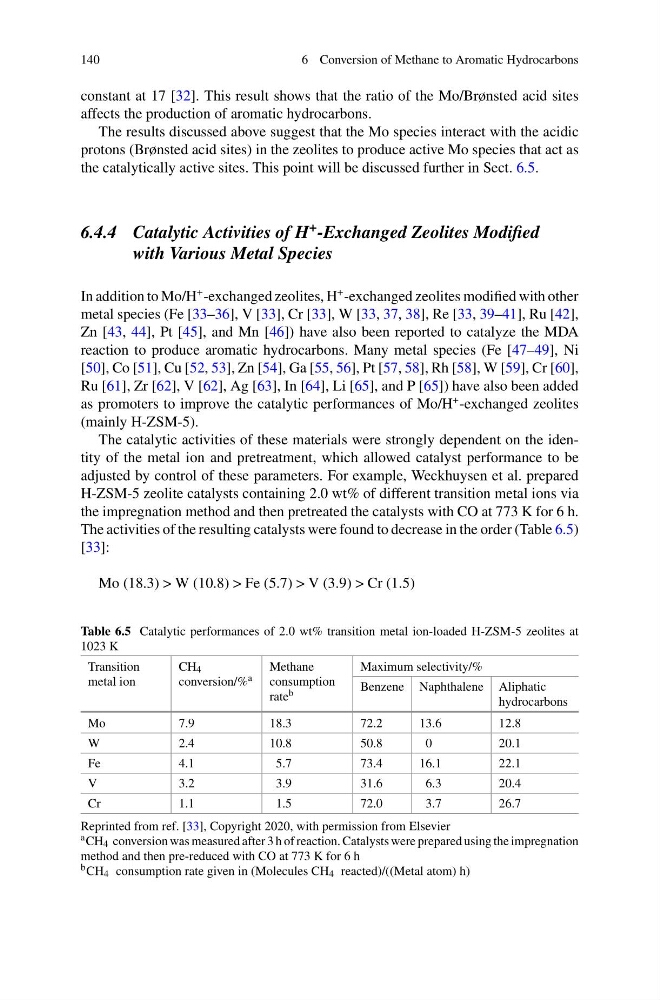
The catalytic activities of these materials were strongly dependent on the identity of the metal ion and pretreatment, which allowed catalyst performance to be
adjusted by control of these parameters. For example, Weckhuysen et al. prepared
H-ZSM-5 zeolite catalysts containing 2.0 wt% of different transition metal ions via
the impregnation method and then pretreated the catalysts with CO at 773 K for 6 h.
The activities of the resulting catalysts were found to decrease in the order (Table 6.5)
[33]:
Mo (18.3) > W (10.8) > Fe (5.7) > V (3.9) > Cr (1.5)
Table 6.5 Catalytic performances of 2.0 wt% transition metal ion-loaded H-ZSM-5 zeolites at
1023 K
Transition
metal ion
CH 4
conversion/% a
Methane
consumption
rate b
Maximum selectivity/%
Benzene Naphthalene Aliphatic
hydrocarbons
Mo
7.9
18.3
72.2
13.6
12.8
W
2.4
10.8
50.8
0
20.1
Fe
4.1
5.7
73.4
16.1
22.1
V
3.2
3.9
31.6
6.3
20.4
Cr
1.1
1.5
72.0
3.7
26.7
Reprinted from ref. [33], Copyright 2020, with permission from Elsevier
a CH 4 conversion was measured after 3 h of reaction. Catalysts were prepared using the impregnation
method and then pre-reduced with CO at 773 K for 6 h
b CH 4 consumption rate given in (Molecules CH 4 reacted)/((Metal atom) h)
6 Conversion of Methane to Aromatic Hydrocarbons
constant at 17 [32]. This result shows that the ratio of the Mo/Brønsted acid sites
affects the production of aromatic hydrocarbons.
The results discussed above suggest that the Mo species interact with the acidic
protons (Brønsted acid sites) in the zeolites to produce active Mo species that act as
the catalytically active sites. This point will be discussed further in Sect. 6.5.
6.4.4 Catalytic Activities of H + -Exchanged Zeolites Modified
with Various Metal Species
In addition to Mo/H
+ -exchanged zeolites, H
+ -exchanged zeolites modified with other
metal species (Fe [33–36], V [33], Cr [33], W [33, 37, 38], Re [33, 39–41], Ru [42],
Zn [43, 44], Pt [45], and Mn [46]) have also been reported to catalyze the MDA
reaction to produce aromatic hydrocarbons. Many metal species (Fe [47–49], Ni
[50], Co [51], Cu [52, 53], Zn [54], Ga [55, 56], Pt [57, 58], Rh [58], W [59], Cr [60],
Ru [61], Zr [62], V [62], Ag [63], In [64], Li [65], and P [65]) have also been added
as promoters to improve the catalytic performances of Mo/H
+ -exchanged zeolites
(mainly H-ZSM-5).
The catalytic activities of these materials were strongly dependent on the identity of the metal ion and pretreatment, which allowed catalyst performance to be
adjusted by control of these parameters. For example, Weckhuysen et al. prepared
H-ZSM-5 zeolite catalysts containing 2.0 wt% of different transition metal ions via
the impregnation method and then pretreated the catalysts with CO at 773 K for 6 h.
The activities of the resulting catalysts were found to decrease in the order (Table 6.5)
[33]:
Mo (18.3) > W (10.8) > Fe (5.7) > V (3.9) > Cr (1.5)
Table 6.5 Catalytic performances of 2.0 wt% transition metal ion-loaded H-ZSM-5 zeolites at
1023 K
Transition
metal ion
CH 4
conversion/% a
Methane
consumption
rate b
Maximum selectivity/%
Benzene Naphthalene Aliphatic
hydrocarbons
Mo
7.9
18.3
72.2
13.6
12.8
W
2.4
10.8
50.8
0
20.1
Fe
4.1
5.7
73.4
16.1
22.1
V
3.2
3.9
31.6
6.3
20.4
Cr
1.1
1.5
72.0
3.7
26.7
Reprinted from ref. [33], Copyright 2020, with permission from Elsevier
a CH 4 conversion was measured after 3 h of reaction. Catalysts were prepared using the impregnation
method and then pre-reduced with CO at 773 K for 6 h
b CH 4 consumption rate given in (Molecules CH 4 reacted)/((Metal atom) h)