

6.4 Zeolite-Based Catalysts for the Conversion …
137
6.4.3 Effect of the Si/Al Ratios of H + -Exchanged Zeolites
on Their Catalytic Performances
As mentioned above, both an H
+ -exchanged zeolite structure and Mo species are
crucial for achieving catalytic activity in the MDA reaction; for example, Mo/NaZSM-5 does not show catalytic activity in this reaction. The acidic properties of
H
+ -exchanged zeolite are due to their Brønsted acid sites, which originate from the
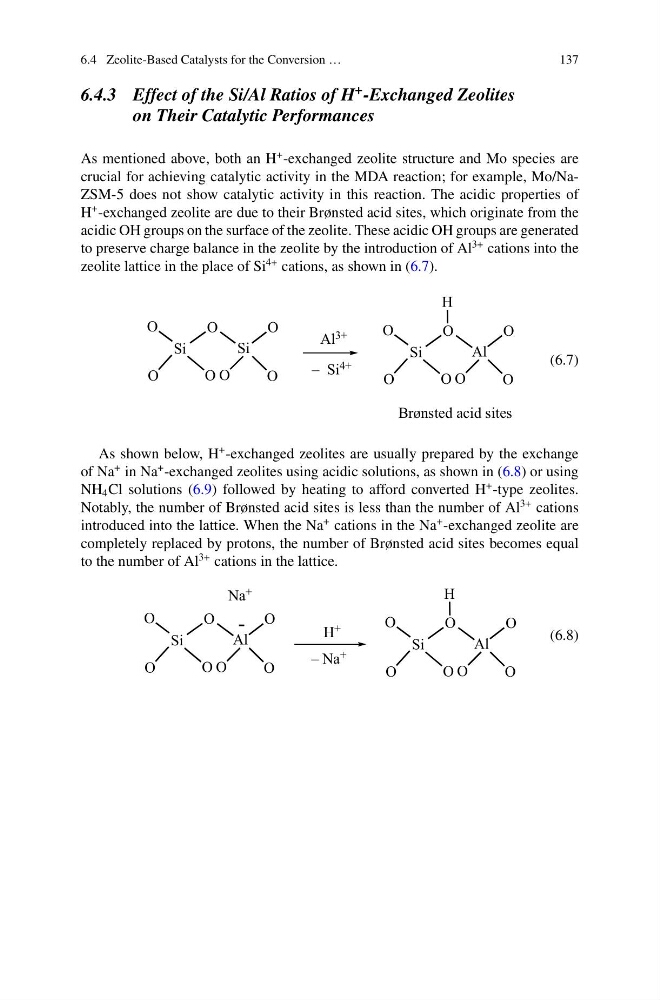
acidic OH groups on the surface of the zeolite. These acidic OH groups are generated
to preserve charge balance in the zeolite by the introduction of Al
3+ cations into the
zeolite lattice in the place of Si
4+ cations, as shown in (6.7).
Si
O
O
O
O
O
Si
O
O
H
Si
O
O
O
O
O
Al
O
O
Al 3+
– Si 4+
Brønsted acid sites
(6.7)
As shown below, H
+ -exchanged zeolites are usually prepared by the exchange
of Na
+ in Na
+ -exchanged zeolites using acidic solutions, as shown in (6.8) or using
NH 4 Cl solutions (6.9) followed by heating to afford converted H
+ -type zeolites.
Notably, the number of Brønsted acid sites is less than the number of Al
3+ cations
introduced into the lattice. When the Na
+ cations in the Na
+ -exchanged zeolite are
completely replaced by protons, the number of Brønsted acid sites becomes equal
to the number of Al
3+ cations in the lattice.
Si
O
O
O
O
O
Al
O
O
H
Si
O
O
O
O
O
Al
O
O
H +
– Na +
Na +
-
(6.8)
137
6.4.3 Effect of the Si/Al Ratios of H + -Exchanged Zeolites
on Their Catalytic Performances
As mentioned above, both an H
+ -exchanged zeolite structure and Mo species are
crucial for achieving catalytic activity in the MDA reaction; for example, Mo/NaZSM-5 does not show catalytic activity in this reaction. The acidic properties of
H
+ -exchanged zeolite are due to their Brønsted acid sites, which originate from the
acidic OH groups on the surface of the zeolite. These acidic OH groups are generated
to preserve charge balance in the zeolite by the introduction of Al
3+ cations into the
zeolite lattice in the place of Si
4+ cations, as shown in (6.7).
Si
O
O
O
O
O
Si
O
O
H
Si
O
O
O
O
O
Al
O
O
Al 3+
– Si 4+
Brønsted acid sites
(6.7)
As shown below, H
+ -exchanged zeolites are usually prepared by the exchange
of Na
+ in Na
+ -exchanged zeolites using acidic solutions, as shown in (6.8) or using
NH 4 Cl solutions (6.9) followed by heating to afford converted H
+ -type zeolites.
Notably, the number of Brønsted acid sites is less than the number of Al
3+ cations
introduced into the lattice. When the Na
+ cations in the Na
+ -exchanged zeolite are
completely replaced by protons, the number of Brønsted acid sites becomes equal
to the number of Al
3+ cations in the lattice.
Si
O
O
O
O
O
Al
O
O
H
Si
O
O
O
O
O
Al
O
O
H +
– Na +
Na +
-
(6.8)