

6.3 Thermodynamics of the Direct Conversion …
129
6.3 Thermodynamics of the Direct Conversion of Methane
Under Non-oxidative Conditions for Hydrocarbon
Production
Although the MDA reaction is typically carried out between 900 K and 1100 K, which
are relatively high reaction temperatures compared to those used in the oxidative
conversion of methane, non-oxidative conditions result in higher benzene selectivity.
Thus, benzene and toluene are the main hydrocarbon products along with traces of
ethylene and ethane [17, 18]. The MDA reaction is more suitable for the production
of aromatic hydrocarbons than oxidative conversion when only methane is used as a
reactant.
In this section, the characteristics of the MDA reaction are explained from a
thermodynamic viewpoint and compared with those of the oxidative coupling of
methane. The equilibrium conversions of methane to benzene, C 2 H 6 , C 2 H 4 , and
carbon (C) together with hydrogen achieved under non-oxidative conditions at 773 K
are shown below [17, 18].
Equilibrium CH 4 conversion: 3.1% at 773 K
6 CH 4
C 6 H 6 + 9 H 2
(6.2)
Equilibrium CH 4 conversion: 0.45% at 773 K
2 CH 4 (g)
C 2 H 6 (g) + H 2 (g)
(6.3)
Equilibrium CH 4 conversion: 0.62% at 773 K
2 CH 4 (g)
C 2 H 4 (g) + 2 H 2 (g)
(6.4)
Equilibrium CH 4 conversion: 52% at 773 K
CH 4 (g)
C (s) + 2 H 2 (g)
(6.5)
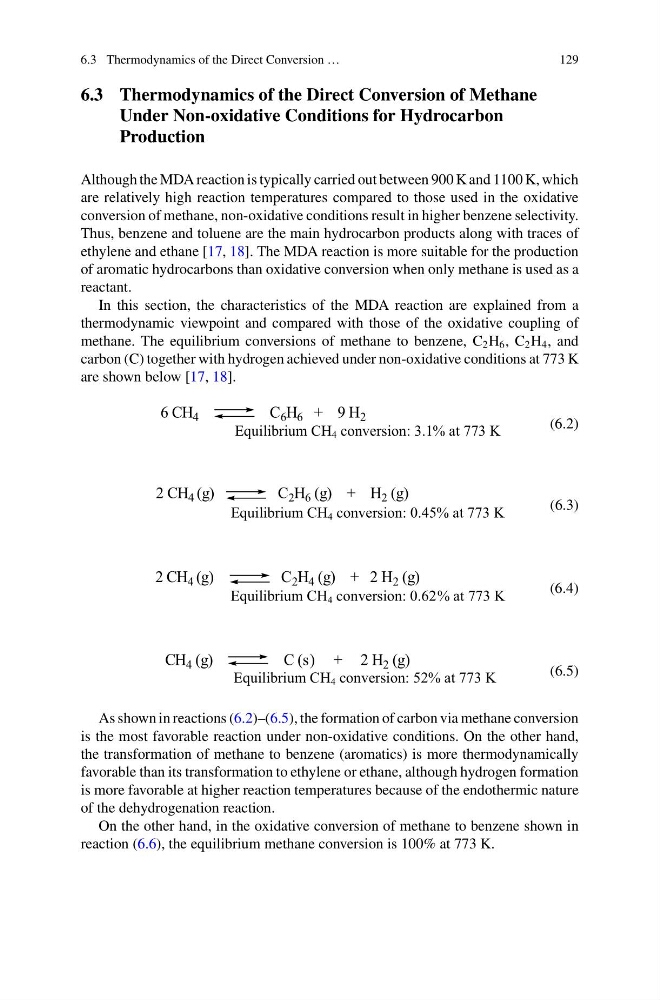
As shown in reactions (6.2)–(6.5), the formation of carbon via methane conversion
is the most favorable reaction under non-oxidative conditions. On the other hand,
the transformation of methane to benzene (aromatics) is more thermodynamically
favorable than its transformation to ethylene or ethane, although hydrogen formation
is more favorable at higher reaction temperatures because of the endothermic nature
of the dehydrogenation reaction.
On the other hand, in the oxidative conversion of methane to benzene shown in
reaction (6.6), the equilibrium methane conversion is 100% at 773 K.
129
6.3 Thermodynamics of the Direct Conversion of Methane
Under Non-oxidative Conditions for Hydrocarbon
Production
Although the MDA reaction is typically carried out between 900 K and 1100 K, which
are relatively high reaction temperatures compared to those used in the oxidative
conversion of methane, non-oxidative conditions result in higher benzene selectivity.
Thus, benzene and toluene are the main hydrocarbon products along with traces of
ethylene and ethane [17, 18]. The MDA reaction is more suitable for the production
of aromatic hydrocarbons than oxidative conversion when only methane is used as a
reactant.
In this section, the characteristics of the MDA reaction are explained from a
thermodynamic viewpoint and compared with those of the oxidative coupling of
methane. The equilibrium conversions of methane to benzene, C 2 H 6 , C 2 H 4 , and
carbon (C) together with hydrogen achieved under non-oxidative conditions at 773 K
are shown below [17, 18].
Equilibrium CH 4 conversion: 3.1% at 773 K
6 CH 4
C 6 H 6 + 9 H 2
(6.2)
Equilibrium CH 4 conversion: 0.45% at 773 K
2 CH 4 (g)
C 2 H 6 (g) + H 2 (g)
(6.3)
Equilibrium CH 4 conversion: 0.62% at 773 K
2 CH 4 (g)
C 2 H 4 (g) + 2 H 2 (g)
(6.4)
Equilibrium CH 4 conversion: 52% at 773 K
CH 4 (g)
C (s) + 2 H 2 (g)
(6.5)
As shown in reactions (6.2)–(6.5), the formation of carbon via methane conversion
is the most favorable reaction under non-oxidative conditions. On the other hand,
the transformation of methane to benzene (aromatics) is more thermodynamically
favorable than its transformation to ethylene or ethane, although hydrogen formation
is more favorable at higher reaction temperatures because of the endothermic nature
of the dehydrogenation reaction.
On the other hand, in the oxidative conversion of methane to benzene shown in
reaction (6.6), the equilibrium methane conversion is 100% at 773 K.