

118
5 C–C Bond Formation via the Condensation …
then flushed with H 2 , resulting in the formation of C2 to C7 saturated hydrocarbon
products, mainly C 2 H 6 . Thus, the overall reaction was carried out via periodic twostep operation in the absence of oxygen [122–125].
5.8.2 One-Step Non-oxidative Coupling of Methane
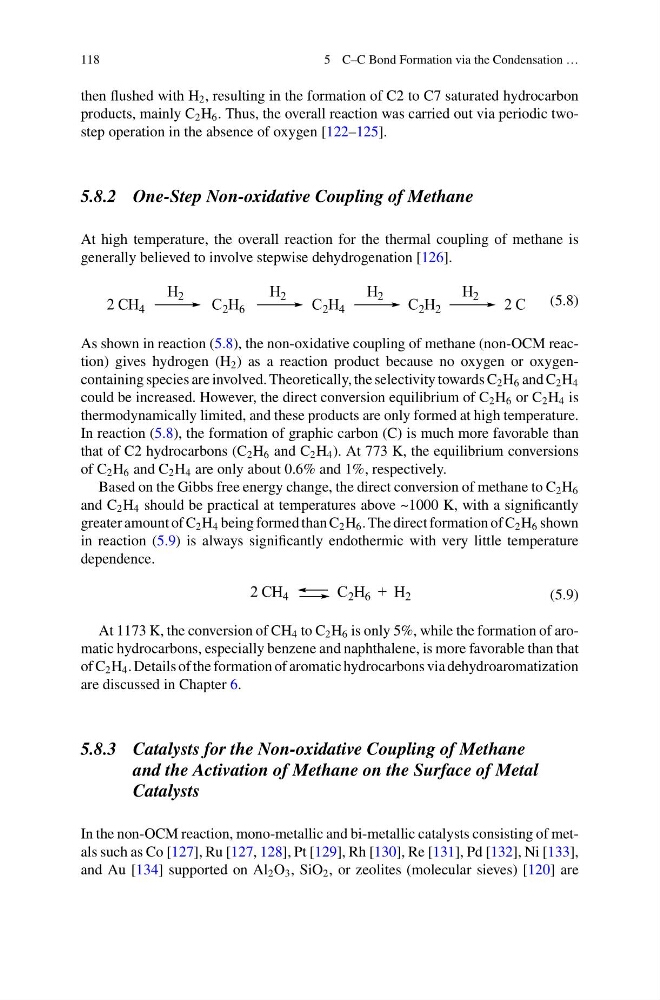
At high temperature, the overall reaction for the thermal coupling of methane is
generally believed to involve stepwise dehydrogenation [126].
(5.8)
As shown in reaction (5.8), the non-oxidative coupling of methane (non-OCM reaction) gives hydrogen (H 2 ) as a reaction product because no oxygen or oxygencontaining species are involved. Theoretically, the selectivity towards C 2 H 6 and C 2 H 4
could be increased. However, the direct conversion equilibrium of C 2 H 6 or C 2 H 4 is
thermodynamically limited, and these products are only formed at high temperature.
In reaction (5.8), the formation of graphic carbon (C) is much more favorable than
that of C2 hydrocarbons (C 2 H 6 and C 2 H 4 ). At 773 K, the equilibrium conversions
of C 2 H 6 and C 2 H 4 are only about 0.6% and 1%, respectively.
Based on the Gibbs free energy change, the direct conversion of methane to C 2 H 6
and C 2 H 4 should be practical at temperatures above ~1000 K, with a significantly
greater amount of C 2 H 4 being formed than C 2 H 6 . The direct formation of C 2 H 6 shown
in reaction (5.9) is always significantly endothermic with very little temperature
dependence.
(5.9)
At 1173 K, the conversion of CH 4 to C 2 H 6 is only 5%, while the formation of aromatic hydrocarbons, especially benzene and naphthalene, is more favorable than that
of C 2 H 4 . Details of the formation of aromatic hydrocarbons via dehydroaromatization
are discussed in Chapter 6.
5.8.3 Catalysts for the Non-oxidative Coupling of Methane
and the Activation of Methane on the Surface of Metal
Catalysts
In the non-OCM reaction, mono-metallic and bi-metallic catalysts consisting of metals such as Co [127], Ru [127, 128], Pt [129], Rh [130], Re [131], Pd [132], Ni [133],
and Au [134] supported on Al 2 O 3 , SiO 2 , or zeolites (molecular sieves) [120] are
5 C–C Bond Formation via the Condensation …
then flushed with H 2 , resulting in the formation of C2 to C7 saturated hydrocarbon
products, mainly C 2 H 6 . Thus, the overall reaction was carried out via periodic twostep operation in the absence of oxygen [122–125].
5.8.2 One-Step Non-oxidative Coupling of Methane
At high temperature, the overall reaction for the thermal coupling of methane is
generally believed to involve stepwise dehydrogenation [126].
(5.8)
As shown in reaction (5.8), the non-oxidative coupling of methane (non-OCM reaction) gives hydrogen (H 2 ) as a reaction product because no oxygen or oxygencontaining species are involved. Theoretically, the selectivity towards C 2 H 6 and C 2 H 4
could be increased. However, the direct conversion equilibrium of C 2 H 6 or C 2 H 4 is
thermodynamically limited, and these products are only formed at high temperature.
In reaction (5.8), the formation of graphic carbon (C) is much more favorable than
that of C2 hydrocarbons (C 2 H 6 and C 2 H 4 ). At 773 K, the equilibrium conversions
of C 2 H 6 and C 2 H 4 are only about 0.6% and 1%, respectively.
Based on the Gibbs free energy change, the direct conversion of methane to C 2 H 6
and C 2 H 4 should be practical at temperatures above ~1000 K, with a significantly
greater amount of C 2 H 4 being formed than C 2 H 6 . The direct formation of C 2 H 6 shown
in reaction (5.9) is always significantly endothermic with very little temperature
dependence.
(5.9)
At 1173 K, the conversion of CH 4 to C 2 H 6 is only 5%, while the formation of aromatic hydrocarbons, especially benzene and naphthalene, is more favorable than that
of C 2 H 4 . Details of the formation of aromatic hydrocarbons via dehydroaromatization
are discussed in Chapter 6.
5.8.3 Catalysts for the Non-oxidative Coupling of Methane
and the Activation of Methane on the Surface of Metal
Catalysts
In the non-OCM reaction, mono-metallic and bi-metallic catalysts consisting of metals such as Co [127], Ru [127, 128], Pt [129], Rh [130], Re [131], Pd [132], Ni [133],
and Au [134] supported on Al 2 O 3 , SiO 2 , or zeolites (molecular sieves) [120] are