

3.1 Subsonic Wind Tunnels for Aeronautics
59
3.1.5 Low Turbulence Research Wind Tunnel
This type of wind tunnel is well suited for fundamental studies of complex flows
and their stability such as two and three-dimensional boundary layers, separation,
vortices, wakes, laminar to turbulent transition, as well as studies on flow control for
maintenance of laminarity and suppression of separation.
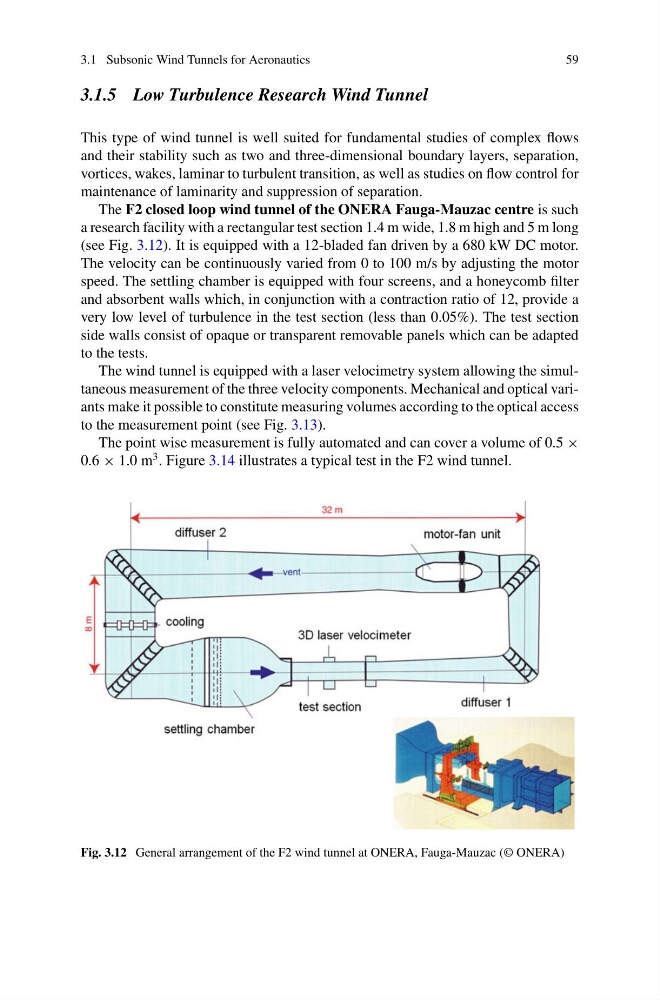
The F2 closed loop wind tunnel of the ONERA Fauga-Mauzac centre is such
a research facility with a rectangular test section 1.4 m wide, 1.8 m high and 5 m long
(see Fig. 3.12). It is equipped with a 12-bladed fan driven by a 680 kW DC motor.
The velocity can be continuously varied from 0 to 100 m/s by adjusting the motor
speed. The settling chamber is equipped with four screens, and a honeycomb filter
and absorbent walls which, in conjunction with a contraction ratio of 12, provide a
very low level of turbulence in the test section (less than 0.05%). The test section
side walls consist of opaque or transparent removable panels which can be adapted
to the tests.
The wind tunnel is equipped with a laser velocimetry system allowing the simultaneous measurement of the three velocity components. Mechanical and optical variants make it possible to constitute measuring volumes according to the optical access
to the measurement point (see Fig. 3.13).
The point wise measurement is fully automated and can cover a volume of 0.5 ×
0.6 × 1.0 m
3 . Figure 3.14 illustrates a typical test in the F2 wind tunnel.
Fig. 3.12 General arrangement of the F2 wind tunnel at ONERA, Fauga-Mauzac (© ONERA)
59
3.1.5 Low Turbulence Research Wind Tunnel
This type of wind tunnel is well suited for fundamental studies of complex flows
and their stability such as two and three-dimensional boundary layers, separation,
vortices, wakes, laminar to turbulent transition, as well as studies on flow control for
maintenance of laminarity and suppression of separation.
The F2 closed loop wind tunnel of the ONERA Fauga-Mauzac centre is such
a research facility with a rectangular test section 1.4 m wide, 1.8 m high and 5 m long
(see Fig. 3.12). It is equipped with a 12-bladed fan driven by a 680 kW DC motor.
The velocity can be continuously varied from 0 to 100 m/s by adjusting the motor
speed. The settling chamber is equipped with four screens, and a honeycomb filter
and absorbent walls which, in conjunction with a contraction ratio of 12, provide a
very low level of turbulence in the test section (less than 0.05%). The test section
side walls consist of opaque or transparent removable panels which can be adapted
to the tests.
The wind tunnel is equipped with a laser velocimetry system allowing the simultaneous measurement of the three velocity components. Mechanical and optical variants make it possible to constitute measuring volumes according to the optical access
to the measurement point (see Fig. 3.13).
The point wise measurement is fully automated and can cover a volume of 0.5 ×
0.6 × 1.0 m
3 . Figure 3.14 illustrates a typical test in the F2 wind tunnel.
Fig. 3.12 General arrangement of the F2 wind tunnel at ONERA, Fauga-Mauzac (© ONERA)