

42
2 Wind Tunnels and Other Aerodynamic Test Facilities
2.6 The Main Sections of a Wind Tunnel
The variation of the velocity, V, of the flow in a duct of variable cross section area,
A, is related by the relation given by Hugoniot’s theorem based on the mass-flow
conservation:
dV
V
1 − M
2
+
d A
A
= 0
where M is the Mach number.
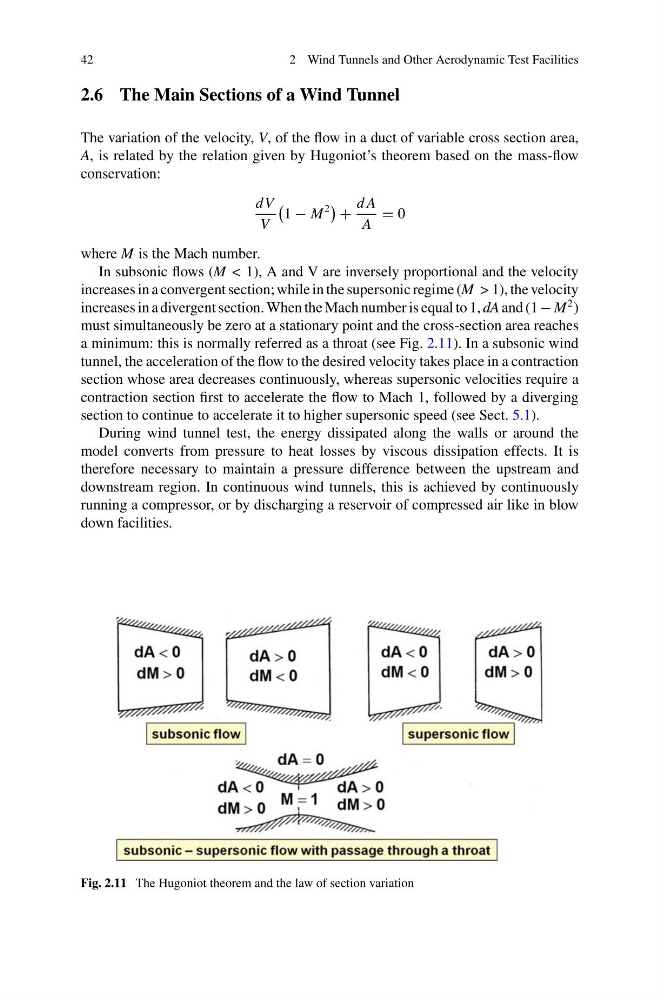
In subsonic flows (M < 1), A and V are inversely proportional and the velocity
increases in a convergent section; while in the supersonic regime (M > 1), the velocity
increases in a divergent section. When the Mach number is equal to 1, dA and (1 − M
2 )
must simultaneously be zero at a stationary point and the cross-section area reaches
a minimum: this is normally referred as a throat (see Fig. 2.11). In a subsonic wind
tunnel, the acceleration of the flow to the desired velocity takes place in a contraction
section whose area decreases continuously, whereas supersonic velocities require a
contraction section first to accelerate the flow to Mach 1, followed by a diverging
section to continue to accelerate it to higher supersonic speed (see Sect. 5.1).
During wind tunnel test, the energy dissipated along the walls or around the
model converts from pressure to heat losses by viscous dissipation effects. It is
therefore necessary to maintain a pressure difference between the upstream and
downstream region. In continuous wind tunnels, this is achieved by continuously
running a compressor, or by discharging a reservoir of compressed air like in blow
down facilities.
Fig. 2.11 The Hugoniot theorem and the law of section variation
2 Wind Tunnels and Other Aerodynamic Test Facilities
2.6 The Main Sections of a Wind Tunnel
The variation of the velocity, V, of the flow in a duct of variable cross section area,
A, is related by the relation given by Hugoniot’s theorem based on the mass-flow
conservation:
dV
V
1 − M
2
+
d A
A
= 0
where M is the Mach number.
In subsonic flows (M < 1), A and V are inversely proportional and the velocity
increases in a convergent section; while in the supersonic regime (M > 1), the velocity
increases in a divergent section. When the Mach number is equal to 1, dA and (1 − M
2 )
must simultaneously be zero at a stationary point and the cross-section area reaches
a minimum: this is normally referred as a throat (see Fig. 2.11). In a subsonic wind
tunnel, the acceleration of the flow to the desired velocity takes place in a contraction
section whose area decreases continuously, whereas supersonic velocities require a
contraction section first to accelerate the flow to Mach 1, followed by a diverging
section to continue to accelerate it to higher supersonic speed (see Sect. 5.1).
During wind tunnel test, the energy dissipated along the walls or around the
model converts from pressure to heat losses by viscous dissipation effects. It is
therefore necessary to maintain a pressure difference between the upstream and
downstream region. In continuous wind tunnels, this is achieved by continuously
running a compressor, or by discharging a reservoir of compressed air like in blow
down facilities.
Fig. 2.11 The Hugoniot theorem and the law of section variation