

2.2 From Wind Tunnel Test to Reality
31
Reynolds number ranges between 30 and 200 millions and; for a car travelling at
120 km/h, it is approximately 9 million. Unfortunately in most of the wind tunnel
test, the Reynolds numbers are usually limited to 10–100 times lower.
The Reynolds number plays a key role in representing the viscous effects, that
is to say the behaviour of the boundary layers and more generally of the dissipative
flow field, including wakes, mixing layers, laminar to turbulent transition, separation,
etc. These phenomena can strongly influence the behaviour of the vehicle, causing
a loss of performance or stability, unwanted vibrations or in worst cases more catastrophic scenarios. Except for wind tunnels where full scale vehicles can be tested,
in aeronautics testing is most often performed on small-scale models, the reduction
ratio being in some cases over 100. This results in a much lower Reynolds number than in flight. However, to compensate for the low Reynolds number due to the
reduced dimensions of the model, it is generally not possible to increase the velocity
by the necessary proportions, as it would result in a prohibitive increase in the power
required. As well as the risk of entering the supersonic regime where other complications can be encountered and especially if the vehicle is supposed to operate in
subsonic conditions.
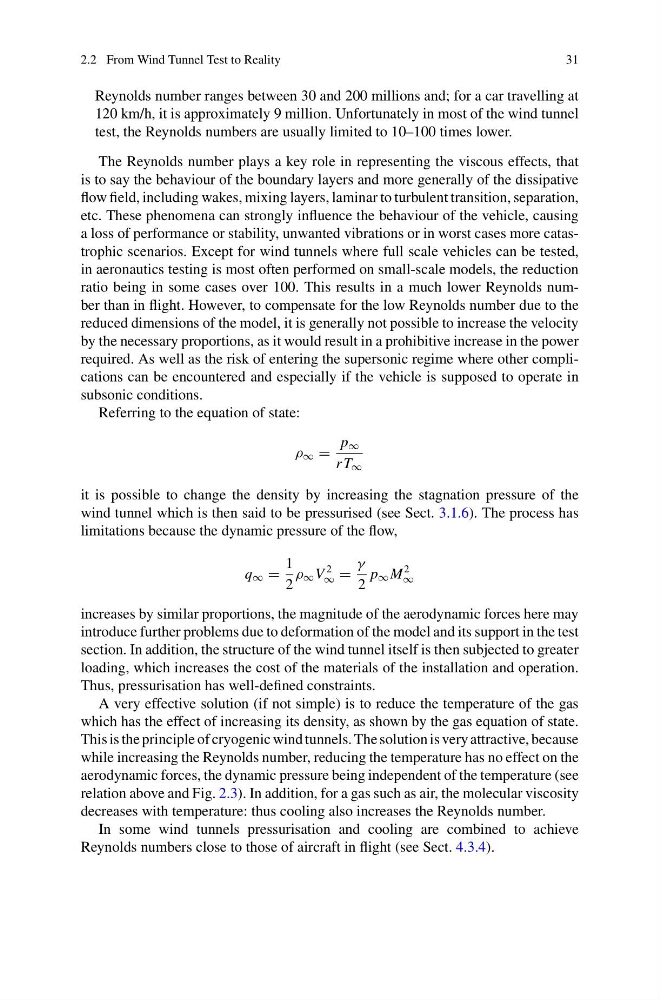
Referring to the equation of state:
ρ ∞ =
p ∞
r T ∞
it is possible to change the density by increasing the stagnation pressure of the
wind tunnel which is then said to be pressurised (see Sect. 3.1.6). The process has
limitations because the dynamic pressure of the flow,
q ∞ =
1
2
ρ ∞ V
2
∞ =
γ
2
p ∞ M
2
∞
increases by similar proportions, the magnitude of the aerodynamic forces here may
introduce further problems due to deformation of the model and its support in the test
section. In addition, the structure of the wind tunnel itself is then subjected to greater
loading, which increases the cost of the materials of the installation and operation.
Thus, pressurisation has well-defined constraints.
A very effective solution (if not simple) is to reduce the temperature of the gas
which has the effect of increasing its density, as shown by the gas equation of state.
This is the principle of cryogenic wind tunnels. The solution is very attractive, because
while increasing the Reynolds number, reducing the temperature has no effect on the
aerodynamic forces, the dynamic pressure being independent of the temperature (see
relation above and Fig. 2.3). In addition, for a gas such as air, the molecular viscosity
decreases with temperature: thus cooling also increases the Reynolds number.
In some wind tunnels pressurisation and cooling are combined to achieve
Reynolds numbers close to those of aircraft in flight (see Sect. 4.3.4).
31
Reynolds number ranges between 30 and 200 millions and; for a car travelling at
120 km/h, it is approximately 9 million. Unfortunately in most of the wind tunnel
test, the Reynolds numbers are usually limited to 10–100 times lower.
The Reynolds number plays a key role in representing the viscous effects, that
is to say the behaviour of the boundary layers and more generally of the dissipative
flow field, including wakes, mixing layers, laminar to turbulent transition, separation,
etc. These phenomena can strongly influence the behaviour of the vehicle, causing
a loss of performance or stability, unwanted vibrations or in worst cases more catastrophic scenarios. Except for wind tunnels where full scale vehicles can be tested,
in aeronautics testing is most often performed on small-scale models, the reduction
ratio being in some cases over 100. This results in a much lower Reynolds number than in flight. However, to compensate for the low Reynolds number due to the
reduced dimensions of the model, it is generally not possible to increase the velocity
by the necessary proportions, as it would result in a prohibitive increase in the power
required. As well as the risk of entering the supersonic regime where other complications can be encountered and especially if the vehicle is supposed to operate in
subsonic conditions.
Referring to the equation of state:
ρ ∞ =
p ∞
r T ∞
it is possible to change the density by increasing the stagnation pressure of the
wind tunnel which is then said to be pressurised (see Sect. 3.1.6). The process has
limitations because the dynamic pressure of the flow,
q ∞ =
1
2
ρ ∞ V
2
∞ =
γ
2
p ∞ M
2
∞
increases by similar proportions, the magnitude of the aerodynamic forces here may
introduce further problems due to deformation of the model and its support in the test
section. In addition, the structure of the wind tunnel itself is then subjected to greater
loading, which increases the cost of the materials of the installation and operation.
Thus, pressurisation has well-defined constraints.
A very effective solution (if not simple) is to reduce the temperature of the gas
which has the effect of increasing its density, as shown by the gas equation of state.
This is the principle of cryogenic wind tunnels. The solution is very attractive, because
while increasing the Reynolds number, reducing the temperature has no effect on the
aerodynamic forces, the dynamic pressure being independent of the temperature (see
relation above and Fig. 2.3). In addition, for a gas such as air, the molecular viscosity
decreases with temperature: thus cooling also increases the Reynolds number.
In some wind tunnels pressurisation and cooling are combined to achieve
Reynolds numbers close to those of aircraft in flight (see Sect. 4.3.4).