

22
1 The Experimental Approach in Aerodynamic Design
probe affects measurements, which may lead to pilot misinterpretation. Whilst, ice
accretion on wings modifies the airflow around the wings: advancing stall angle,
increasing drag and reducing manoeuvrability. The shape of ice formed on an engine
intake modifies the airflow entering the engine and thus the engine performance.
Furthermore, ice blocks formed on the engine intake may detach and impact the
compressor blades, leading to damage and possible engine failure.
Altitude test facilities make it possible to carry out tests under the same conditions
to that at a given altitude, including simulating icing conditions.
1.8.2 How Does an Altitude Test Cell Work?
The DGA (DGA is the French Defence Procurement Agency) Aero-engine Testing
branch is specialised in testing under simulated altitude conditions. Since 1946, it has
been designing and carrying out test campaigns on air-breathing aero-engines, their
components, assemblies and sub-assemblies and associated equipment, under simulated flight and icing conditions. The operation of these facilities will be elaborated
below.
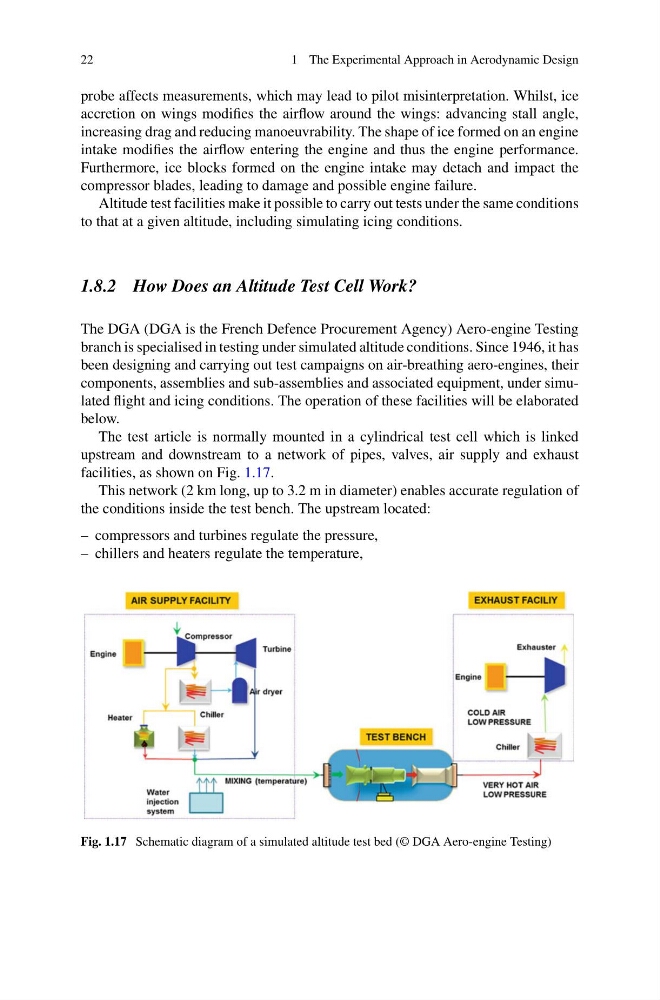
The test article is normally mounted in a cylindrical test cell which is linked
upstream and downstream to a network of pipes, valves, air supply and exhaust
facilities, as shown on Fig. 1.17.
This network (2 km long, up to 3.2 m in diameter) enables accurate regulation of
the conditions inside the test bench. The upstream located:
– compressors and turbines regulate the pressure,
– chillers and heaters regulate the temperature,
Fig. 1.17 Schematic diagram of a simulated altitude test bed (© DGA Aero-engine Testing)
1 The Experimental Approach in Aerodynamic Design
probe affects measurements, which may lead to pilot misinterpretation. Whilst, ice
accretion on wings modifies the airflow around the wings: advancing stall angle,
increasing drag and reducing manoeuvrability. The shape of ice formed on an engine
intake modifies the airflow entering the engine and thus the engine performance.
Furthermore, ice blocks formed on the engine intake may detach and impact the
compressor blades, leading to damage and possible engine failure.
Altitude test facilities make it possible to carry out tests under the same conditions
to that at a given altitude, including simulating icing conditions.
1.8.2 How Does an Altitude Test Cell Work?
The DGA (DGA is the French Defence Procurement Agency) Aero-engine Testing
branch is specialised in testing under simulated altitude conditions. Since 1946, it has
been designing and carrying out test campaigns on air-breathing aero-engines, their
components, assemblies and sub-assemblies and associated equipment, under simulated flight and icing conditions. The operation of these facilities will be elaborated
below.
The test article is normally mounted in a cylindrical test cell which is linked
upstream and downstream to a network of pipes, valves, air supply and exhaust
facilities, as shown on Fig. 1.17.
This network (2 km long, up to 3.2 m in diameter) enables accurate regulation of
the conditions inside the test bench. The upstream located:
– compressors and turbines regulate the pressure,
– chillers and heaters regulate the temperature,
Fig. 1.17 Schematic diagram of a simulated altitude test bed (© DGA Aero-engine Testing)