

268
12 Laser Spectroscopy and Electron Beam Excitation
12.6 Laser-Induced Fluorescence (LIF)
Laser Induced Fluorescence (LIF) belongs to the same category of radiation/absorption processes as employed in previous techniques; but here the measurement signal is obtained from the subsequent spontaneous emission of the absorbed
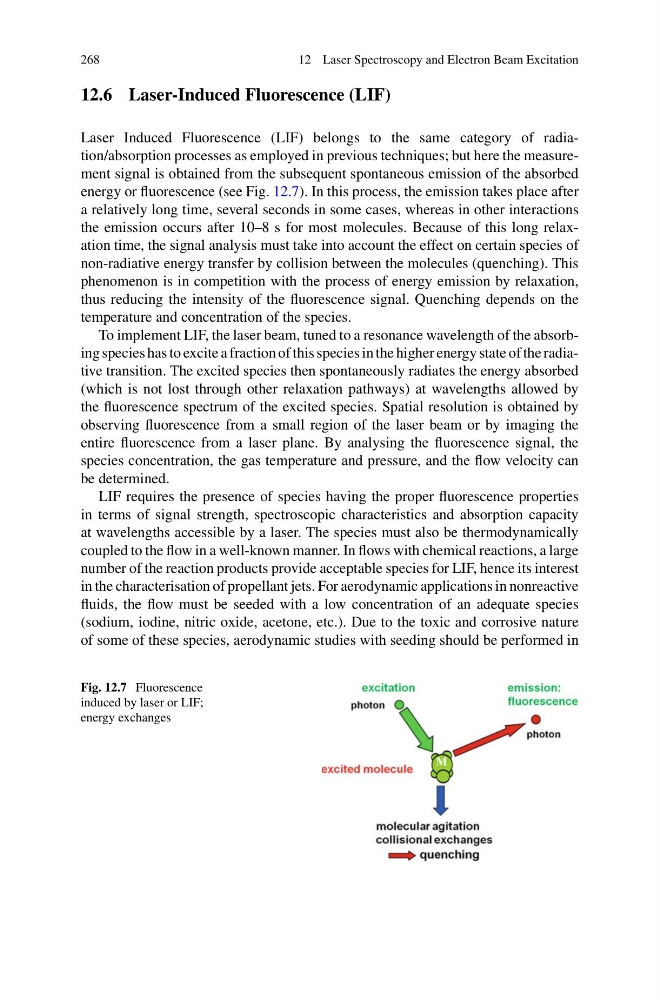
energy or fluorescence (see Fig. 12.7). In this process, the emission takes place after
a relatively long time, several seconds in some cases, whereas in other interactions
the emission occurs after 10–8 s for most molecules. Because of this long relaxation time, the signal analysis must take into account the effect on certain species of
non-radiative energy transfer by collision between the molecules (quenching). This
phenomenon is in competition with the process of energy emission by relaxation,
thus reducing the intensity of the fluorescence signal. Quenching depends on the
temperature and concentration of the species.
To implement LIF, the laser beam, tuned to a resonance wavelength of the absorbing species has to excite a fraction of this species in the higher energy state of the radiative transition. The excited species then spontaneously radiates the energy absorbed
(which is not lost through other relaxation pathways) at wavelengths allowed by
the fluorescence spectrum of the excited species. Spatial resolution is obtained by
observing fluorescence from a small region of the laser beam or by imaging the
entire fluorescence from a laser plane. By analysing the fluorescence signal, the
species concentration, the gas temperature and pressure, and the flow velocity can
be determined.
LIF requires the presence of species having the proper fluorescence properties
in terms of signal strength, spectroscopic characteristics and absorption capacity
at wavelengths accessible by a laser. The species must also be thermodynamically
coupled to the flow in a well-known manner. In flows with chemical reactions, a large
number of the reaction products provide acceptable species for LIF, hence its interest
in the characterisation of propellant jets. For aerodynamic applications in nonreactive
fluids, the flow must be seeded with a low concentration of an adequate species
(sodium, iodine, nitric oxide, acetone, etc.). Due to the toxic and corrosive nature
of some of these species, aerodynamic studies with seeding should be performed in
Fig. 12.7 Fluorescence
induced by laser or LIF;
energy exchanges
12 Laser Spectroscopy and Electron Beam Excitation
12.6 Laser-Induced Fluorescence (LIF)
Laser Induced Fluorescence (LIF) belongs to the same category of radiation/absorption processes as employed in previous techniques; but here the measurement signal is obtained from the subsequent spontaneous emission of the absorbed
energy or fluorescence (see Fig. 12.7). In this process, the emission takes place after
a relatively long time, several seconds in some cases, whereas in other interactions
the emission occurs after 10–8 s for most molecules. Because of this long relaxation time, the signal analysis must take into account the effect on certain species of
non-radiative energy transfer by collision between the molecules (quenching). This
phenomenon is in competition with the process of energy emission by relaxation,
thus reducing the intensity of the fluorescence signal. Quenching depends on the
temperature and concentration of the species.
To implement LIF, the laser beam, tuned to a resonance wavelength of the absorbing species has to excite a fraction of this species in the higher energy state of the radiative transition. The excited species then spontaneously radiates the energy absorbed
(which is not lost through other relaxation pathways) at wavelengths allowed by
the fluorescence spectrum of the excited species. Spatial resolution is obtained by
observing fluorescence from a small region of the laser beam or by imaging the
entire fluorescence from a laser plane. By analysing the fluorescence signal, the
species concentration, the gas temperature and pressure, and the flow velocity can
be determined.
LIF requires the presence of species having the proper fluorescence properties
in terms of signal strength, spectroscopic characteristics and absorption capacity
at wavelengths accessible by a laser. The species must also be thermodynamically
coupled to the flow in a well-known manner. In flows with chemical reactions, a large
number of the reaction products provide acceptable species for LIF, hence its interest
in the characterisation of propellant jets. For aerodynamic applications in nonreactive
fluids, the flow must be seeded with a low concentration of an adequate species
(sodium, iodine, nitric oxide, acetone, etc.). Due to the toxic and corrosive nature
of some of these species, aerodynamic studies with seeding should be performed in
Fig. 12.7 Fluorescence
induced by laser or LIF;
energy exchanges