

266
12 Laser Spectroscopy and Electron Beam Excitation
12.5 Stimulated Raman Scattering
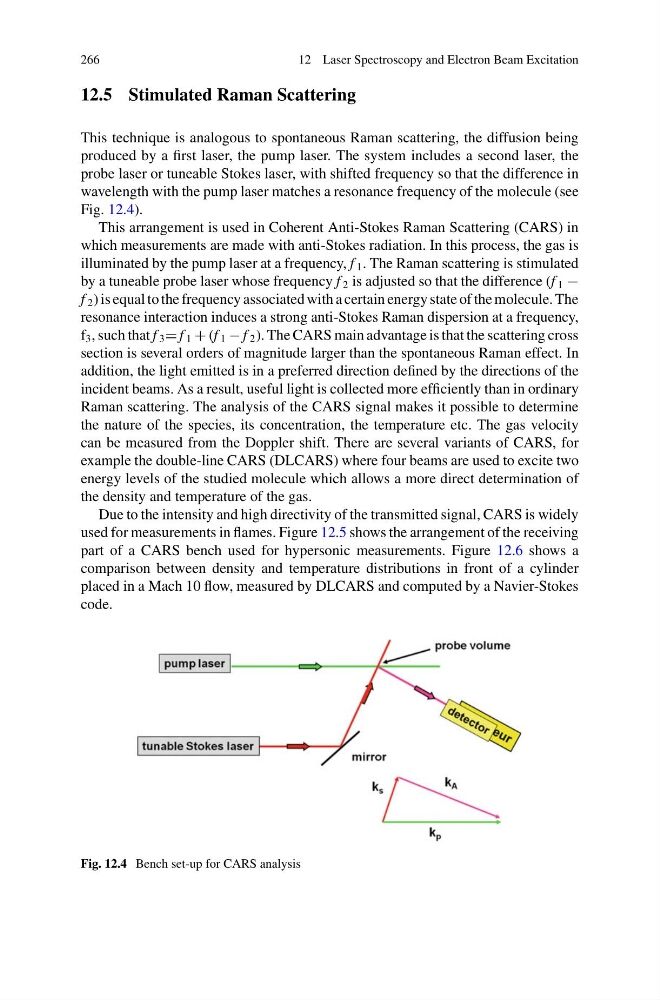
This technique is analogous to spontaneous Raman scattering, the diffusion being
produced by a first laser, the pump laser. The system includes a second laser, the
probe laser or tuneable Stokes laser, with shifted frequency so that the difference in
wavelength with the pump laser matches a resonance frequency of the molecule (see
Fig. 12.4).
This arrangement is used in Coherent Anti-Stokes Raman Scattering (CARS) in
which measurements are made with anti-Stokes radiation. In this process, the gas is
illuminated by the pump laser at a frequency, f 1 . The Raman scattering is stimulated
by a tuneable probe laser whose frequency f 2 is adjusted so that the difference (f 1 −
f 2 ) is equal to the frequency associated with a certain energy state of the molecule. The
resonance interaction induces a strong anti-Stokes Raman dispersion at a frequency,
f 3 , such that f 3 = f 1 + (f 1 − f 2 ). The CARS main advantage is that the scattering cross
section is several orders of magnitude larger than the spontaneous Raman effect. In
addition, the light emitted is in a preferred direction defined by the directions of the
incident beams. As a result, useful light is collected more efficiently than in ordinary
Raman scattering. The analysis of the CARS signal makes it possible to determine
the nature of the species, its concentration, the temperature etc. The gas velocity
can be measured from the Doppler shift. There are several variants of CARS, for
example the double-line CARS (DLCARS) where four beams are used to excite two
energy levels of the studied molecule which allows a more direct determination of
the density and temperature of the gas.
Due to the intensity and high directivity of the transmitted signal, CARS is widely
used for measurements in flames. Figure 12.5 shows the arrangement of the receiving
part of a CARS bench used for hypersonic measurements. Figure 12.6 shows a
comparison between density and temperature distributions in front of a cylinder
placed in a Mach 10 flow, measured by DLCARS and computed by a Navier-Stokes
code.
Fig. 12.4 Bench set-up for CARS analysis
12 Laser Spectroscopy and Electron Beam Excitation
12.5 Stimulated Raman Scattering
This technique is analogous to spontaneous Raman scattering, the diffusion being
produced by a first laser, the pump laser. The system includes a second laser, the
probe laser or tuneable Stokes laser, with shifted frequency so that the difference in
wavelength with the pump laser matches a resonance frequency of the molecule (see
Fig. 12.4).
This arrangement is used in Coherent Anti-Stokes Raman Scattering (CARS) in
which measurements are made with anti-Stokes radiation. In this process, the gas is
illuminated by the pump laser at a frequency, f 1 . The Raman scattering is stimulated
by a tuneable probe laser whose frequency f 2 is adjusted so that the difference (f 1 −
f 2 ) is equal to the frequency associated with a certain energy state of the molecule. The
resonance interaction induces a strong anti-Stokes Raman dispersion at a frequency,
f 3 , such that f 3 = f 1 + (f 1 − f 2 ). The CARS main advantage is that the scattering cross
section is several orders of magnitude larger than the spontaneous Raman effect. In
addition, the light emitted is in a preferred direction defined by the directions of the
incident beams. As a result, useful light is collected more efficiently than in ordinary
Raman scattering. The analysis of the CARS signal makes it possible to determine
the nature of the species, its concentration, the temperature etc. The gas velocity
can be measured from the Doppler shift. There are several variants of CARS, for
example the double-line CARS (DLCARS) where four beams are used to excite two
energy levels of the studied molecule which allows a more direct determination of
the density and temperature of the gas.
Due to the intensity and high directivity of the transmitted signal, CARS is widely
used for measurements in flames. Figure 12.5 shows the arrangement of the receiving
part of a CARS bench used for hypersonic measurements. Figure 12.6 shows a
comparison between density and temperature distributions in front of a cylinder
placed in a Mach 10 flow, measured by DLCARS and computed by a Navier-Stokes
code.
Fig. 12.4 Bench set-up for CARS analysis