

11.6 Particle Image Velocimetry
255
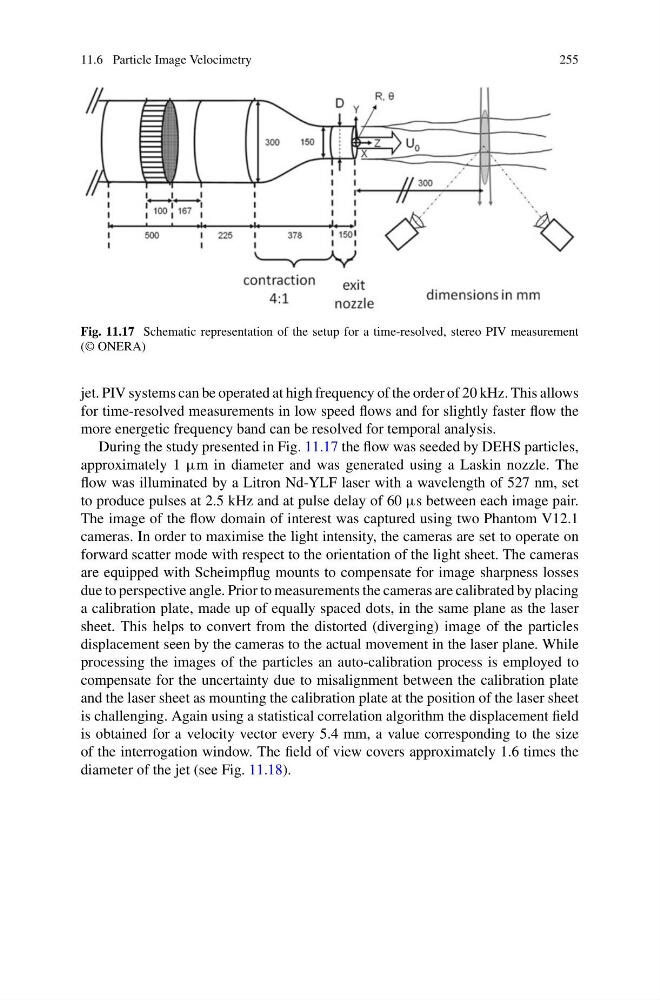
Fig. 11.17 Schematic representation of the setup for a time-resolved, stereo PIV measurement
(© ONERA)
jet. PIV systems can be operated at high frequency of the order of 20 kHz. This allows
for time-resolved measurements in low speed flows and for slightly faster flow the
more energetic frequency band can be resolved for temporal analysis.
During the study presented in Fig. 11.17 the flow was seeded by DEHS particles,
approximately 1 µm in diameter and was generated using a Laskin nozzle. The
flow was illuminated by a Litron Nd-YLF laser with a wavelength of 527 nm, set
to produce pulses at 2.5 kHz and at pulse delay of 60 µs between each image pair.
The image of the flow domain of interest was captured using two Phantom V12.1
cameras. In order to maximise the light intensity, the cameras are set to operate on
forward scatter mode with respect to the orientation of the light sheet. The cameras
are equipped with Scheimpflug mounts to compensate for image sharpness losses
due to perspective angle. Prior to measurements the cameras are calibrated by placing
a calibration plate, made up of equally spaced dots, in the same plane as the laser
sheet. This helps to convert from the distorted (diverging) image of the particles
displacement seen by the cameras to the actual movement in the laser plane. While
processing the images of the particles an auto-calibration process is employed to
compensate for the uncertainty due to misalignment between the calibration plate
and the laser sheet as mounting the calibration plate at the position of the laser sheet
is challenging. Again using a statistical correlation algorithm the displacement field
is obtained for a velocity vector every 5.4 mm, a value corresponding to the size
of the interrogation window. The field of view covers approximately 1.6 times the
diameter of the jet (see Fig. 11.18).
255
Fig. 11.17 Schematic representation of the setup for a time-resolved, stereo PIV measurement
(© ONERA)
jet. PIV systems can be operated at high frequency of the order of 20 kHz. This allows
for time-resolved measurements in low speed flows and for slightly faster flow the
more energetic frequency band can be resolved for temporal analysis.
During the study presented in Fig. 11.17 the flow was seeded by DEHS particles,
approximately 1 µm in diameter and was generated using a Laskin nozzle. The
flow was illuminated by a Litron Nd-YLF laser with a wavelength of 527 nm, set
to produce pulses at 2.5 kHz and at pulse delay of 60 µs between each image pair.
The image of the flow domain of interest was captured using two Phantom V12.1
cameras. In order to maximise the light intensity, the cameras are set to operate on
forward scatter mode with respect to the orientation of the light sheet. The cameras
are equipped with Scheimpflug mounts to compensate for image sharpness losses
due to perspective angle. Prior to measurements the cameras are calibrated by placing
a calibration plate, made up of equally spaced dots, in the same plane as the laser
sheet. This helps to convert from the distorted (diverging) image of the particles
displacement seen by the cameras to the actual movement in the laser plane. While
processing the images of the particles an auto-calibration process is employed to
compensate for the uncertainty due to misalignment between the calibration plate
and the laser sheet as mounting the calibration plate at the position of the laser sheet
is challenging. Again using a statistical correlation algorithm the displacement field
is obtained for a velocity vector every 5.4 mm, a value corresponding to the size
of the interrogation window. The field of view covers approximately 1.6 times the
diameter of the jet (see Fig. 11.18).