

246
11 Non-intrusive Measurement Techniques
frequency noise. Just to have an idea, in a flow at 300 m/s and a fringe spacing of
15 µm, the frequency, fm, is occurring at 20 MHz and the duration of a burst is
approximately 1 µs. Therefore, the issue at hand is to measure a high frequency,
very accurately, in a signal of very short duration and potentially in the presence of
noise.
Before further analysis, the signal is filtered by both a high-pass and low-pass
filter to remove the low frequency, background noise, and the high-frequency noise
respectively. In addition a minimum and maximum limit is set to eliminate high
amplitude signals which are linked to large particles not convected by the flow and
spurious signals. Various methods were developed to extract the frequency content
of the signal and most of the systems are now based on Fourier transform of the
signal.
11.4.3 Modes of Operation
The part that splits the main beam into two and the lens that focusses them into the
probe volume is called the transmitting optics and the part that collects the scattered
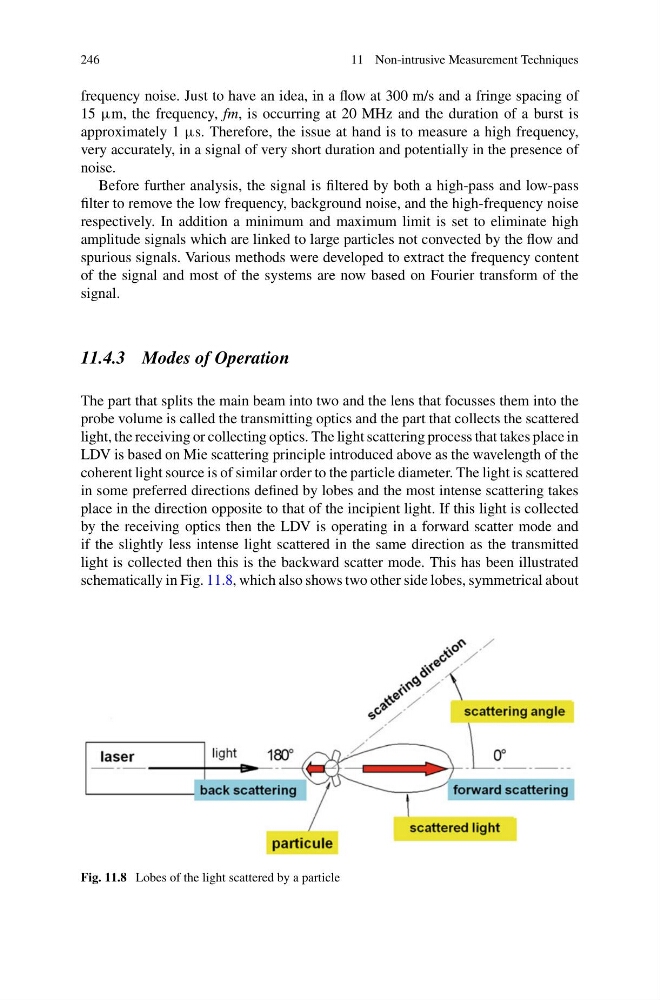
light, the receiving or collecting optics. The light scattering process that takes place in
LDV is based on Mie scattering principle introduced above as the wavelength of the
coherent light source is of similar order to the particle diameter. The light is scattered
in some preferred directions defined by lobes and the most intense scattering takes
place in the direction opposite to that of the incipient light. If this light is collected
by the receiving optics then the LDV is operating in a forward scatter mode and
if the slightly less intense light scattered in the same direction as the transmitted
light is collected then this is the backward scatter mode. This has been illustrated
schematically in Fig. 11.8, which also shows two other side lobes, symmetrical about
Fig. 11.8 Lobes of the light scattered by a particle
11 Non-intrusive Measurement Techniques
frequency noise. Just to have an idea, in a flow at 300 m/s and a fringe spacing of
15 µm, the frequency, fm, is occurring at 20 MHz and the duration of a burst is
approximately 1 µs. Therefore, the issue at hand is to measure a high frequency,
very accurately, in a signal of very short duration and potentially in the presence of
noise.
Before further analysis, the signal is filtered by both a high-pass and low-pass
filter to remove the low frequency, background noise, and the high-frequency noise
respectively. In addition a minimum and maximum limit is set to eliminate high
amplitude signals which are linked to large particles not convected by the flow and
spurious signals. Various methods were developed to extract the frequency content
of the signal and most of the systems are now based on Fourier transform of the
signal.
11.4.3 Modes of Operation
The part that splits the main beam into two and the lens that focusses them into the
probe volume is called the transmitting optics and the part that collects the scattered
light, the receiving or collecting optics. The light scattering process that takes place in
LDV is based on Mie scattering principle introduced above as the wavelength of the
coherent light source is of similar order to the particle diameter. The light is scattered
in some preferred directions defined by lobes and the most intense scattering takes
place in the direction opposite to that of the incipient light. If this light is collected
by the receiving optics then the LDV is operating in a forward scatter mode and
if the slightly less intense light scattered in the same direction as the transmitted
light is collected then this is the backward scatter mode. This has been illustrated
schematically in Fig. 11.8, which also shows two other side lobes, symmetrical about
Fig. 11.8 Lobes of the light scattered by a particle