

11.4 Laser Doppler Velocimetry or Anemometry
243
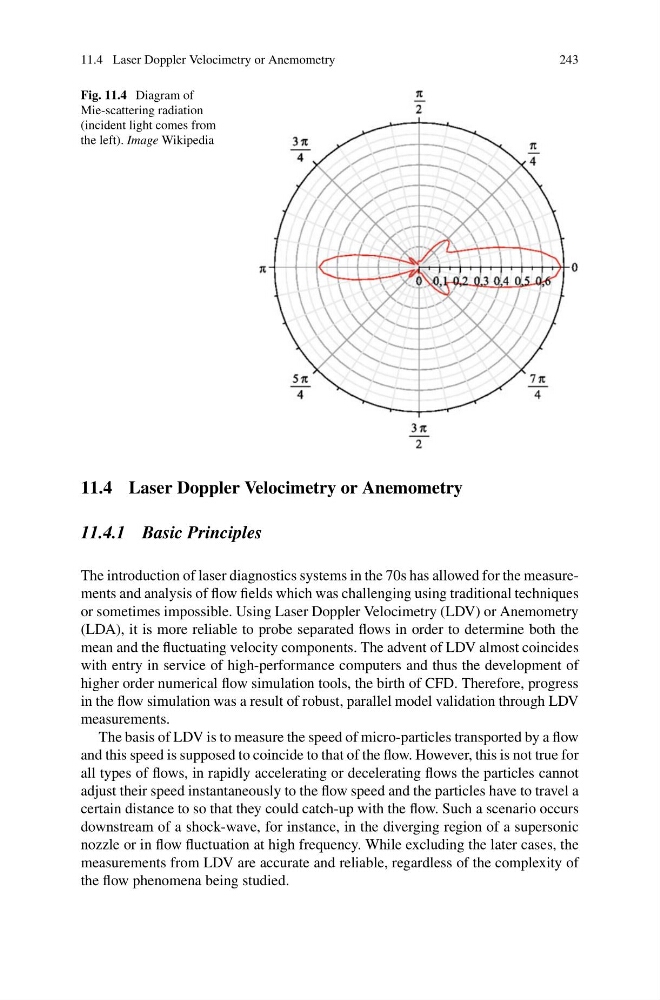
Fig. 11.4 Diagram of
Mie-scattering radiation
(incident light comes from
the left). Image Wikipedia
11.4 Laser Doppler Velocimetry or Anemometry
11.4.1 Basic Principles
The introduction of laser diagnostics systems in the 70s has allowed for the measurements and analysis of flow fields which was challenging using traditional techniques
or sometimes impossible. Using Laser Doppler Velocimetry (LDV) or Anemometry
(LDA), it is more reliable to probe separated flows in order to determine both the
mean and the fluctuating velocity components. The advent of LDV almost coincides
with entry in service of high-performance computers and thus the development of
higher order numerical flow simulation tools, the birth of CFD. Therefore, progress
in the flow simulation was a result of robust, parallel model validation through LDV
measurements.
The basis of LDV is to measure the speed of micro-particles transported by a flow
and this speed is supposed to coincide to that of the flow. However, this is not true for
all types of flows, in rapidly accelerating or decelerating flows the particles cannot
adjust their speed instantaneously to the flow speed and the particles have to travel a
certain distance to so that they could catch-up with the flow. Such a scenario occurs
downstream of a shock-wave, for instance, in the diverging region of a supersonic
nozzle or in flow fluctuation at high frequency. While excluding the later cases, the
measurements from LDV are accurate and reliable, regardless of the complexity of
the flow phenomena being studied.
243
Fig. 11.4 Diagram of
Mie-scattering radiation
(incident light comes from
the left). Image Wikipedia
11.4 Laser Doppler Velocimetry or Anemometry
11.4.1 Basic Principles
The introduction of laser diagnostics systems in the 70s has allowed for the measurements and analysis of flow fields which was challenging using traditional techniques
or sometimes impossible. Using Laser Doppler Velocimetry (LDV) or Anemometry
(LDA), it is more reliable to probe separated flows in order to determine both the
mean and the fluctuating velocity components. The advent of LDV almost coincides
with entry in service of high-performance computers and thus the development of
higher order numerical flow simulation tools, the birth of CFD. Therefore, progress
in the flow simulation was a result of robust, parallel model validation through LDV
measurements.
The basis of LDV is to measure the speed of micro-particles transported by a flow
and this speed is supposed to coincide to that of the flow. However, this is not true for
all types of flows, in rapidly accelerating or decelerating flows the particles cannot
adjust their speed instantaneously to the flow speed and the particles have to travel a
certain distance to so that they could catch-up with the flow. Such a scenario occurs
downstream of a shock-wave, for instance, in the diverging region of a supersonic
nozzle or in flow fluctuation at high frequency. While excluding the later cases, the
measurements from LDV are accurate and reliable, regardless of the complexity of
the flow phenomena being studied.