

9.4 Skin Friction Measurement
213
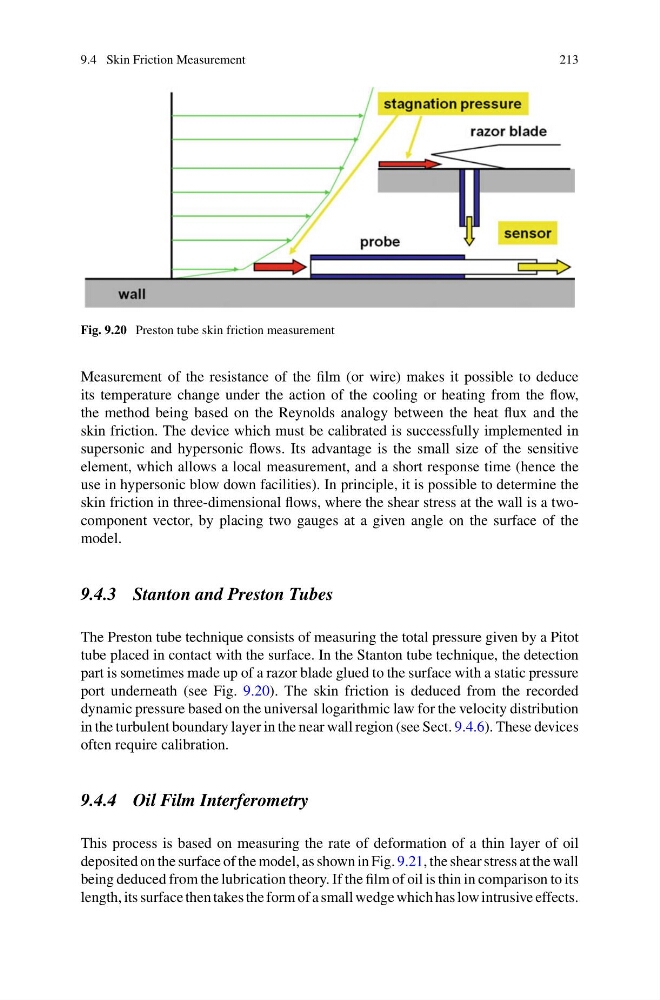
Fig. 9.20 Preston tube skin friction measurement
Measurement of the resistance of the film (or wire) makes it possible to deduce
its temperature change under the action of the cooling or heating from the flow,
the method being based on the Reynolds analogy between the heat flux and the
skin friction. The device which must be calibrated is successfully implemented in
supersonic and hypersonic flows. Its advantage is the small size of the sensitive
element, which allows a local measurement, and a short response time (hence the
use in hypersonic blow down facilities). In principle, it is possible to determine the
skin friction in three-dimensional flows, where the shear stress at the wall is a twocomponent vector, by placing two gauges at a given angle on the surface of the
model.
9.4.3 Stanton and Preston Tubes
The Preston tube technique consists of measuring the total pressure given by a Pitot
tube placed in contact with the surface. In the Stanton tube technique, the detection
part is sometimes made up of a razor blade glued to the surface with a static pressure
port underneath (see Fig. 9.20). The skin friction is deduced from the recorded
dynamic pressure based on the universal logarithmic law for the velocity distribution
in the turbulent boundary layer in the near wall region (see Sect. 9.4.6). These devices
often require calibration.
9.4.4 Oil Film Interferometry
This process is based on measuring the rate of deformation of a thin layer of oil
deposited on the surface of the model, as shown in Fig. 9.21, the shear stress at the wall
being deduced from the lubrication theory. If the film of oil is thin in comparison to its
length, its surface then takes the form of a small wedge which has low intrusive effects.
213
Fig. 9.20 Preston tube skin friction measurement
Measurement of the resistance of the film (or wire) makes it possible to deduce
its temperature change under the action of the cooling or heating from the flow,
the method being based on the Reynolds analogy between the heat flux and the
skin friction. The device which must be calibrated is successfully implemented in
supersonic and hypersonic flows. Its advantage is the small size of the sensitive
element, which allows a local measurement, and a short response time (hence the
use in hypersonic blow down facilities). In principle, it is possible to determine the
skin friction in three-dimensional flows, where the shear stress at the wall is a twocomponent vector, by placing two gauges at a given angle on the surface of the
model.
9.4.3 Stanton and Preston Tubes
The Preston tube technique consists of measuring the total pressure given by a Pitot
tube placed in contact with the surface. In the Stanton tube technique, the detection
part is sometimes made up of a razor blade glued to the surface with a static pressure
port underneath (see Fig. 9.20). The skin friction is deduced from the recorded
dynamic pressure based on the universal logarithmic law for the velocity distribution
in the turbulent boundary layer in the near wall region (see Sect. 9.4.6). These devices
often require calibration.
9.4.4 Oil Film Interferometry
This process is based on measuring the rate of deformation of a thin layer of oil
deposited on the surface of the model, as shown in Fig. 9.21, the shear stress at the wall
being deduced from the lubrication theory. If the film of oil is thin in comparison to its
length, its surface then takes the form of a small wedge which has low intrusive effects.