

9.3 Pressure Sensitive Paint
211
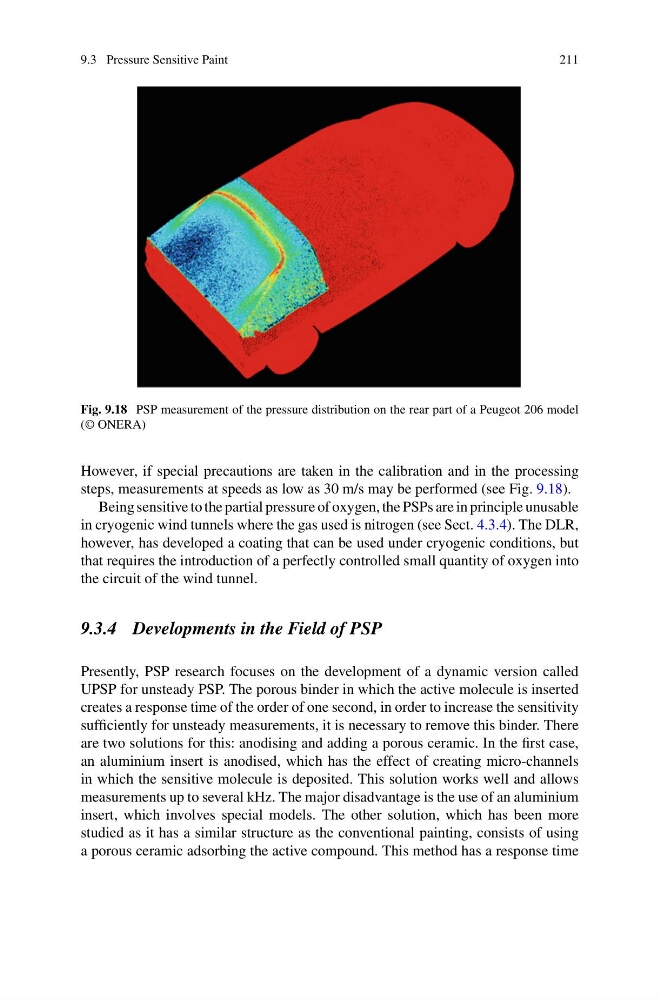
Fig. 9.18 PSP measurement of the pressure distribution on the rear part of a Peugeot 206 model
(© ONERA)
However, if special precautions are taken in the calibration and in the processing
steps, measurements at speeds as low as 30 m/s may be performed (see Fig. 9.18).
Being sensitive to the partial pressure of oxygen, the PSPs are in principle unusable
in cryogenic wind tunnels where the gas used is nitrogen (see Sect. 4.3.4). The DLR,
however, has developed a coating that can be used under cryogenic conditions, but
that requires the introduction of a perfectly controlled small quantity of oxygen into
the circuit of the wind tunnel.
9.3.4 Developments in the Field of PSP
Presently, PSP research focuses on the development of a dynamic version called
UPSP for unsteady PSP. The porous binder in which the active molecule is inserted
creates a response time of the order of one second, in order to increase the sensitivity
sufficiently for unsteady measurements, it is necessary to remove this binder. There
are two solutions for this: anodising and adding a porous ceramic. In the first case,
an aluminium insert is anodised, which has the effect of creating micro-channels
in which the sensitive molecule is deposited. This solution works well and allows
measurements up to several kHz. The major disadvantage is the use of an aluminium
insert, which involves special models. The other solution, which has been more
studied as it has a similar structure as the conventional painting, consists of using
a porous ceramic adsorbing the active compound. This method has a response time
211
Fig. 9.18 PSP measurement of the pressure distribution on the rear part of a Peugeot 206 model
(© ONERA)
However, if special precautions are taken in the calibration and in the processing
steps, measurements at speeds as low as 30 m/s may be performed (see Fig. 9.18).
Being sensitive to the partial pressure of oxygen, the PSPs are in principle unusable
in cryogenic wind tunnels where the gas used is nitrogen (see Sect. 4.3.4). The DLR,
however, has developed a coating that can be used under cryogenic conditions, but
that requires the introduction of a perfectly controlled small quantity of oxygen into
the circuit of the wind tunnel.
9.3.4 Developments in the Field of PSP
Presently, PSP research focuses on the development of a dynamic version called
UPSP for unsteady PSP. The porous binder in which the active molecule is inserted
creates a response time of the order of one second, in order to increase the sensitivity
sufficiently for unsteady measurements, it is necessary to remove this binder. There
are two solutions for this: anodising and adding a porous ceramic. In the first case,
an aluminium insert is anodised, which has the effect of creating micro-channels
in which the sensitive molecule is deposited. This solution works well and allows
measurements up to several kHz. The major disadvantage is the use of an aluminium
insert, which involves special models. The other solution, which has been more
studied as it has a similar structure as the conventional painting, consists of using
a porous ceramic adsorbing the active compound. This method has a response time