

130
5 Supersonic Wind Tunnels
5.3.5 Blow Down Transonic/Supersonic Wind Tunnel
The origin for the construction of the transonic/supersonic Mach 3 wind tunnel
of the ISL (French-German Research Institute of St. Louis) in 2015 is the result of
a reflection on future guided munitions. This research wind tunnel is used for the
study of the aerodynamic behaviour of models driven by different types of actuators.
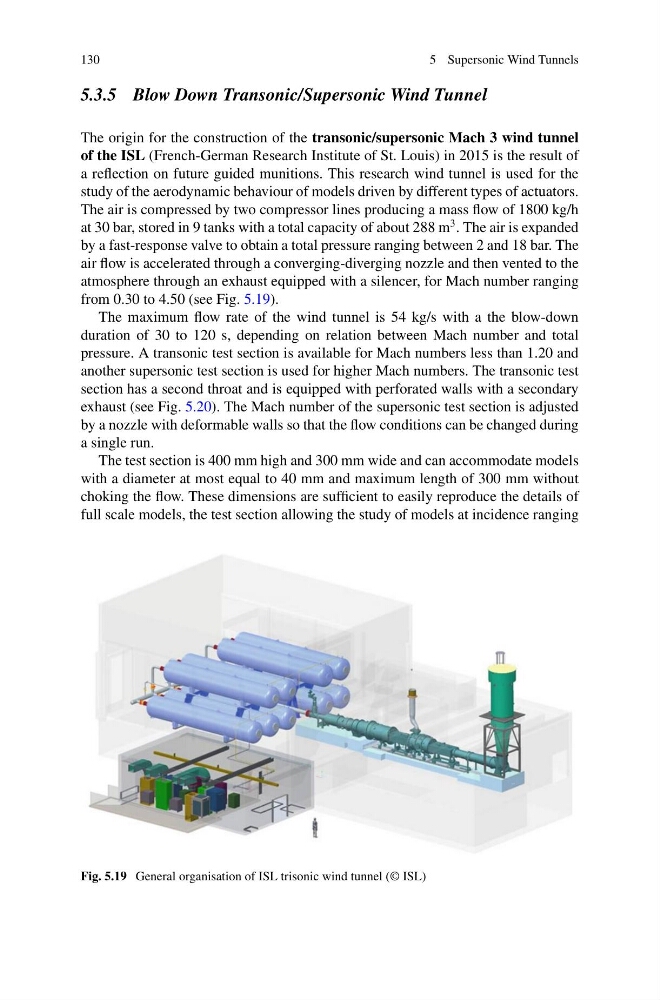
The air is compressed by two compressor lines producing a mass flow of 1800 kg/h
at 30 bar, stored in 9 tanks with a total capacity of about 288 m
3 . The air is expanded
by a fast-response valve to obtain a total pressure ranging between 2 and 18 bar. The
air flow is accelerated through a converging-diverging nozzle and then vented to the
atmosphere through an exhaust equipped with a silencer, for Mach number ranging
from 0.30 to 4.50 (see Fig. 5.19).
The maximum flow rate of the wind tunnel is 54 kg/s with a the blow-down
duration of 30 to 120 s, depending on relation between Mach number and total
pressure. A transonic test section is available for Mach numbers less than 1.20 and
another supersonic test section is used for higher Mach numbers. The transonic test
section has a second throat and is equipped with perforated walls with a secondary
exhaust (see Fig. 5.20). The Mach number of the supersonic test section is adjusted
by a nozzle with deformable walls so that the flow conditions can be changed during
a single run.
The test section is 400 mm high and 300 mm wide and can accommodate models
with a diameter at most equal to 40 mm and maximum length of 300 mm without
choking the flow. These dimensions are sufficient to easily reproduce the details of
full scale models, the test section allowing the study of models at incidence ranging
Fig. 5.19 General organisation of ISL trisonic wind tunnel (© ISL)
5 Supersonic Wind Tunnels
5.3.5 Blow Down Transonic/Supersonic Wind Tunnel
The origin for the construction of the transonic/supersonic Mach 3 wind tunnel
of the ISL (French-German Research Institute of St. Louis) in 2015 is the result of
a reflection on future guided munitions. This research wind tunnel is used for the
study of the aerodynamic behaviour of models driven by different types of actuators.
The air is compressed by two compressor lines producing a mass flow of 1800 kg/h
at 30 bar, stored in 9 tanks with a total capacity of about 288 m
3 . The air is expanded
by a fast-response valve to obtain a total pressure ranging between 2 and 18 bar. The
air flow is accelerated through a converging-diverging nozzle and then vented to the
atmosphere through an exhaust equipped with a silencer, for Mach number ranging
from 0.30 to 4.50 (see Fig. 5.19).
The maximum flow rate of the wind tunnel is 54 kg/s with a the blow-down
duration of 30 to 120 s, depending on relation between Mach number and total
pressure. A transonic test section is available for Mach numbers less than 1.20 and
another supersonic test section is used for higher Mach numbers. The transonic test
section has a second throat and is equipped with perforated walls with a secondary
exhaust (see Fig. 5.20). The Mach number of the supersonic test section is adjusted
by a nozzle with deformable walls so that the flow conditions can be changed during
a single run.
The test section is 400 mm high and 300 mm wide and can accommodate models
with a diameter at most equal to 40 mm and maximum length of 300 mm without
choking the flow. These dimensions are sufficient to easily reproduce the details of
full scale models, the test section allowing the study of models at incidence ranging
Fig. 5.19 General organisation of ISL trisonic wind tunnel (© ISL)