

5.3 Typical Supersonic Wind Tunnels
125
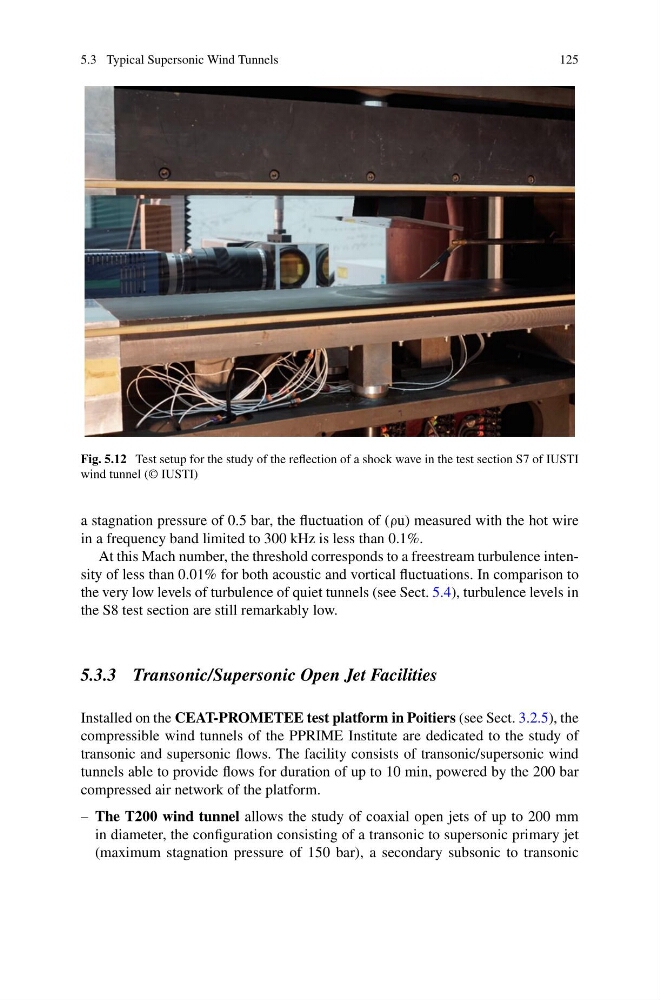
Fig. 5.12 Test setup for the study of the reflection of a shock wave in the test section S7 of IUSTI
wind tunnel (© IUSTI)
a stagnation pressure of 0.5 bar, the fluctuation of (ρu) measured with the hot wire
in a frequency band limited to 300 kHz is less than 0.1%.
At this Mach number, the threshold corresponds to a freestream turbulence intensity of less than 0.01% for both acoustic and vortical fluctuations. In comparison to
the very low levels of turbulence of quiet tunnels (see Sect. 5.4), turbulence levels in
the S8 test section are still remarkably low.
5.3.3 Transonic/Supersonic Open Jet Facilities
Installed on the CEAT-PROMETEE test platform in Poitiers (see Sect. 3.2.5), the
compressible wind tunnels of the PPRIME Institute are dedicated to the study of
transonic and supersonic flows. The facility consists of transonic/supersonic wind
tunnels able to provide flows for duration of up to 10 min, powered by the 200 bar
compressed air network of the platform.
– The T200 wind tunnel allows the study of coaxial open jets of up to 200 mm
in diameter, the configuration consisting of a transonic to supersonic primary jet
(maximum stagnation pressure of 150 bar), a secondary subsonic to transonic
125
Fig. 5.12 Test setup for the study of the reflection of a shock wave in the test section S7 of IUSTI
wind tunnel (© IUSTI)
a stagnation pressure of 0.5 bar, the fluctuation of (ρu) measured with the hot wire
in a frequency band limited to 300 kHz is less than 0.1%.
At this Mach number, the threshold corresponds to a freestream turbulence intensity of less than 0.01% for both acoustic and vortical fluctuations. In comparison to
the very low levels of turbulence of quiet tunnels (see Sect. 5.4), turbulence levels in
the S8 test section are still remarkably low.
5.3.3 Transonic/Supersonic Open Jet Facilities
Installed on the CEAT-PROMETEE test platform in Poitiers (see Sect. 3.2.5), the
compressible wind tunnels of the PPRIME Institute are dedicated to the study of
transonic and supersonic flows. The facility consists of transonic/supersonic wind
tunnels able to provide flows for duration of up to 10 min, powered by the 200 bar
compressed air network of the platform.
– The T200 wind tunnel allows the study of coaxial open jets of up to 200 mm
in diameter, the configuration consisting of a transonic to supersonic primary jet
(maximum stagnation pressure of 150 bar), a secondary subsonic to transonic