

5.3 Typical Supersonic Wind Tunnels
123
to generate a freestream flow with very low background disturbances while reducing
the effect of the tunnel wall turbulence as well. This is essential for very detailed
analysis of the fluctuating components and turbulence structure in transitional and
separating flows, using hot-wire anemometry, still the most convenient technique for
the measurement of unsteadiness in flows. This involves constant monitoring of the
quality of air, which has to be strictly dried and dust-free, and while maintaining constant ambient conditions. The minimum duration over which aerodynamic conditions
must be kept constant depends on the characteristic time of the phenomena expected,
the constraint being the time required for data acquisition to ensure an acceptable
size of the sample, a duration that becomes important for conditional analyses. Hence
the need of a wind tunnel operating continuously. Finally, a wind tunnel capable of
operating at moderate Reynolds numbers is important for validation of numerical
modelling such as LES or DES.
The main characteristics of the wind tunnel, which is equipped with two test
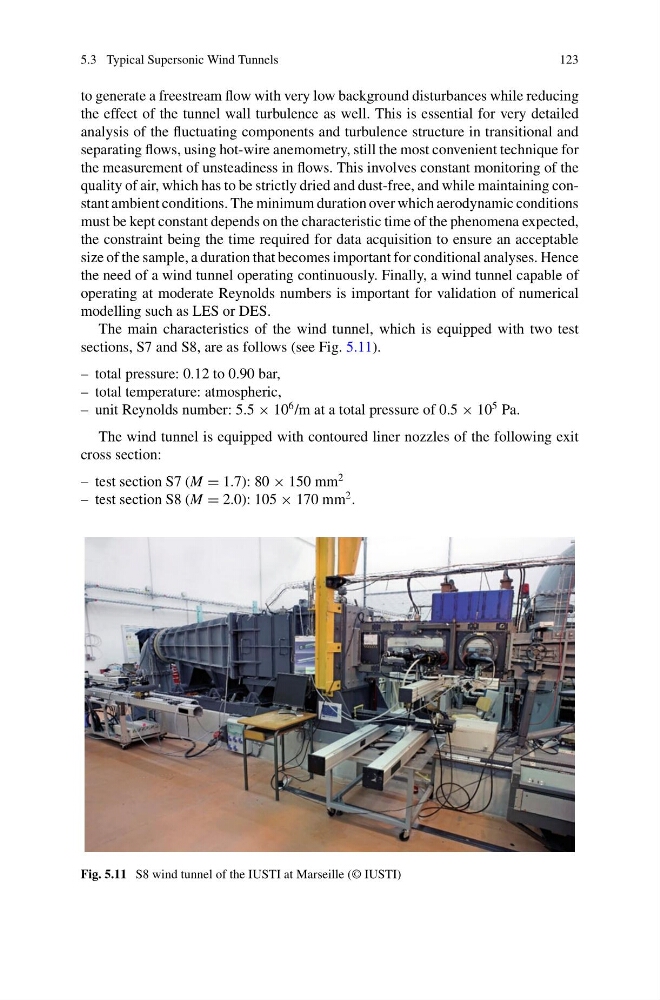
sections, S7 and S8, are as follows (see Fig. 5.11).
– total pressure: 0.12 to 0.90 bar,
– total temperature: atmospheric,
– unit Reynolds number: 5.5 × 10
6 /m at a total pressure of 0.5 × 10
5 Pa.
The wind tunnel is equipped with contoured liner nozzles of the following exit
cross section:
– test section S7 (M = 1.7): 80 × 150 mm
2
– test section S8 (M = 2.0): 105 × 170 mm
2 .
Fig. 5.11 S8 wind tunnel of the IUSTI at Marseille (© IUSTI)
123
to generate a freestream flow with very low background disturbances while reducing
the effect of the tunnel wall turbulence as well. This is essential for very detailed
analysis of the fluctuating components and turbulence structure in transitional and
separating flows, using hot-wire anemometry, still the most convenient technique for
the measurement of unsteadiness in flows. This involves constant monitoring of the
quality of air, which has to be strictly dried and dust-free, and while maintaining constant ambient conditions. The minimum duration over which aerodynamic conditions
must be kept constant depends on the characteristic time of the phenomena expected,
the constraint being the time required for data acquisition to ensure an acceptable
size of the sample, a duration that becomes important for conditional analyses. Hence
the need of a wind tunnel operating continuously. Finally, a wind tunnel capable of
operating at moderate Reynolds numbers is important for validation of numerical
modelling such as LES or DES.
The main characteristics of the wind tunnel, which is equipped with two test
sections, S7 and S8, are as follows (see Fig. 5.11).
– total pressure: 0.12 to 0.90 bar,
– total temperature: atmospheric,
– unit Reynolds number: 5.5 × 10
6 /m at a total pressure of 0.5 × 10
5 Pa.
The wind tunnel is equipped with contoured liner nozzles of the following exit
cross section:
– test section S7 (M = 1.7): 80 × 150 mm
2
– test section S8 (M = 2.0): 105 × 170 mm
2 .
Fig. 5.11 S8 wind tunnel of the IUSTI at Marseille (© IUSTI)